



- Published on: 2026-09-28 12:15:26
What Is Dark Pool Liquidity? How Hidden Orders Shape Markets

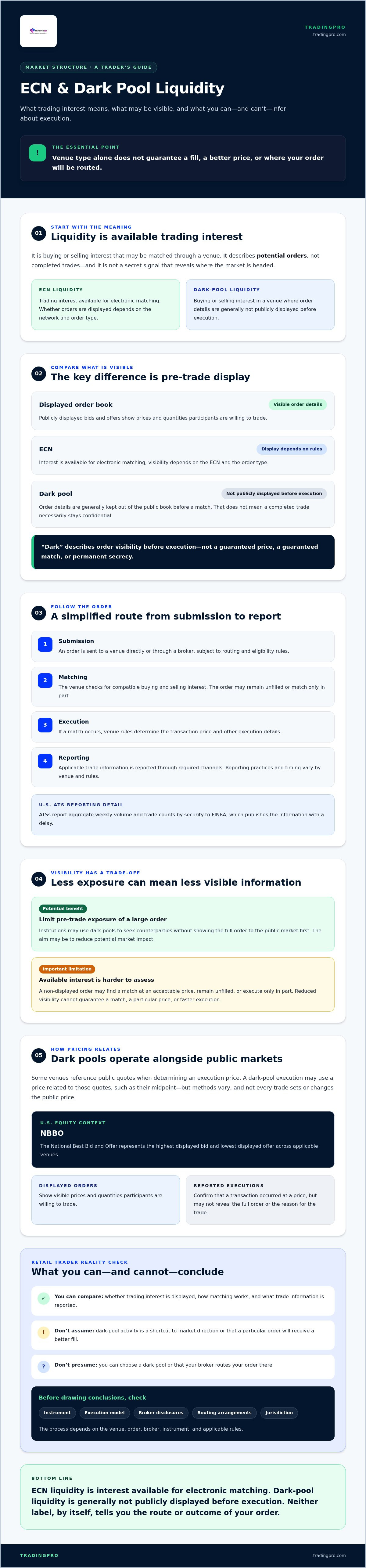
If you’re asking “what is ECN liquidity,” it means buying and selling interest available to be matched through an electronic communication network, or ECN. Some ECNs display orders, while dark pools generally keep order details out of the public book before a trade. Neither venue type guarantees a better fill or tells you where your own order will go.
It’s reasonable to wonder whether hidden institutional orders move visible prices or change how a broker executes an order. The answer depends on the venue, instrument, order, and routing arrangements, so don’t treat dark-pool activity as a shortcut to market direction. This guide explains how ECN and dark-pool liquidity differ, how both relate to public markets, and what retail traders can realistically infer. You’ll also learn which broker disclosures and execution details to check before making assumptions about order routing.
Key Takeaways
- ECN liquidity is trading interest available for electronic matching. Its visibility depends on the network and order type.
- Compare an ECN’s displayed order interest with the less visible order flow in dark pools.
- Understand the basic path from order submission to matching, execution, and applicable trade reporting.
- Consider the potential benefits of reduced pre-trade visibility alongside the limits it creates for assessing available interest.
- Check the instrument, execution model, broker disclosures, and jurisdiction before drawing conclusions about where a trade is routed.
What Is Dark Pool Liquidity? A Clear Definition for Traders
Dark pool liquidity is buying or selling interest held in a trading venue where orders aren’t publicly displayed before execution. It describes potential orders, not completed trades. A dark pool isn’t a separate asset, a guaranteed source of buyers or sellers, or a secret price feed that reveals where a market is headed.
Institutions may use these venues to seek counterparties for large orders without showing the full order to the public market first. A large displayed order can signal trading intent and may affect how other participants quote or trade. Keeping an order non-displayed can reduce that pre-trade exposure, but it can’t guarantee a match, a particular price, or faster execution. The Dark pool overview offers broader background on the venue type and its history.
What makes liquidity “dark”?
“Dark” refers to the lack of public display of order details before execution. It doesn’t necessarily mean that only the trader’s identity is hidden, or that a completed trade stays confidential forever. Depending on the venue and applicable rules, execution information may be reported after the trade, sometimes without publicly identifying the parties. Reporting practices and timing vary, so don’t assume every order or fill remains invisible.
This differs from an order book that displays bids and offers for market participants to see. If you’re comparing venues and asking what is ECN liquidity, focus on whether trading interest is available for electronic matching and whether the ECN displays that interest. Dark pools generally don’t show orders publicly before they match.
Who uses dark pools, and why?
Institutional investors, including firms managing large portfolios, may use dark pools when they want to trade a substantial position while limiting how much of that order is exposed in advance. The aim is to reduce potential market impact, not to secure a better outcome. An order may find a match at an acceptable price, remain unfilled, or execute only in part.
That’s the trade-off: less pre-trade visibility can protect order details, while also making available interest harder for other participants to assess. Retail traders shouldn’t assume they can choose a dark pool or that their broker routes an order there. Access and routing depend on the broker, instrument, account terms, and jurisdiction. Check the relevant execution disclosures before drawing conclusions about where a particular trade may be handled.
How Dark Pool Liquidity Works Alongside Public Markets
Dark pools operate alongside public exchanges, not outside the broader pricing process. A non-displayed order may be matched using rules set by its venue, and some venues reference public quotes when determining an execution price. In U.S. equity markets, the National Best Bid and Offer (NBBO) represents the highest displayed bid and lowest displayed offer across applicable venues. A dark-pool execution may use a price related to those quotes, such as their midpoint, but methods vary and not every trade sets or changes the public price.
An order’s hidden status describes whether its details are displayed before execution; it doesn’t predetermine the price or guarantee that the order will fill. The same distinction matters when considering ECN liquidity: an order may be available for electronic matching, but whether it is displayed and whether it executes depend on the network’s rules and available counterparties.
From order to report
A simplified order journey looks like this:
- Submission: A participant sends an order to a venue directly or through a broker, subject to the relevant routing and eligibility rules.
- Matching: The venue checks for compatible buying and selling interest. An order may remain unfilled or match only in part.
- Execution: If a match occurs, the venue’s rules determine the transaction price and other execution details.
- Reporting: Applicable trade information is reported through the required channels. In the U.S., ATSs report aggregate weekly volume and trade counts by security to FINRA, which publishes the information with a delay.
The precise process depends on the instrument, venue, broker, and jurisdiction. For a plain-language overview of the U.S. context, see FINRA on dark pools.
Quotes, price discovery, and transparency
Price discovery is the ongoing process by which buyers and sellers establish market prices. Displayed orders contribute visible information: they show prices and quantities participants are willing to trade. A reported execution adds a different signal, confirming that a transaction occurred at a particular price, though not necessarily revealing the full order behind it or the reason for the trade.
That’s why asking what is ECN liquidity helps clarify the comparison. An ECN provides electronic matching, and the visibility of its orders depends on its rules and order types. Dark pools generally keep order details non-displayed before execution. Public quotes can still inform dark-pool pricing, but hidden trades don’t automatically dictate where visible prices move. Reporting rules and eligible instruments vary, so verify current disclosures for the market you’re trading.
If you’re comparing brokerage account environments, review the registration details alongside the applicable instrument and execution disclosures before deciding whether to proceed.
Dark Pools vs. ECNs and Lit Exchanges: What Actually Differs?
These venue labels describe different ways trading interest may be handled, not a ranking of execution quality. An ECN, or electronic communication network, is an electronic system that matches trading interests. A dark pool is a non-displayed trading venue, while a lit exchange publishes orders and quotes under its rules. In the U.S., dark pools that meet the relevant definition may operate as Alternative Trading Systems (ATSs). Terminology and venue structures can differ across markets.
If you’re asking what is ECN liquidity, look at the trading interest available to be matched electronically, then check whether the network displays those orders. An ECN’s matching function doesn’t mean every order is visible to every trader. Visibility depends on its rules and order types. The comparison below is a simplified guide, not a description of any specific broker’s routing.
| Feature | Dark pool | ECN | Lit exchange |
|---|---|---|---|
| Order visibility | Interest generally isn’t publicly displayed before execution. | Electronic matching; order visibility depends on the network and order type. | Displays eligible orders and quotes to market participants under exchange rules. |
| Typical participants | Often institutions and their brokers seeking to handle larger orders. | May connect brokers, institutions, liquidity providers, and other participants. | Participants vary and may include retail and institutional firms trading through members or brokers. |
| Price discovery | May use public prices as a reference; hidden interest contributes less visible information before a match. | Can bring multiple trading interests together; displayed orders may contribute to visible pricing. | Public quotes and executions provide important, though not complete, market information. |
| Retail relevance | Direct access or broker routing isn’t guaranteed; check the instrument and broker disclosures. | Retail access depends on the broker, market, and available trading setup. | Retail traders can generally view public quotes, but access and execution still depend on their broker and product. |
Compare the mechanics, not just the names
Imagine a buyer submitting an order through an electronic network. The system seeks a compatible seller, and its rules determine whether the interest is displayed and how a match occurs. In a dark pool, order details are generally not shown publicly beforehand. On a lit exchange, eligible bids and offers can appear in the public book. Neither label alone proves a better price, faster fill, or lower total cost. Compare actual execution terms and disclosures.
Also identify what you’re trading. A product offered through a broker may be a derivative that tracks a share’s price, rather than a share that gives you physical ownership. Venue types, product rights, and protections vary by instrument and jurisdiction. Verify the product documentation and applicable broker disclosures before treating an exchange or ECN label as evidence of what you own or how your order will be handled.
Do Dark Pools Affect Retail Traders? Benefits, Risks, and Misconceptions
Dark-pool activity can matter to retail traders, but it doesn’t automatically mean manipulation, unfair treatment, or a predictable move in a security’s price. A market-wide volume estimate says nothing by itself about how a specific broker handled your order. To assess your own execution, look at its price, timing, order type, and the broker’s relevant disclosures.
Keep the evidence in view. A claim that hidden trading is “controlling” a price needs more than a screenshot or a post describing unusual volume. Check what the figures measure, which venues they cover, when they were reported, and whether the data comes from a primary source. Don’t treat social-media claims as verified venue activity.
Potential benefits and trade-offs
For an institution placing a large order, displaying the full quantity could signal its intentions to other traders. A non-displayed venue may help reduce that pre-trade signaling and the potential market impact of showing a large order. But an order still needs a compatible counterparty. It may not fill, may fill only partly, or may execute at a price the trader doesn’t prefer.
That balance matters for retail traders, too. Reduced display can limit information available to the public market, while a venue’s label alone tells you little about the outcome of an individual order. Just as asking what is ECN liquidity helps clarify how electronically matched interest may differ in visibility, assessing execution quality means checking actual terms and results rather than assuming one venue is always better.
Question dramatic claims
Separate a valid market-structure concern from an allegation about a particular trade. Hidden orders are a feature of certain venues; that fact alone doesn’t establish misconduct or prove a retail order received poor execution. Look for primary regulator information and your broker’s execution disclosures before accepting claims about routing, fairness, or market-wide volume.
- Check the scope: Does a volume claim refer to dark pools specifically, or a broader category of off-exchange trading?
- Check the evidence: Is the information from a regulator or reporting source, or an unverified online estimate?
- Check your order: Review the instrument, execution model, and available details about how the broker handles orders.
Execution quality involves more than venue choice. Order type, market conditions, and the product being traded can all matter. For additional context on trading tools and market resources, explore the TradingPRO Trade Hub. Review the relevant instrument and account information, then view registration details if you’re considering an account.
How to Assess Dark Pool Claims and Your Broker's Execution
Use a document-first approach. A dark-pool label or online claim can’t tell you how your own order was handled. To assess execution, identify the product, understand the broker’s role, and check the disclosures that apply to your account and location. Knowing what is ECN liquidity helps distinguish electronic trading interest from non-displayed orders, but neither term confirms where a particular retail order went.
A four-step checklist for reviewing execution claims
- Identify the instrument. Check the product name and terms. Is it an exchange-traded share, or a broker-issued derivative that provides price exposure? Don’t assume trading a share-linked product means you own the underlying shares.
- Confirm the responsible entity. Read the account and legal documents to identify which broker entity provides the service. Applicable execution arrangements and protections can vary by entity and jurisdiction.
- Read the execution disclosures. Look for how orders may be handled, what venues or counterparties may be involved, and what information the broker provides about execution. Ask the broker directly if a material detail isn’t clear.
- Compare the practical terms. Review available order types, costs, and execution information in current official documents. Use the same instrument and comparable order details when evaluating examples; a venue label alone isn’t a like-for-like comparison.
Keep records of order confirmations and statements. If you’re investigating a particular fill, compare its reported details with the order you placed and the information your broker makes available. That evidence is more useful than assuming a trade reached a specific venue based on market-wide activity.
What dark-pool liquidity does not tell you
Dark-pool activity doesn’t establish that your retail order entered a dark pool. It doesn’t prove your broker promises a better price or faster fill, either. Nor does it replace product research, risk controls, or checking the rules that apply in your jurisdiction. Separate what a venue can do from what your broker’s documents say about your own account and instrument.
Execution arrangements depend on the instrument, account terms, and applicable entity. Review TradingPRO’s account information and registration details at your own pace, then verify the current disclosures relevant to your situation before deciding whether to proceed.
Make Your Next Trading Decision With Clarity
ECN liquidity is trading interest available for electronic matching, with visibility determined by the network’s rules and order types. Dark pools generally keep orders out of public view before execution, while lit exchanges display eligible orders and quotes. Public quotes can inform dark-pool pricing without revealing every order or determining every trade. Knowing what is ECN liquidity helps you compare electronic matching with hidden orders, but it doesn’t show where your own order will be routed.
Keep your focus on what you can verify: identify the instrument, check whether it’s a share or a derivative, and review the execution disclosures that apply to your broker, account, and jurisdiction. Don’t treat dramatic market-wide claims as proof of how an individual trade was handled.
TradingPRO offers Rookie, Micro, Pro, and Scalp account tiers, as well as social trading and copy trading. Review the relevant account details and disclosures before deciding whether to register. Explore TradingPRO account options and registration details, then move forward with a clear view of the terms that matter to you.
Frequently Asked Questions
What is dark pool liquidity in simple terms?
Dark pool liquidity is buying or selling interest in a venue where orders generally aren’t shown publicly before a trade. It’s potential trading interest, not a completed transaction or a hidden price signal. For example, an institution may submit an order without displaying its full size in a public order book. Whether that order finds a match, and at what price, depends on the venue’s rules and available counterparties.
How does dark pool liquidity work?
A participant submits an order to a dark pool directly or through a broker. The venue attempts to match it with compatible buying or selling interest under its own rules. An order may remain unfilled, fill partly, or execute. In U.S. securities markets, applicable trade information is reported after execution, while the specific reporting requirements and timing depend on the venue and instrument. Processes vary across markets, so check relevant disclosures.
Is dark pool liquidity legal?
Dark pools can operate legally within applicable market rules, but requirements depend on the jurisdiction and type of venue. In the United States, dark pools commonly operate as alternative trading systems, subject to regulatory requirements that apply to their structure and activities. That doesn’t mean every trading practice is automatically permitted. For a particular venue or product, consult current regulator information and the relevant broker disclosures rather than assuming rules are identical worldwide.
Can retail traders access dark pools directly?
Don’t assume you can access a dark pool directly. Access and order routing depend on the broker, instrument, account terms, and jurisdiction. A broker may handle an order through different arrangements, but that doesn’t establish that a particular retail order entered a dark pool. Check the broker’s execution disclosures and ask how orders for your specific instrument may be handled. Market-wide dark-pool activity alone can’t answer that question.
Are dark pools the same as ECNs?
No. A dark pool is defined by non-displayed order interest before execution. An ECN, or electronic communication network, matches trading interests, and the visibility of its orders depends on its rules and order types. If you’re asking what is ECN liquidity, think of trading interest available through electronic matching, which may be displayed. The terms aren’t interchangeable in every market, so verify how a venue uses them.
Do dark pools affect stock prices?
They can affect markets indirectly, but dark-pool activity doesn’t automatically set or move a stock’s public price. Some venues may use public quotes as a reference for execution, while completed trades can provide additional information after reporting. If substantial trading interest is kept from public view, it may affect how much information visible markets show. Still, a claim that dark-pool activity caused a specific price move needs evidence beyond volume estimates or online speculation.
Does dark pool liquidity guarantee better trade execution?
No. A dark pool doesn’t guarantee a better price, faster fill, or completed order. There must be compatible trading interest, and an order may not execute or may fill only partly. Execution depends on factors such as the instrument, order terms, market conditions, and venue rules. Compare your broker’s current disclosures and available execution information. Don’t treat a venue label or general claims about hidden liquidity as proof of the result your own order will receive.


