




- Published on: 2026-09-28 10:16:04
Transparent Trading Performance History: What to Check Before You Choose

What if the trading record with the biggest return tells you the least about the risk taken to achieve it? A screenshot can highlight winning trades while leaving losses, fees, and the dates covered out of view. A transparent trading performance history makes results easier to assess, but only when you can see how they were produced.
Strong past returns can be compelling, and comparing headline numbers may seem like a quick way to choose. But strategies can carry different levels of risk, cover different periods, and report results before or after costs. Past performance also can’t guarantee future outcomes. Keep those limits in view when comparing a broker or copy trading option.
This guide explains what evidence to look for, how to spot missing context, and how to compare returns alongside risk, costs, and trading history. You’ll have a clearer framework for deciding whether a performance claim is relevant to your needs, rather than simply impressive on screen.
Key Takeaways
- A transparent trading performance history should show dated results alongside the activity and risk context needed to interpret them.
- Look beyond headline returns: maximum drawdown shows the historical peak-to-trough decline, while other risk measures add perspective.
- Check who produced the record, which dates it covers, and how results were calculated before treating a performance claim as credible.
- Compare histories using consistent periods and methods, including net returns, fees, drawdown, and strategy type. Flag missing or incomparable details.
- Use performance evidence to inform your decision, not to predict future results. An account or copy trading feature does not independently verify a trader’s history.
What Does a Transparent Trading Performance History Actually Show?
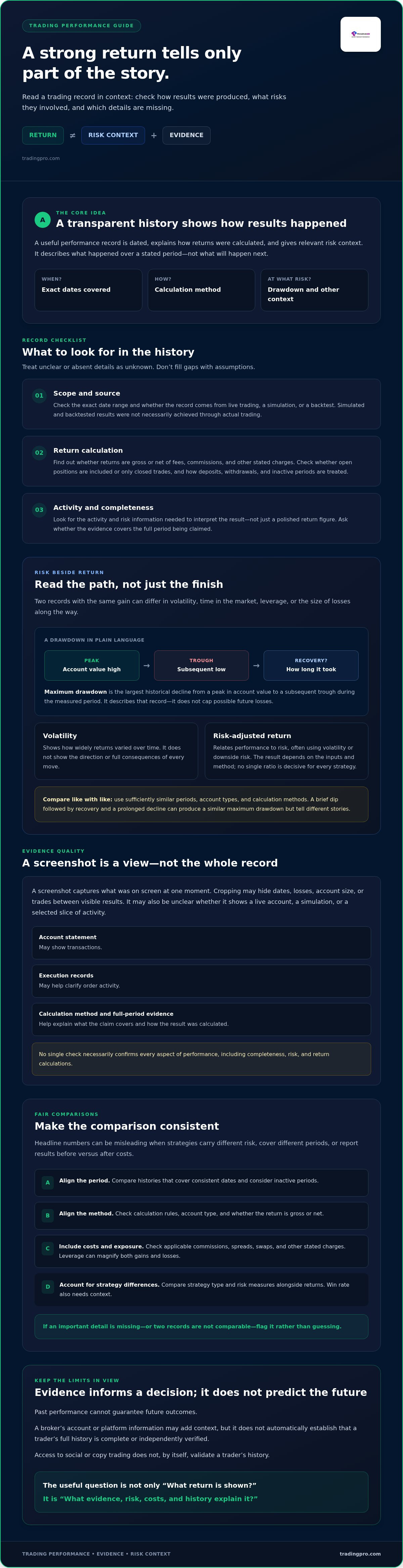
A transparent trading performance history is a dated record of trading results and activity that explains how returns were calculated and provides relevant risk context. It describes what happened over a stated period, not what will happen next. A return figure without dates, calculation rules, and risk information is difficult to interpret or compare.
Keep the trader’s record separate from the broker’s information. A trader’s history concerns an account’s outcomes and activity. Broker records may show details such as order execution, account settings, or platform activity. Those details can add context, but they don’t automatically establish that a trader’s full performance history is complete or independently verified. Learn more about investment performance measurement, including how calculation choices shape reported results.
Which details make a trading track record more transparent?
Start by checking the record’s scope. Note the exact date range and whether results come from live trading, a simulation, or a backtest. These are different kinds of evidence: simulated or backtested results weren’t necessarily achieved through actual trading.
Next, find out how returns are calculated. Are they gross or net of fees, commissions, and other stated charges? Do the figures include open positions, or only closed trades? Deposits and withdrawals can also affect reported account growth. Inactive periods may affect how representative the record is, so check whether they are included.
Look for enough information to understand these choices, not just a polished return percentage. If key details aren’t available, record them as unknown rather than filling in the gaps yourself.
Why screenshots alone leave important questions unanswered
A screenshot can be useful as an illustration, but it captures only what appears on screen at that moment. Cropping may hide the date range, losses, account size, or trades between the visible results. It may also be unclear whether the image shows a live account, a simulated environment, or a selected slice of activity.
Ask whether the underlying records or calculation method can be checked, and whether the evidence covers the full period being claimed. Different checks can support different details: an account statement may show transactions, while execution records may help clarify order activity. No single check necessarily confirms every aspect of performance, including completeness, risk, and how returns were calculated.
Use the same discipline when reviewing a broker’s platform or account information. Access to social or copy trading doesn’t, by itself, validate a trader’s history. Assess the record based on its evidence and context, then consider what it can and can’t tell you.
Which Performance Metrics Reveal the Risk Behind the Returns?
A return figure shows an outcome, not the path or risk behind it. Two records with the same gain may differ in volatility, time in the market, leverage, or the size of losses along the way. A transparent trading performance history makes these differences easier to assess by presenting returns alongside risk measures and the period covered.
Risk-adjusted return describes performance in relation to the risk taken, often using a measure such as volatility or downside risk. The result depends on the inputs and calculation method, so no single ratio is decisive for every strategy. Treat it as one comparison tool, not a complete verdict.
How should you interpret drawdown and volatility?
Maximum drawdown is the largest historical decline from a peak in account value to a subsequent trough during the measured period. It describes what happened in that record, not a cap on possible future losses. Volatility indicates how widely returns varied over time, but it doesn’t show the direction or full consequences of every move.
Compare these measures only when the records use sufficiently similar periods, account types, and calculation methods. Also check how long recovery from a decline took and how much market exposure the strategy carried. A brief dip followed by recovery and a prolonged decline can produce a similar maximum drawdown but tell different stories.
What do fees, leverage, and sample size change?
Reported returns can look different before and after costs. Check whether calculations include applicable commissions, spreads, swaps, and other stated charges. If costs are omitted or unclear, you can’t make a like-for-like comparison with a net return.
Leverage can magnify gains and losses, making the return alone especially incomplete. Win rate needs context too: a strategy may win often but lose more on each losing trade than it gains on each winner. Review average gain, average loss, and the number of trades behind the rate. For example, a high win rate based on a handful of trades offers limited evidence about repeatability.
Scrutinize the source as well as the metrics. The CFTC has reported an enforcement action involving fabricated trading performance, a reminder that claims need scrutiny. Its account supports the case for verifying trading performance evidence, but checking one metric or record can’t establish every aspect of performance.
Use these measures to frame questions, not to predict outcomes or make a decision based on one number alone. If you’re considering TradingPRO, assess the evidence and risk first, then review TradingPRO account options alongside the applicable terms.
Can You Trust a Trading Performance History? Check Its Evidence
You can’t judge a trading record by its headline return alone. A credible assessment depends on the source, the method used to calculate results, and whether you can review enough context to understand what the figures include. Treat each performance claim as something to verify, not as proof of future profitability.
Separate three kinds of information. Trader-provided claims may come with supporting documents, but still need checking. Platform-generated summaries can organize account activity, yet their presence alone doesn’t establish independent verification. Independently verifiable data can be checked against a relevant underlying record or third-party source, though even that may not confirm every detail of a strategy.
Follow a practical verification sequence
Work through these checks before relying on a record:
- Identify the source. Find out who produced the history and whether the underlying account or data source can be checked.
- Confirm the record type. Establish whether it reflects live trading, a simulation, a backtest, or manually entered figures.
- Check the scope. Verify the date range, account ownership, and strategy description. Look for missing intervals, unexplained resets, or strategy changes that could affect interpretation.
- Review the calculation rules. Ask how returns were calculated and whether deposits, withdrawals, costs, open positions, and losses are accounted for.
- Match claims to evidence. Check whether the supporting records cover the full period and results being advertised, rather than a selected slice.
No single document or check settles every question. An account statement may support some transaction details, for example, but may not establish that the entire history is complete or that the calculation method is appropriate. A transparent trading performance history should make its limits and methodology clear enough for you to assess what the evidence does and doesn’t show.
Warning signs that deserve a closer look
Pause if a presentation highlights winning trades, selected dates, or headline percentages while leaving losses, fees, open trades, or calculation rules unexplained. Also investigate gaps in the record, unclear account ownership, or unexplained changes to the strategy. A polished dashboard or screenshot may be a useful starting point, but it isn’t a substitute for supporting evidence.
Claims of guaranteed returns or pressure to act quickly are reasons to stop and verify before proceeding. Even authentic historical records can’t prove that a strategy will remain profitable or remove market risk. Treat the evidence as one input to a decision, and keep uncertainty in view.
Comparing Trading Histories Without Apples to Oranges
How can you compare records across different strategies?
Separate strategies by trading style, instruments, and market conditions before weighing performance. A drawdown from a brief, high-frequency approach may not mean the same thing as one from a strategy that holds positions over longer periods. Compare activity, exposure, and risk measures alongside returns, and avoid ranking records on one percentage alone. For copied strategies, clarify whether you’re assessing social trading or copy trading. The article’s “Social Trading vs Copy Trading” guide can help explain the distinction.
Use a consistent comparison sheet. Record “not disclosed” or “not comparable” where information is missing. Don’t estimate or fill gaps with assumptions.
| Field | What to record |
|---|---|
| Source | Who produced the record and what data supports it? |
| Period | What dates does it cover, and are the periods comparable? |
| Net returns | Are results calculated after applicable costs? |
| Drawdown | What historical peak-to-trough decline is reported, and how was it calculated? |
| Fees | Which commissions, spreads, swaps, or other stated costs are included? |
| Strategy type | What approach, instruments, and holding horizon does the record represent? |
What should a practical comparison checklist include?
Before drawing a conclusion, capture the trader or account identity, data source, coverage period, calculation method, and whether the results are live. Add fees, drawdown, leverage context, trade count, and any disclosed strategy changes. These details help reveal whether two records can fairly be compared, even when both present returns in the same format.
A transparent trading performance history makes comparison more disciplined, but it doesn’t make different strategies identical or turn past outcomes into a forecast. Missing or mismatched fields are useful findings in themselves: they show where confidence in a direct comparison should stop.
Once you’ve assessed the evidence and risk, you can explore a TradingPRO account and review its terms before deciding whether it fits your needs.
Turn Performance-History Checks Into a More Informed Trading Decision
Use a clear sequence before choosing an account or copying a strategy: verify the record’s source and scope, assess returns alongside risk, compare like with like, then review the relevant terms. Historical performance can inform your thinking, but it can’t forecast results or remove the possibility of loss.
Keep the evidence separate from the platform. TradingPRO offers Rookie, Micro, Pro, and Scalp accounts, as well as social and copy trading. Those account options and features don’t independently validate a trader’s history. Before relying on performance information, confirm what is available, how it’s produced, and what period it covers.
What should you confirm before using social or copy trading?
Check what history and risk information is displayed for each strategy, and verify those details are available before making a decision. Review the applicable terms to understand how copying works, whether allocation controls are described, what fees or other costs may apply, and how losses could affect your account. Don’t assume a displayed summary answers every question.
If you’re new to trading, build foundational knowledge with a beginner’s guide before assessing strategy records. Familiarity with basic trading concepts can help you understand what the figures show and what they leave out.
How can you take the next step without overcommitting?
Compare account terms against your experience and intended approach. TradingPRO’s Rookie Account is one available tier, alongside Micro, Pro, and Scalp. Choosing an account tier doesn’t verify a trader’s performance or limit potential losses, so assess the terms and risks independently.
Before you choose or copy a strategy, confirm the relevant performance disclosures, entity-specific terms, and risks for your situation. If important details are unclear or unavailable, pause and seek clarification rather than treating missing information as reassurance. A transparent trading performance history supports a more informed decision, not a guarantee of future results.
When you’re ready to review the available account options and terms, register with TradingPRO. Take time to understand the risks before deciding whether to trade or use copy trading.
Choose With Evidence, Context, and Confidence
A transparent trading performance history helps you ask sharper questions, not predict what comes next. Check who produced the record, how returns were calculated, and whether dates, costs, and risk measures are clear. Then compare like with like. If important details are missing, treat that as uncertainty rather than filling the gaps with assumptions.
TradingPRO offers Rookie, Micro, Pro, and Scalp accounts, along with social and copy trading. These options don’t independently verify a trader’s history or remove the risk of loss. Before choosing an account or copying a strategy, review the performance information available, relevant terms, and risks that apply to you.
Ready to explore your options? Register with TradingPRO and review your account options, taking the time to assess the terms before you decide. A disciplined check today can help you move forward with clearer expectations and a more informed approach.
Frequently Asked Questions
Is a trading performance history the same as a verified track record?
No. A trading performance history is a dated account of reported results and activity. A verified track record has supporting evidence that can be checked against an underlying data source or by an independent party. Ask what was verified, by whom, and for which dates and calculations. Verification may support particular details without confirming that the record is complete or that every return figure uses a suitable method.
Can a broker guarantee that a trader’s historical performance is accurate?
No. A broker may provide account or execution information, but that doesn’t automatically confirm a trader’s full history, calculation method, or omitted activity. Check what the broker’s records cover and whether they can be matched to the performance claim. Treat a platform summary as one source of information, not proof of every result. TradingPRO’s account and social or copy trading offerings aren’t themselves verification of trader histories.
What metrics should I check in a trading performance history?
Review returns alongside maximum drawdown, volatility, win rate, average gain, average loss, and trade count. Check the date range and whether returns are net of applicable costs, such as commissions, spreads, and swaps. Also look for leverage and open-position context. No one metric tells the whole story: a high win rate, for example, can hide losses that are larger than average gains.
How many months or years of trading history should I review?
There’s no single period that makes a record reliable for every strategy. Review the full available history and note its start and end dates, gaps, inactive periods, and any strategy changes. A short record may reflect only a narrow set of market conditions, while a longer one still needs context about risk and calculation methods. Compare records only across reasonably similar periods and approaches.
Can past trading performance predict future results?
No. Historical results describe what happened under past market conditions and don’t establish what will happen next. A strategy may face different volatility, execution conditions, or losses in the future. Use past performance to assess evidence, risk, and consistency, not as a promise or forecast. Even a complete, carefully checked history can’t eliminate market risk or guarantee future profitability.
What is the difference between live, simulated, and backtested performance?
Live performance comes from trading in an actual account. Simulated performance is generated in a simulated environment, while backtested performance applies a strategy to historical market data. Simulations and backtests may not reflect real execution, costs, or the pressures of live trading. Check how results were produced and whether they’re clearly labeled. Don’t compare these figures as though they represent the same kind of evidence.
Is copy trading safe if a trader shows a strong historical return?
No historical return makes copy trading risk-free. Before copying, check the record’s source, dates, drawdown, costs, leverage context, and trade activity. Review how copying works, including any available allocation controls and applicable terms, and consider that copied trades can lose value. A strong return may not show the full risk taken or predict future results. Make a decision based on evidence and your understanding of the risks.


