




- Published on: 2026-09-26 12:40:02
Trading Exotic Currency Pairs: A Practical Guide for 2026

When trading exotic currency pairs, the main risk may not be getting the direction wrong. It may be underestimating how spreads, thin liquidity, and sudden volatility can affect a trade. Pairs such as USD/TRY and USD/ZAR can also react sharply to economic and political developments that are easy to overlook when you focus only on the chart.
If the differences between major, minor, and exotic pairs feel unclear, caution is justified. Exotic pairs commonly combine a major currency with one from an emerging economy, and their trading conditions can vary significantly. Wider spreads and lower liquidity may raise the cost of entering or exiting, while local central-bank decisions, inflation, and political news can move prices.
This practical guide explains how to identify exotic pairs and assess liquidity, spreads, and active market hours before placing a trade. You’ll also learn how to track relevant news, set position sizes with volatility in mind, and review each trade using a repeatable process. The goal is to make informed decisions with risk checks in place before seeking an opportunity.
Key Takeaways
- Learn why exotic-pair classifications can vary across market sources and brokers, and check what a specific pair represents.
- Assess whether potential diversification or market exposure justifies the added trading and research challenges.
- Use a repeatable process for trading exotic currency pairs, from choosing a pair to reviewing the outcome.
- Before placing a trade, verify instrument availability, current spreads, trading hours, and product disclosures.
- Set risk limits and build familiarity through practice and independent research before risking money.
What Are Exotic Currency Pairs, and How Do They Differ?
An exotic currency pair commonly combines a major currency, such as the US dollar or euro, with a currency that’s traded less frequently in global forex markets. USD/TRY, for example, pairs the US dollar with the Turkish lira. The label describes a broad market category, not a guarantee that every pair has the same liquidity, spread, or volatility.
Currency-pair classifications aren’t universal. Sources and brokers may group pairs differently, so check how a provider labels an instrument rather than relying on the category alone. For a foundational overview of exotic pairs and their common characteristics, see Wikipedia’s currency-pair reference.
How Are Exotic Pairs Different From Major and Minor Pairs?
Major pairs involve widely traded currencies and typically include the US dollar. EUR/USD and USD/JPY are familiar examples. Minor pairs generally combine widely traded currencies without the US dollar, such as EUR/GBP, though naming conventions can differ between providers.
Exotic pairs are often distinguished by one currency being less frequently traded than those in major pairs. USD/TRY is a conventional example. Lower trading activity can mean fewer available buyers and sellers at a given moment, which may affect liquidity and widen the quoted bid-ask spread. These effects vary by pair and market conditions, so don’t assume every exotic pair trades alike.
Which Currencies May Appear in Exotic Pairs?
Examples include the Turkish lira (TRY), South African rand (ZAR), and Brazilian real (BRL), often paired with a major currency. These are illustrations, not a list of instruments guaranteed to be available on any particular trading platform. Availability and trading conditions can depend on the provider, account, and region.
Exotic-pair classifications depend on market convention and provider, so verify how a specific instrument is categorized and what conditions apply before trading.
That check matters because a label alone doesn’t tell you how easily you can enter or exit, what spread you may encounter, or how the pair could respond to market developments. Use the instrument’s actual trading conditions as your guide, not assumptions based on its category.
How Liquidity, Spreads, and Market Events Shape Exotic-Pair Trading
Before planning an entry, assess how easily you can trade the pair and what the quoted price may cost you. Liquidity is the ease of buying or selling without materially affecting the quoted price. If fewer counterparties are active, an order may be harder to execute at the price you see, especially when market conditions shift.
The bid-ask spread is the difference between the price at which you can sell (the bid) and the price at which you can buy (the ask). It affects the prices available to open and close a position. Compare conditions for the specific pair and time you plan to trade rather than assuming every exotic pair has the same spread or liquidity.
Why Can Exotic-Pair Spreads and Execution Conditions Differ?
Quoted spreads can change with market activity and the number of counterparties available. A spread shown on a platform is only one part of the cost picture. Check whether other charges apply to the instrument or account, and review the provider’s product disclosures. Don’t assume the displayed spread captures every potential cost.
Check live trading conditions before each decision. Spreads and execution conditions can vary by pair, provider, and market moment.
Comparison snapshot: Use this as a guide to what to investigate, not as a fixed rule for every pair.
- More active conditions: Check whether more market participants are present and compare the live bid-ask spread.
- Quieter conditions: Confirm the current spread and consider whether reduced activity could affect the price available for your order.
- News or market disruption: Recheck prices and conditions, since market activity can shift around significant events.
What News and Market Hours Should Traders Monitor?
Currency prices can react to economic releases, central-bank decisions, and political developments. Track relevant events for both currencies in the pair. For USD/TRY, for instance, consider announcements and economic news affecting both the United States and Türkiye, rather than focusing on only one side of the quote.
Market activity can also vary with trading-session overlap and local holidays. Use an economic calendar, verify event times in your own time zone, and check whether a holiday may affect activity in either currency’s market. This preparation is essential when trading exotic currency pairs: a familiar chart pattern won’t tell you what news is approaching or whether conditions have changed.
Before taking a next step, review the provider’s current instrument availability, account details, and risk disclosures. You can review TradingPRO’s registration options, then verify whether the specific instrument and conditions suit your plan before proceeding.
Are Exotic Currency Pairs Worth Trading? Compare the Trade-Offs
Exotic pairs can offer exposure to currency markets influenced by economic conditions and policy decisions that may differ from those driving major pairs. That distinct exposure may interest traders researching a particular market, but it doesn’t automatically diversify a portfolio or improve its risk-return profile. The trade-off is additional research: market information may be less familiar, and trading conditions can vary by instrument, provider, and time.
Don’t mistake a large price move for an easy opportunity. Volatility means prices can move sharply in either direction. It doesn’t predict which way they’ll go, guarantee a favorable entry, or ensure that a trade can be closed at the price you expect.
What Are the Potential Benefits and Drawbacks?
Compare the general characteristics, then verify the specifics for the instrument you’re considering. A pair’s label alone doesn’t establish its current costs or availability.
| Consideration | Potential appeal | Practical challenge |
|---|---|---|
| Market exposure | May provide exposure to different economic drivers. | Those drivers can be unfamiliar and may not diversify other holdings. |
| Price movement | Changing prices may create trade setups to evaluate. | Volatility increases uncertainty, not the likelihood of a successful trade. |
| Trading conditions | A trader can compare instruments and providers. | Liquidity, spreads, and other conditions must be checked for the specific instrument and account. |
| Market information | Research can build understanding of another economy. | Relevant news may be harder to interpret without reliable, timely sources. |
Keep the distinction clear: liquidity and price behavior are market considerations; instrument availability, spreads, and other account conditions are provider-specific. Verify the latter directly before making a decision.
Who Might Consider Exotic Pairs, and Who Should Wait?
Before trading exotic currency pairs, assess whether you can research both economies, follow relevant events, and manage potential losses within your own limits. Experience with basic currency-pair mechanics and risk controls is a useful foundation, but it doesn’t remove market risk.
If you’re new to forex, build familiarity with currency quotes, position sizing, and risk limits before adding less familiar markets. If you can’t explain what could move either currency, or haven’t checked the instrument’s trading conditions, pause and do more research.
Suitability depends on your knowledge, objectives, and tolerance for loss. Compare the possible exposure with the research demands and trading conditions, then decide whether the trade fits your plan. There’s no universal answer, and choosing not to trade is a valid decision.
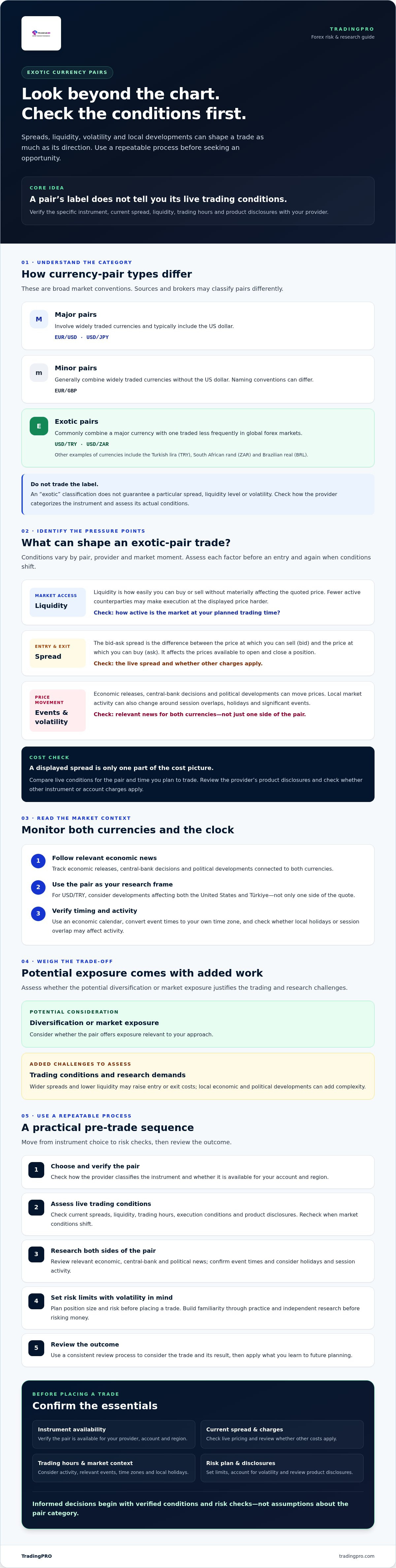
How to Research and Plan an Exotic Currency-Pair Trade
Make every decision before entry deliberate. This process takes you from choosing a pair to reviewing the result, with live conditions and risk limits built in. If currency quotes, pips, or position sizing are unfamiliar, first review a Forex Trading for Beginners Guide to strengthen those foundations.
- 1. Select a pair you can research. Identify both currencies and the economic forces that may influence them. Check recent developments and upcoming scheduled announcements for each economy. If you can’t find or interpret relevant information, choose a pair you understand better or wait.
- 2. Confirm the instrument and its terms. Check that the specific pair and instrument are available for your region and account. Read the provider’s current product disclosures and specifications so you understand how the instrument works and what risks apply.
- 3. Check current trading conditions. Review live spreads, trading hours, and any other charges or conditions stated by the provider. Conditions can vary, so don’t rely on a general description or an earlier quote. You can inspect the TradingPRO Trade Hub tools page as a research resource, but confirm which features are relevant and available before relying on them.
- 4. Write the trade plan and set a risk limit. State what would invalidate your trade idea, where you intend to exit if it’s wrong, and the maximum loss you’re prepared to accept. Size the position based on that predefined limit, the distance to your planned exit, and the instrument’s specifications. Don’t use a universal percentage or choose a size before checking how a price move translates into potential loss.
- 5. Account for changing conditions. Consider upcoming announcements, thin market periods, gaps, and spreads that may change. A stop order can help define an exit instruction, but it doesn’t eliminate risk or guarantee execution at the requested price in fast or gapping markets. If the possible loss or execution uncertainty doesn’t fit your plan, skip the trade.
- 6. Record and review. Log your rationale, relevant events, planned risk, and outcome. Then assess whether you followed the process, not just whether the trade made or lost money. Use the review to refine your research and decision-making.
Use this checklist to structure your approach, not to predict the result. Before taking any further step, verify the instrument, conditions, and disclosures for your specific account. Review TradingPRO registration options and confirm availability and terms before proceeding.
How to Take Your Next Step With Exotic Currency Pairs
Before trading exotic currency pairs, make sure you can explain what may move either currency, how the instrument works, and what conditions apply to your account. Set a risk limit before considering an entry. If any part of the plan is unclear, pause and keep researching.
- Understand the pair: Identify both currencies and the economic or political developments you’ll monitor.
- Verify the instrument: Check the current instrument list, product type, and relevant disclosures.
- Confirm trading conditions: Review current spreads, trading hours, account terms, and eligibility for your region.
- Define your risk: Decide in advance what would invalidate your trade idea and how much potential loss you can accept.
- Practice and review: Continue learning and test your process before risking money. Practice can build familiarity, but it can’t guarantee results.
Check Account and Instrument Details Before You Decide
TradingPRO offers Rookie, Micro, Pro, and Scalp Accounts, as well as social and copy trading. These account options don’t confirm that a specific exotic pair or instrument is available to you. Review the Rookie Account details as one option to investigate, then verify regional eligibility, product type, account terms, and the current instrument list before deciding.
Need to strengthen your foundations first? A Forex Trading for Beginners Guide can help you review core terminology and concepts before assessing a more complex market. Keep learning independently, and don’t treat practice or other traders’ activity as assurance of an outcome.
Move Forward With a Clear, Risk-Aware Plan
Research comes first. Confirm you understand the pair, know the instrument’s terms, and have defined your risk limits before choosing an account or considering a trade. If the available information doesn’t answer your questions, wait rather than fill the gaps with assumptions.
Once you’ve checked account eligibility, instrument availability, and current terms, you can decide whether to proceed. Create a TradingPRO account.
Make Your Next Move With a Clear Plan
Trading exotic currency pairs calls for more than a view on price direction. It requires a working understanding of the pair, current instrument conditions, relevant market developments, and a risk limit set before entering. Keep researching and reviewing your decisions. If key details remain unclear, wait until you can assess them with confidence.
TradingPRO offers Rookie, Micro, Pro, and Scalp account tiers, along with social and copy trading. These options don’t remove market risk or confirm that a particular exotic pair is available. Before choosing an account, check your region’s eligibility, the current instrument list, account terms, and relevant risk disclosures.
After completing those checks, create a TradingPRO account to explore your next step. Move at your own pace and let careful preparation guide each decision.
Frequently Asked Questions
What are exotic currency pairs?
Exotic currency pairs commonly combine a major currency, such as the US dollar or euro, with a currency that’s traded less frequently. USD/MXN, for example, pairs the US dollar with the Mexican peso. There’s no single classification used by every market source or broker, so a pair’s label can vary. Check the instrument’s actual trading conditions rather than assuming its category tells you everything about it.
Which currencies are considered exotic in forex trading?
Currencies such as the Mexican peso (MXN), Turkish lira (TRY), South African rand (ZAR), and Brazilian real (BRL) may appear in pairs described as exotic. Classification depends on the currency combination and the convention a source or provider uses; a currency isn’t necessarily labeled exotic in every context. These examples don’t confirm that a particular broker offers the pairs. Check its current instrument list and account terms.
Are exotic currency pairs riskier than major pairs?
They can involve different risks, but the level of risk varies by pair and market conditions. Lower trading activity may affect liquidity and quoted spreads, while local economic or political developments can influence prices. Volatility can mean larger moves in either direction, not a better or more predictable trade. Before trading exotic currency pairs, assess whether you understand both currencies and can manage the potential loss within your plan.
Why can exotic currency pairs have wider spreads?
Spreads may widen when fewer buyers and sellers are active or available to trade at a given moment. The spread is the difference between a pair’s bid and ask prices, so it affects the quoted prices for opening or closing a position. It can change with the instrument and market conditions. Check the live spread and any other applicable charges with your provider rather than relying on a general estimate.
Can beginners trade exotic currency pairs?
Beginners should first learn how currency quotes, spreads, position sizing, and risk limits work. Exotic pairs can require research into less familiar economies and news, so build a clear understanding of both currencies and the instrument’s terms. Practice and independent research can help you develop a process, but they can’t ensure a particular result. If you can’t explain the risks, keep learning before risking money.
How do I choose an exotic currency pair to research?
Start with a pair whose two economies you can research using reliable information. Identify the currencies, their key economic drivers, and upcoming announcements that could affect them. Then check whether the pair’s market hours and current trading conditions fit your ability to monitor it. Don’t choose solely because a chart shows a large move; first decide whether you understand what could influence either currency and what could invalidate your trade idea.
What should I check before trading an exotic currency pair?
Confirm the instrument is available to you, then review its product type, current spread, trading hours, account terms, and relevant disclosures. Research scheduled economic releases and central-bank announcements for both currencies. Set a risk limit and position size before placing an order, and consider how changing spreads or fast markets could affect an exit. If any key detail is unclear, pause and verify it with the provider.


