




- Published on: 2026-09-23 10:22:12
Recession Trading Strategies: 2026 Active Trader Guide

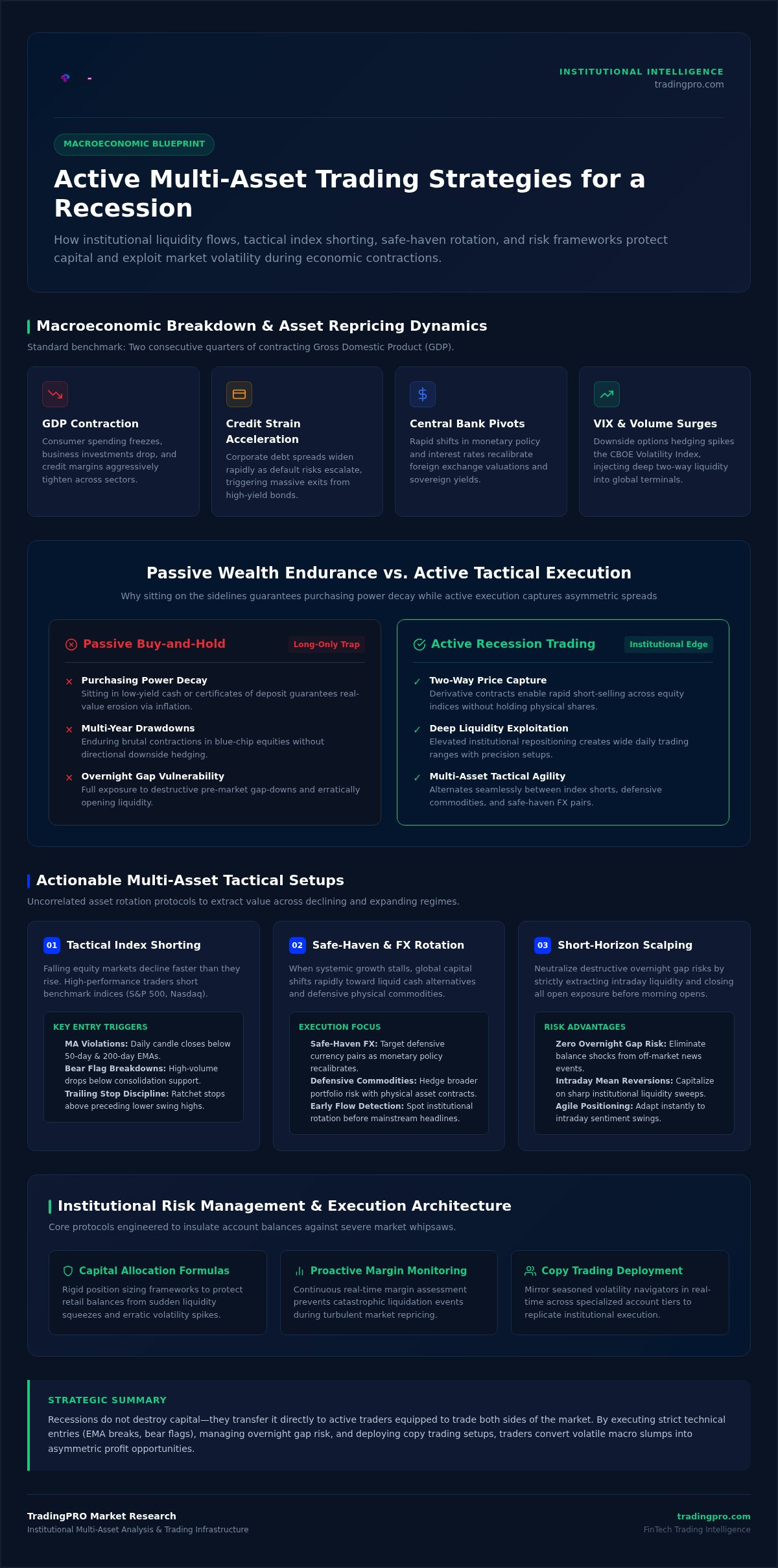
Economic downturns don't destroy capital; they transfer it directly to active participants equipped to trade both sides of the market. Watching long-only holdings plummet during sudden growth contractions is brutal, especially when overnight gap risk and erratic market whipsaws threaten your balance. Passive holding simply fails during macroeconomic slumps. To protect your hard-earned capital and seize asymmetric opportunities, you need proven trading strategies for a recession that convert volatile turbulence into precision setups across global indices, currencies, and defensive commodities.
You already know that sitting on the sidelines guarantees inflation will eat away your purchasing power, but entering violent pullbacks without a tactical playbook is reckless. This active guide gives you the institutional edge required to protect capital and exploit market volatility during an economic downturn. We will break down elite risk management protocols that safeguard retail balances, examine actionable multi-asset setups, and show you how modern copy trading environments let you seamlessly replicate seasoned volatility specialists in real time.
Key Takeaways
- Master high-conviction trading strategies for a recession by alternating between defensive commodities, safe-haven FX pairs, and tactical index shorting.
- Learn why short-horizon scalping neutralizes destructive overnight gap risks, allowing you to extract intraday liquidity without holding exposure into morning opens.
- Deploy institutional capital allocation formulas and proactive margin monitoring to insulate your account balance against severe volatility whipsaws.
- Build an agile execution desk across specialized account tiers or deploy copy trading to mirror seasoned market navigators in real time.
What Happens to Financial Markets During an Economic Recession?
Traditional finance conditions everyday investors to dread broad macroeconomic contractions. Understanding what is a recession reveals why this fear exists. Standard economic definitions require two consecutive quarters of contracting gross domestic product (GDP). When that benchmark occurs, consumer spending freezes, business investment plummets, and credit margins tighten aggressively.
Mainstream wealth managers often preach passive endurance. They advise holding long-only equity allocations while watching account values erode. For active market operators, this macroeconomic breakdown generates unprecedented opportunity. Institutional players actively liquidate massive equity holdings, which floods the financial ecosystem with intense trading volume. Elevated trading volume means deep liquidity. When liquidity spikes alongside sharp directional momentum, executing responsive trading strategies for a recession becomes vastly superior to static buy-and-hold investing.
Deconstructing Market Cycles and Asset Repricing
Market downturns never arrive without technical footprints. Corporate earnings compression acts as the primary catalyst. As consumer balance sheets weaken, forward revenue projections collapse, forcing institutional funds to offload high-multiple equities. This triggers distinct asset behavior:
The Divergence Between Economic Pain and Trading Volume
Main Street economic stagnation does not mirror trading terminal activity. The CBOE Volatility Index (VIX) reliably surges during downturns as institutions buy downside options protection. This institutional repositioning creates large daily trading ranges across global indices, foreign exchange pairs, and physical commodities.
Derivative traders hold a distinct competitive edge here. Unconstrained by long-only mandates, active traders utilize contracts to capture two-way price action without acquiring underlying shares. You can short-sell rolling equity indices within seconds, buy safe-haven currencies, or position for rapid intraday mean reversions. Mastering foundational currency mechanics through our forex trading for beginners guide allows you to identify where capital flows before broad market trends hit mainstream headlines. Deploying disciplined trading strategies for a recession transforms macroeconomic volatility from a portfolio risk into an asymmetric profit driver.
Core Multi-Asset Strategies for Navigating Bearish Market Regimes
Passive wealth management advice urges retail investors to park cash in low-yielding certificates of deposit or endure multi-year drawdowns in blue-chip equities. That passive approach guarantees purchasing power decay. Executing proactive trading strategies for a recession demands tactical agility across uncorrelated asset classes. By alternating seamlessly between short index exposures, safe-haven foreign exchange, and physical commodities, traders transform broad economic turbulence into actionable setups.
Tactical Short Selling Across Global Stock Indices
Falling equity markets fall faster than they rise. High-performance traders use contract-for-difference mechanisms to short benchmark indices like the S&P 500 or Nasdaq without borrowing physical stock certificates. Key technical entry triggers focus on structural momentum breaks:
- Moving Average Violations: Initiate short setups when daily candle closes drop cleanly below the 50-day and 200-day exponential moving averages.
- Bear Flag Confirmations: Enter on high-volume breakdowns below consolidation support lines during secondary bear market rallies.
- Trailing Stop Discipline: Lock in unrealized gains by ratcheting trailing stops just above preceding lower swing highs to survive intraday squeezes.
Safe-Haven Currencies and Commodity Rotation Plays
When systemic growth stalls, global capital seeks safety immediately. Studying lessons from the Great Recession proves that liquid cash alternatives and physical stores of value attract massive institutional capital inflows. The US Dollar (USD) and Swiss Franc (CHF) serve as primary foreign exchange beneficiaries during liquidity panics.
Simultaneously, spot gold provides an exceptional asymmetric hedge when sovereign yields fall and monetary authorities ease conditions. Conversely, industrial commodities face sustained headwinds. As manufacturing output cools, shorting crude oil offers clear downside momentum, giving active accounts multiple avenues to extract returns across distinct asset sectors.
Harnessing Collective Edge Through Copy Trading
Navigating violent macro shocks independently can strain analytical resources. Social trading networks resolve this by enabling dynamic trade replication. You can allocate capital to follow battle-tested volatility managers who specialize in crisis regimes. Success relies on evaluating strategy profiles properly:
- Prioritize low historical maximum drawdown metrics over sheer annualized return percentages.
- Check average position hold durations to ensure the trader avoids holding unhedged positions through major weekend news cycles.
- Evaluate performance during prior market corrections to verify genuine downside competence.
To dive deeper into automated strategy replication dynamics, explore our comprehensive social trading vs copy trading comparison. Traders ready to execute robust trading strategies for a recession can open a live account to access real-time execution across global markets.
Recession Trading Styles Compared: Scalping vs. Swing vs. Trend Following
Execution style determines your survival during market contractions. Competitor guides often preach long-term patience, urging retail accounts to absorb double-digit drawdowns. Active operators reject this passive friction. Selecting the right operational framework directly aligns your exposure risk with daily liquidity fluctuations. Tailoring your approach across scalping, swing trading, or trend following forms the cornerstone of executable trading strategies for a recession.
| Trading Style | Typical Holding Period | Primary Edge | Overnight Gap Risk |
|---|---|---|---|
| Scalping | Seconds to Minutes | Captures rapid order flow and high-volume spreads | Zero (Flat daily) |
| Swing Trading | 2 to 10 Days | Capitalizes on monetary policy and sentiment pivots | Moderate (Mitigated by stops) |
| Trend Following | Weeks to Months | Extracts macro repricing runs across multi-asset sectors | High (Requires wider buffers) |
Intraday Scalping: Minimizing Overnight Exposure
Holding open positions past the cash session close exposes your balance to catastrophic overnight gaps. Geopolitical headlines, sudden earnings downgrades, and inter-bank liquidity vacuums can bypass static stop losses entirely. Scalping neutralizes this danger. By ending every operational session completely in cash, scalpers insulate capital from after-hours shocks.
Peak performance in volatile markets requires lightning-fast order routing and ultra-tight spreads. Checking our best trading infrastructure for scalping breakdown highlights why execution speed matters during high-volume opens. When European and US liquidity windows overlap, intraday scalpers capture rapid micro-expansions without exposing their account principal to overnight market shifts.
Swing Trading Macro Shifts and Monetary Pivots
Swing traders capitalize on structural swings over several days. Bear markets rarely move in straight downward lines. They produce explosive counter-trend rallies that punish impatient short sellers. Swing execution isolates these overextended corrective moves using momentum indicators like the Relative Strength Index (RSI).
Key economic catalysts provide the fuel. High-impact calendar events such as central bank interest rate decisions, inflation data prints, and non-farm payroll reports create distinct multi-day directional waves. Swing traders establish entries at major resistance zones, setting predefined risk boundaries that target deep liquidity sweeps below recent lows.
Trend Following Across Prolonged Bear Markets
Protracted economic contractions reward ruthless trend followers. Moving average crossover systems keep you aligned with persistent institutional distribution. By systematically shorting bear flag pullbacks on daily charts, trend followers eliminate discretionary second-guessing.
Discipline overrides emotion here. Successful trend traders scale into winning positions as lower highs lock into place, systematically ratcheting risk stops to protect baseline principal. Integrating these structured operational styles into cohesive trading strategies for a recession transforms macroeconomic distress into calculated tactical momentum.
Institutional Risk Management Frameworks for Volatile Environments
Aggressive market environments crush undisciplined traders. While traditional wealth advisors often promote rigid 60/40 portfolios that fail when stocks and bonds fall simultaneously, institutional desks rely on dynamic mathematical limits. Preserving equity takes precedence over chasing yield. Mastering protective trading strategies for a recession requires strict operational rules that prevent a single adverse market swing from draining your trading account.
Dynamic Position Sizing and Capital Allocation Rules
Position sizing should never rely on instinct. Elite execution demands strict adherence to the one percent rule: risk no more than 1% of your total liquid account equity on any single trade setup. Calculating position volume requires working backward from technical invalidated price levels rather than choosing static lot sizes.
First, identify your structural invalidation level on the chart. Measure the distance in points or pips between your entry price and that invalidation point. Adjust your contract volume so that if the market hits that boundary, your balance absorbs exactly your predetermined risk threshold. If you are refining this sizing discipline in real market conditions, practicing inside a structured Rookie Account provides an optimal proving ground to hone your mathematical execution without exposing substantial balance reserves.
Mitigating Liquidity Gaps and Flash Volatility
High-velocity macroeconomic events trigger sudden price dislocations. Major inflation data releases, emergency rate decisions, and geopolitical escalations create order book air pockets where slippage can widen execution spreads. Managing these conditions requires three structural safeguards:
- Average True Range (ATR) Calibration: Expand stop-loss distances dynamically using multi-period ATR indicators to avoid getting shaken out by normal market turbulence.
- Cross-Asset Hedging: Pair directional short index positions with offsetting safe-haven currency allocations to absorb unexpected midday squeeze rallies.
- Built-In Downside Insulation: Trade exclusively on platforms with integrated negative balance protection so extreme gap risk cannot push your liabilities beyond initial deposits.
Eliminate unnecessary financial exposure. Establish disciplined margin monitoring to prevent broker liquidation engines from triggering forced closes at the bottom of intraday spikes. Ready to execute institutionally backed trading strategies for a recession with robust execution parameters? Register for an active trading account to manage macro volatility with professional tools.
Setting Up Your Active Recession Trading Desk in 2026
High-volatility regimes demand purpose-built trading environments. Trying to execute fast-moving macro setups on sluggish retail platforms guarantees expensive slippage and delayed fills. Successful operators align their platform speed, account mechanics, and analytical routines before committing fresh capital. Perfecting your operational desk is just as critical as picking the right trading strategies for a recession.
Choosing the Right Multi-Tier Account Structure
Your trading setup must match your specific operational cadence and risk appetite. Whether you run rapid scalping scripts or execute deliberate multi-day swings, choosing the proper account architecture prevents execution bottlenecks:
- Rookie and Micro Accounts: Ideal for mastering position sizing, verifying execution rules, and building consistency without overextending capital reserves. Review operational features in our best broker for rookie traders overview.
- Pro Account: Built for experienced swing and trend traders seeking institutional fills across global indices, foreign exchange pairs, and spot commodities.
- Scalp Account: Engineered for ultra-low latency and tight spreads, ensuring tick-by-tick precision during high-volume market opens.
Executing Your Strategy with Complete Market Confidence
Preparation eliminates panic when markets break down. Establish a structured pre-market routine to track shifts in macroeconomic sentiment and sovereign bond yield curves. When yield curves shift or central banks adjust policy rates, institutional capital reallocations accelerate across asset classes.
Focus your attention on a curated recession watchlist. Track high-liquidity instruments that respond cleanly to macro triggers, including major index contracts, safe-haven FX pairs, and spot gold. Gain immediate access to real-time market sentiment, advanced execution capabilities, and institutional analysis through the comprehensive TradingPRO Trade Hub.
Finally, automate your psychological discipline. Record every trade entry and exit in a detailed trading journal. Review your performance metrics weekly to eliminate behavioral mistakes like moving stops or revenge trading during sudden intraday whipsaws. Combining high-performance infrastructure with systematic execution turns disciplined trading strategies for a recession into repeatable operational victories.
Master Market Volatility and Take Control
Economic downturns separate passive spectators from agile traders who seize directional momentum. You don't have to watch macroeconomic contractions erode your portfolio. By implementing responsive trading strategies for a recession, you can alternate between short index opportunities, defensive safe-haven currencies, and spot commodities while deploying non-negotiable risk limits.
Precision execution requires institutional-grade tools and ultimate capital protection. Whether you choose a Rookie, Micro, Pro, or Scalp account, TradingPRO provides ultra-low latency infrastructure backed by built-in negative balance protection to keep your liabilities strictly capped to your deposits. If you prefer a hands-off approach during turbulent sessions, our integrated social trading network lets you mirror seasoned volatility specialists with complete transparency.
Turn market dislocation into your personal competitive advantage. Open a TradingPRO account today and execute your recession trading plan with speed, precision, and confidence.
Frequently Asked Questions
Can you make money trading during a recession?
Yes, active traders frequently find their most lucrative setups during recessions due to surging volatility and deep two-way market liquidity. Unlike passive investors locked into long-only equity portfolios, derivative traders can short falling stock indices, capture currency trends, and trade safe-haven commodities. Deploying disciplined trading strategies for a recession lets you exploit downward momentum just as effectively as bull-market rallies, provided you manage risk rigorously.
What are the safest assets to trade when an economic downturn hits?
Spot gold and safe-haven currencies like the US Dollar and Swiss Franc represent the most resilient assets during economic slumps. These instruments consistently attract institutional capital fleeing equity market risk. While no asset is entirely immune to short-term volatility, their strong liquidity profiles and historical tendency to preserve purchasing power make them reliable vehicles for capital preservation and tactical trend execution.
How does short selling work when financial markets are falling?
Short selling allows you to profit from declining prices by opening a position that gains value as an asset falls. With contracts for difference, you don't need to borrow physical shares or pay complex inventory fees. You execute a sell order at current market prices and close the trade by buying back the contract at a lower level, banking the price difference as profit.
Is scalping or swing trading better during volatile market contractions?
Scalping offers superior risk control during high-volatility slumps because you close all positions before the daily cash session ends. This eliminates destructive overnight gap risk caused by unexpected morning news or corporate earnings reports. Swing trading works well for capturing extended multi-day rallies, but scalping provides tighter risk insulation when market conditions are erratic and unpredictable.
How do central bank interest rate cuts affect currency pair trading?
Rate cuts generally weaken a domestic currency as international investors move capital toward economies offering higher sovereign yields. When a central bank eases policy to stimulate growth, traders sell that currency against stronger counterparts or safe havens like the Swiss Franc. These distinct policy divergences trigger sustained foreign exchange trends that create clean, high-probability directional setups across major currency pairs.
What happens if my trading account balance drops below zero during a market crash?
If you trade with TradingPRO, built-in negative balance protection guarantees your balance will never drop below zero. Violent market gaps and extreme slippage can occasionally bypass stop losses, but institutional safeguards automatically reset negative balances to zero. This ensures your financial liability remains strictly capped to your initial deposit, keeping your personal capital completely safe from unexpected broker debt.
Can beginners use copy trading to navigate market downturns effectively?
Yes, copy trading lets beginners navigate turbulent regimes by automatically mirroring the positions of veteran volatility managers. Instead of guessing market direction, you connect your capital to traders who have proven track records in crisis markets. Pairing automated replication with structured trading strategies for a recession helps novices protect capital while studying institutional risk techniques in real time.


