




- Published on: 2026-10-03 11:58:17
Offshore Forex Broker Regulations: A Trader’s Guide for 2026

An offshore address tells you where a company is registered, not which authority supervises the entity holding your account. That distinction is central to offshore forex broker regulations because it can affect the protections and complaint routes available to you. Company incorporation alone does not establish authorization to provide forex services, so the label “offshore” is not enough to assess a broker.
You can compare trading conditions and flexibility more clearly when you know which entity stands behind your account. Start with the legal entity named in your account agreement, then look up that entity and its permissions in the relevant regulator’s official register. A matching register entry is more useful than a broad claim on a website.
This guide explains the difference between incorporation and financial authorization, how to check an entity’s licence status and details, and how to compare complaint channels and client protections across jurisdictions. It also explains why a licence is one part of due diligence, not a promise of profits or a guarantee against loss. Before opening an account, match the terms to the entity serving your country.
Key Takeaways
- Offshore describes a cross-border location, not a single regulatory standard. Distinguish company incorporation from authorization to provide financial services.
- Compare the rules that apply to the account-holding entity, including its permissions, client classifications, and complaint route.
- Assess offshore forex broker regulations through official records and specific safeguards, not broad marketing claims about protection.
- Use a regulator’s official register to compare the entity name, licence details, and website information with the broker’s account documents.
- Before registering with TradingPRO, identify the regional entity named in your account terms and review the conditions that apply to your account.
What offshore forex broker regulation means, and what it does not
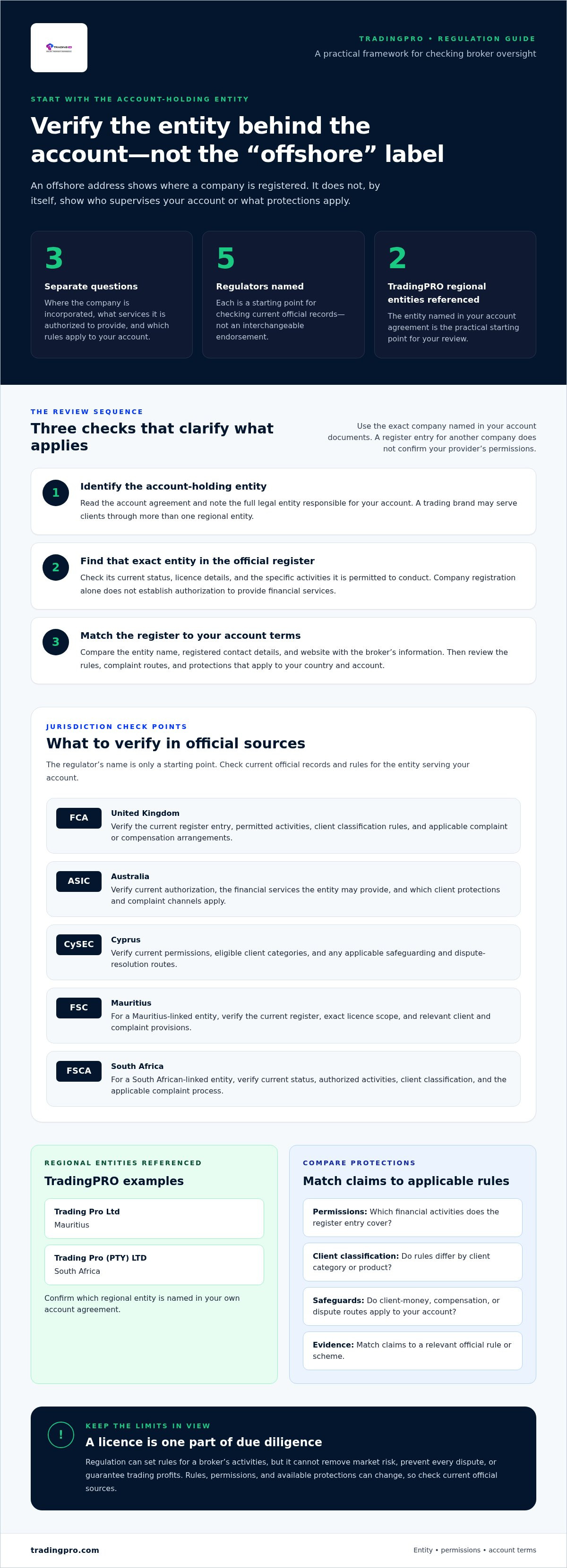
“Offshore” describes a cross-border location. It is not a universal regulatory category, and it does not tell you by itself whether a forex broker is authorized or what protections apply. The relevant framework depends on the jurisdiction and the specific legal entity serving your account. For general background on how oversight differs between countries, see Foreign exchange regulation.
Keep three things separate: where a company is incorporated, whether it is authorized to provide particular financial services, and which rules apply to your account. Protections can depend on the entity, the scope of its permissions, your client classification, and the terms you accept. Regulation can set rules for a broker’s activities, but it cannot remove market risk, prevent every dispute, or guarantee trading profits.
Offshore incorporation versus broker authorization
Company registration establishes that a legal entity exists under a jurisdiction’s company laws. It does not, on its own, establish permission to offer forex or other regulated financial services. Authorization permits an entity to conduct specified activities under the local framework and any conditions attached to that approval.
Do not treat a company number, an “offshore regulated” claim, or a platform name as proof of authorization. Find the full legal entity name and any licence details, then search the relevant regulator’s current official register. Check which activities the entry covers and compare its registered contact details and website with the broker you are dealing with. A register entry for a different company does not show that your account provider has the same permissions.
Why the account-holding entity matters
A trading brand may serve clients through more than one regional legal entity. TradingPRO operates through regional entities including Trading Pro Ltd in Mauritius and Trading Pro (PTY) LTD in South Africa. The entity named in your account agreement determines which company is your counterparty for that account relationship.
The client agreement is the practical starting point: identify the legal entity responsible for your account, then compare that exact name with the official register and read the terms that apply to your country and account. The entity, jurisdiction, and agreement can affect available complaint routes and other protections. Do not assume that an explanation about one regional company applies to every client or account tier.
Use this distinction as your baseline for understanding offshore forex broker regulations: assess the account-holding entity and its verified permissions, not the “offshore” label alone. That gives you a sounder basis for comparing account terms without mistaking regulation for a promise of safe or profitable trading.
How offshore forex regulation works across jurisdictions
There is no single offshore rulebook. Each jurisdiction sets its own framework, so the practical question is what the regulator authorizes the specific account-holding entity to do. Compare the regulator’s remit, the entity’s permissions, how clients are classified, and the complaint route available to you. The global forex market regulations context helps explain why oversight differs across markets, but it does not establish the protections for a particular account.
Use regulator names as starting points for research, not as interchangeable endorsements. This table is a verification framework, not a statement that any broker or entity is licensed. Check each detail against current official records and rules before relying on it.
| Regulator or jurisdiction | What to verify in current official sources |
|---|---|
| FCA, United Kingdom | Verify the entity’s current register entry, permitted activities, client classification rules, and applicable complaint or compensation arrangements. |
| ASIC, Australia | Verify the entity’s current authorization, the financial services it may provide, and which client protections and complaint channels apply. |
| CySEC, Cyprus | Verify the entity’s current permissions, eligible client categories, and any applicable safeguarding and dispute-resolution routes. |
| FSC Mauritius | For a Mauritius-linked entity, verify the regulator’s current register, the exact licence scope, and relevant client and complaint provisions. |
| FSCA, South Africa | For a South African-linked entity, verify its current status, authorized activities, client classification, and applicable complaint process. |
Check every item against current official sources. Rules, permissions, and available protections can change. A regulator’s name on a website does not establish an entity’s status or show that a licence covers every product it offers.
What to compare between jurisdictions
Start with the exact legal name and permitted activities in the regulator’s record. Then check whether the rules distinguish retail from professional clients or treat products differently. Verify whether client-money safeguarding, compensation arrangements, and complaint mechanisms apply to your account, and find out how to use them. A claim such as “funds protected” is not evidence on its own. Match it to a relevant rule or official scheme.
How cross-border services affect a trader
A brand’s headquarters, the regulator named in its marketing, and the entity serving you may be in different countries. Your residence, contracting entity, and account terms help determine which rules and complaint routes may apply. No jurisdiction is universally safer without that context. Apply the same checks to offshore forex broker regulations wherever the entity is based. Once you have identified the entity and reviewed its terms, you can continue to account registration with a clearer view of the relationship.
Do offshore forex brokers offer weaker protections? Compare the evidence
Not automatically. Protection depends on the legal entity serving your account and the rules that apply to it. Some jurisdictions set detailed requirements, while others may provide different safeguards or complaint routes. Compare the evidence rather than relying on labels. A licence can establish regulatory oversight, but it cannot predict trading performance, prevent market losses, or guarantee that a complaint will result in compensation.
Separate documented protections from promotional language. Claims such as “fully protected” or “guaranteed funds” need a clear basis in applicable rules or a named compensation arrangement. The FINRA forex regulations notice outlines retail forex risks and obligations for broker-dealers in its US context. It is a useful reference point, not a rule that automatically applies to an offshore account.
Which protections should traders investigate?
Check the rules and terms for the exact account entity. Look for specific answers to these questions:
- Client money: Do rules require funds to be held separately, and do those rules apply to your entity and account?
- Complaints: What is the broker’s internal process? Can a dispute be escalated to a regulator, ombudsman, or other dispute-resolution body, and are you eligible to use it?
- Compensation: Is a compensation scheme available for this entity, client type, and account? Do not assume one exists simply because the broker is regulated.
- Leverage: What limit applies to your client classification and instruments? In 2026, some offshore jurisdictions have introduced retail leverage caps of 1:200, so “offshore” does not necessarily mean unlimited leverage.
Benefits and limitations of offshore arrangements
Cross-border arrangements can come with different service terms, product access, or leverage conditions. Those features depend on the verified entity and the rules for your location. Treat flexibility as a point to investigate, not proof of better value or weaker oversight. Review the account agreement alongside official records, and look for specific terms instead of broad claims.
There is no reliable shortcut from jurisdiction to a verdict on legitimacy or risk. Make a concrete comparison: identify the applicable safeguarding rules, complaint route, leverage limits, and any compensation eligibility, then consider what those protections mean for your circumstances. That is the practical way to assess offshore forex broker regulations without confusing regulatory status with a promise of safety or returns.
How to verify an offshore forex broker before opening an account
Make verification a repeatable process, not a quick scan of a broker’s homepage. The goal is to confirm that the company named in your account documents matches an official regulator record, and that the record covers the services offered. Follow these steps to assess offshore forex broker regulations using primary sources rather than promotional claims.
A five-step official-register verification checklist
- Identify the contracting entity. Read the client agreement and account terms. Note the complete legal name of the company responsible for your account and the jurisdiction named in the agreement. The trading brand may differ from the legal entity.
- Find the regulator independently. Use an official government or regulator website, not only a link supplied by the broker. Locate its public register and any official warning or alert pages.
- Search the full legal name. If the broker provides a licence or registration number, search that too. Check that the entry identifies the same entity, not a similarly named company or affiliate.
- Match permissions and status. Confirm that the register entry is current and review the activities it authorizes, along with any restrictions or conditions. Compare those details with the forex services offered to you. Company incorporation alone is not proof of financial-services authorization.
- Compare identity details and save records. Check the registered domain and contact details against the website and agreement you are using. Review official warnings for relevant names or domains. Treat mismatches as a reason to pause and investigate. Save dated copies of the register result, warnings, agreement, and applicable terms.
A register result is evidence about the named entity and its listed status. It is not a blanket endorsement of every website using a similar brand, nor does it establish that every product or client is covered. Keep your own dated record so you know which information and terms informed your decision.
Questions to answer before deciding
Before proceeding, make sure you can answer these questions using the agreement, official records, and applicable rules:
- Which legal entity will hold the account relationship, and which version of the client terms governs it?
- What complaint process applies, and where can you escalate a dispute if the internal process does not resolve it?
- Which client-money safeguards, compensation arrangements, and other protections apply to your residence, client classification, and account type?
If an answer is unclear or the records do not match, do not treat a brand name or licence claim as a substitute for verification. Complete these checks first, then proceed to account registration when you are ready.
What TradingPRO clients should review before registering
Use the account documents as your reference point. TradingPRO operates through regional entities, including Trading Pro Ltd in Mauritius and Trading Pro (PTY) LTD in South Africa. Your account agreement identifies the company serving your account and the terms that govern the relationship.
Match the TradingPRO entity to your account documents
Before registration, read the current client agreement and terms for your country. Identify the exact legal entity named as your contracting party, then compare that name with the relevant regulator’s official register. Check the entry’s current status, permitted activities, restrictions, and contact or website details. A similar company name, another entity in a group, or a general brand statement is not a substitute for a matching record.
For any Mauritius- or South Africa-linked account, verify the applicable details directly with the relevant official authority. Do not assume that the same rules or protections apply across regional entities. Your country of residence and the entity named in the agreement help determine which terms and complaint routes are relevant. This puts offshore forex broker regulations into context: focus on the rules that apply to your account, not broad claims about a brand.
Choose an account only after understanding the terms
TradingPRO offers Rookie, Micro, Pro, and Scalp accounts. The Rookie Account is one option to review alongside its account-specific information and the documents for your contracting entity. Before choosing an account, make sure you understand the trading risks, costs, and conditions stated in those documents, as well as any rules that apply to your account type. An account tier does not change market risk or guarantee an outcome.
Use this final review to confirm that the details line up:
- Entity: Does the agreement name the same company you checked in the official register?
- Terms: Do you understand the conditions that govern your account and the services you will use?
- Protections: Have you verified which safeguards and complaint routes apply to your entity, location, and client classification?
Review the Rookie Account information as part of your assessment. If you are ready to proceed, begin registration after reviewing the applicable entity and terms. Keep a copy of the documents you relied on.
Make your next move with clear information
Strong due diligence starts with the legal entity behind your account, not the word “offshore.” Compare the client agreement with the relevant regulator’s current register, confirm the entity’s permissions, and understand the complaint route and protections that apply to your location and account. That is the practical way to assess offshore forex broker regulations without mistaking a licence for guaranteed protection or trading results.
TradingPRO operates through regional entities in Mauritius and South Africa and offers Rookie, Micro, Pro, and Scalp accounts. Review the entity and terms applicable to your account, and make sure you understand the conditions and trading risks for your chosen account before proceeding.
When you are ready, review the account details and register. Keep your records and make your decision with a clear understanding of the terms.
Frequently Asked Questions
Are offshore forex brokers regulated?
Some are authorized to provide specified financial services, while others may only be incorporated as companies. Offshore status alone does not confirm whether a broker is regulated. Check the exact account-holding entity in the relevant regulator’s official register, including its current status and permitted activities. Company registration or a licence claim on a website is not enough to establish that the entity serving you is authorized to provide forex services.
Is an offshore forex broker safe to use?
No label can determine that on its own. Assess the legal entity, verified permissions, account terms, client-fund arrangements, complaint routes, and any compensation eligibility that may apply to you. These checks can clarify the safeguards and recourse available, but they cannot remove trading risk or guarantee a successful outcome. If the entity or its register details do not match, pause and investigate before opening an account or transferring funds.
How can I check whether an offshore forex broker is regulated?
Find the full legal name of the company named in the client agreement and identify its claimed regulator. Go directly to that regulator’s official website, search its public register, and compare the entity’s status, licence scope, restrictions, domain, and contact details with the broker’s documents. Check official warning notices too. Save dated copies of the register result and terms. This helps you assess offshore forex broker regulations using primary sources.
What is the difference between offshore registration and regulation?
Registration usually means a company has been incorporated in a jurisdiction. It does not, by itself, mean the company is authorized to provide financial services. Regulation involves oversight by a relevant authority, while authorization specifies which regulated activities the entity may conduct and under what conditions. Confirm the distinction using the regulator’s register and the account agreement. A company number is not a substitute for checking financial-services permissions.
Do offshore forex brokers offer negative balance protection?
It depends on the entity, applicable rules, client classification, products, and account terms. Do not assume negative balance protection applies because a broker is offshore, regulated, or advertises account safeguards. Look for the protection in the terms that govern your account, then verify whether relevant rules or official disclosures support the claim. If the wording is unclear, treat the availability and scope of protection as unresolved before deciding to trade.
Which regulator oversees my offshore forex trading account?
The regulator, if any, depends on the legal entity named in your account agreement and the permissions recorded for that entity. A brand may operate through regional companies, so its general location or another affiliate’s licence will not necessarily identify who oversees your account. Match the contracting entity to the official register, then check which activities and client categories the entry covers. Your residence and applicable account terms also matter.
Should I register with an offshore forex broker?
Decide only after verifying the account-holding entity, its current regulatory status and permissions, the applicable terms, and the complaint route available to you. Compare safeguards that matter to your circumstances, including client-fund rules and any compensation eligibility. Do not treat offshore status as proof of safety or danger, and remember that regulation cannot prevent market losses or guarantee profits. Proceed only when you understand the risks and terms.


