




- Published on: 2026-09-30 01:40:17
Most Volatile Currency Pairs to Trade in 2026: A Practical Watchlist

The most volatile currency pairs to trade aren’t automatically the best opportunities. Sharp moves can come with wider spreads, thinner liquidity and sudden slippage, turning a promising setup into a riskier trade than it first appears.
Rankings based on average daily movement can help you build a watchlist, but they are only a starting point. Volatility changes with economic data, central-bank decisions and geopolitical events, so yesterday’s ranking may not reflect today’s conditions.
This practical watchlist explains what currency-pair volatility means, how tools such as Average True Range (ATR) and Bollinger Bands can help assess it, and which pairs may merit closer research in 2026. It also covers what can drive price swings and how to check spreads, liquidity, upcoming news and position risk before placing a trade. Treat these pairs as candidates to investigate, not a guaranteed ranking or promise of opportunity.
Key Takeaways
- Use the most volatile currency pairs to trade as a research watchlist, not a fixed ranking or signal to enter.
- Compare GBP/JPY, GBP/USD and AUD/JPY using a consistent timeframe and verified volatility data.
- Check how policy decisions, economic releases, geopolitical events and liquidity conditions could affect each currency in a pair.
- Compare current price movement with the pair’s own history, then review the calendar and trading costs before acting.
- Set personal risk limits and confirm your data is current before turning volatility research into a trading plan.
What Makes a Currency Pair One of the Most Volatile to Trade?
Volatility describes how much a price moves over a specified period. It measures the size of a currency pair’s swings, not their direction: a highly volatile pair can rise, fall or reverse quickly. That distinction matters when researching the most volatile currency pairs to trade. A volatility reading signals movement, not whether a trade is likely to succeed.
Rankings vary with the measurement window, data source and calculation method. A pair showing large moves over one week may look less volatile over a longer period. Comparisons are also misleading if one source uses hourly prices and another uses daily data. For a useful shortlist, apply the same method and timeframe to every pair, then compare each reading with that pair’s own past behavior.
Realized volatility is the standard deviation of a pair’s daily percentage returns over the previous 20 trading days. This defined window gives a consistent snapshot of recent movement, but it doesn’t predict what the pair will do next. For context on currency quotes, see this overview of a currency pair, including major, minor and exotic pairs.
How traders measure currency-pair volatility
Two common tools show different aspects of price movement:
- Average True Range (ATR): Estimates the average price range over a chosen number of candles, accounting for gaps between periods. ATR can help assess how far a pair has been moving, but it doesn’t forecast direction.
- Historical volatility: Measures how much past returns varied over a defined window. It can help compare recent movement across pairs when you use the same data interval and calculation.
Keep the inputs consistent. Daily ATR for one pair and hourly ATR for another are not like-for-like comparisons. Check the period and data source before drawing conclusions.
Why a volatile pair is not automatically a better trade
Bigger swings can create more room for price to move, but they can also magnify losses, trigger stops or make an entry harder to manage. Volatility alone says nothing about the quality of a setup or the probability of success. Costs and liquidity matter too. Exotic pairs can be more volatile in part because lower liquidity may contribute to sharper price moves, as the linked currency-pair overview explains.
Use volatility as one input, not a trade signal. This article provides general educational information, not personalized financial advice. Assess whether a market’s movement and risks fit your circumstances before trading.
Most Volatile Currency Pairs to Watch: A Research-Led 2026 Shortlist
Use this as a research watchlist, not a fixed league table. Volatility shifts with market conditions, and pairs can rank differently depending on the timeframe, data source and measure. The pairs below are candidates for comparison, not a claim that each is currently among the most volatile currency pairs to trade.
Major and cross pairs with notable price swings
GBP/JPY merits attention because expectations for UK and Japanese interest rates can change at different speeds, affecting both currencies in the pair. GBP/USD is another candidate to measure around central-bank decisions and major economic releases. AUD/JPY can respond to changing risk sentiment and developments affecting the Australian dollar. These are reasons to monitor the pairs, not proof that they lead volatility rankings in 2026.
For a fair comparison, use the same daily price data, date range and calculation for each pair. For example, calculate daily ATR or the standard deviation of daily returns over a stated lookback period, then compare the readings. Don’t use a short-term measure for one pair and a longer-term measure for another.
Emerging-market pairs and additional trading risks
USD/ZAR, USD/MXN and USD/TRY are additional candidates, but check current conditions before adding them to an active watchlist. Their currencies may react to local economic and political developments, commodity prices and shifts in global risk sentiment. Liquidity, spreads and market access can differ from those of major pairs and may vary by provider and market conditions. Check current pricing and trading terms rather than assuming a pair’s volatility tells you what it will cost to trade.
One source limitation is important: the February 2026 figures attributed to Carlos And Company report average daily pips, but the supplied reference gives no date range or calculation details, so they cannot support a comparable ranking of these pairs. Without consistent underlying data, avoid presenting a definitive 2026 order or treating a published pip figure as a current reading.
Build a shortlist from evidence you can reproduce: record the data source, dates and calculation, then refresh the comparison as conditions change. If you’re also researching platforms, review the TradingPRO registration page and check current terms before proceeding.
What Drives Currency-Pair Volatility, and What Can Make It Riskier?
A pair’s volatility depends on both currencies and the measurement window. A catalyst can strengthen one currency while weakening the other, widening the pair’s move. If both currencies respond in the same direction, the net effect may be smaller. That’s why the same headline can trigger different reactions across pairs, and why a short-term reading may differ from a longer-term one.
| Driver | How it can affect a pair | What to check |
|---|---|---|
| Policy decisions | Changing interest-rate expectations can alter the relative appeal of two currencies. | Central-bank statements, rate decisions and market expectations. |
| Economic releases | Inflation, employment and growth data can shift expectations for policy and economic strength. | Release schedule, forecast and actual result. |
| Geopolitical events | Conflict, trade tensions or political uncertainty can affect risk appetite and currencies differently. | New developments and exposure of each currency’s economy. |
| Liquidity conditions | Thinner trading can leave fewer orders available, making price moves and execution less predictable. | Trading conditions, market depth where available, and current spreads. |
Central-bank decisions and economic releases
Watch the Federal Reserve, Bank of England and Bank of Japan, but assess each institution’s influence in relation to the other currency in the pair. For example, the Fed raised its target range to 3.75%-4.00% on September 16, 2026. The effect on a dollar pair still depends on expectations for the other currency and how markets interpret the decision. Inflation or employment data can also reset expectations between scheduled meetings. Verify event dates and current policy context before publication or trading.
Distinguish anticipated event risk from surprise risk. Markets may respond before a scheduled announcement as traders adjust positions around expectations. An unexpected result, headline or change in sentiment can prompt a faster repricing. The event itself doesn’t dictate direction; the difference between expectations and what happens can matter.
Liquidity, spreads, and sudden market moves
When liquidity is thinner, available prices may change quickly and orders may be filled at a different price than expected. A chart’s wide high-to-low range shows movement, not transaction costs. It doesn’t tell you the spread or how execution may behave at a particular moment.
Before considering any of the most volatile currency pairs to trade, check live instrument terms and market conditions, including spreads and relevant trading hours. Volatility can raise exposure to favorable and adverse moves. Account for event risk and execution uncertainty rather than relying on a pair’s label alone.
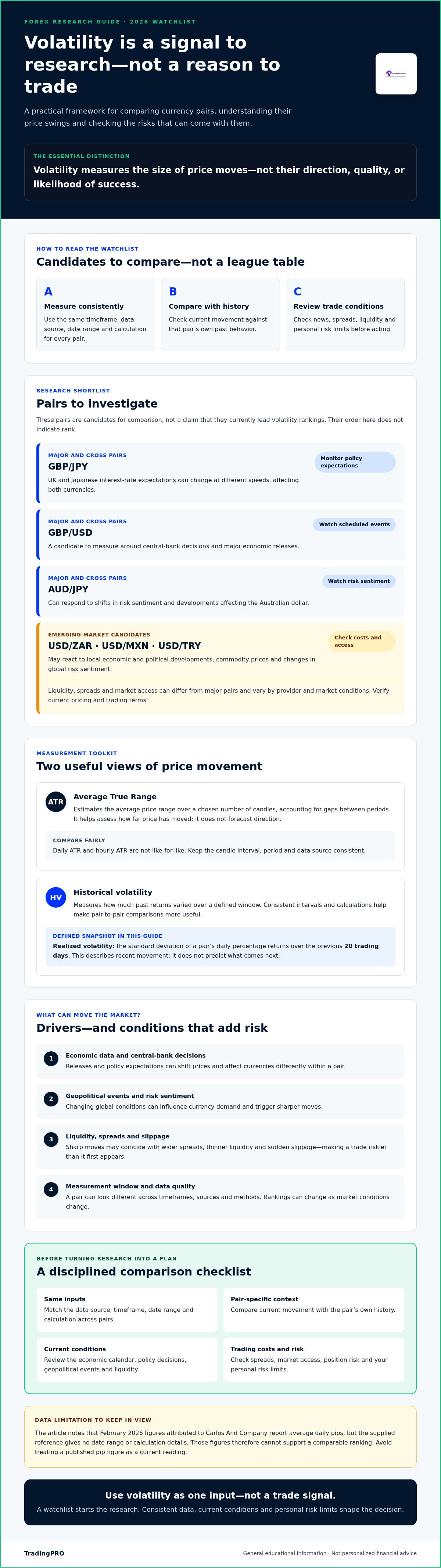
How to Assess Volatile Forex Pairs Before Placing a Trade
Turn a volatility watchlist into a repeatable pre-trade check. The aim isn’t to find the pair with the biggest recent move. It’s to determine whether current movement, upcoming events and trading costs fit a plan you’ve set in advance. For the most volatile currency pairs to trade, apply the same checks each time and record what you find.
Build a repeatable volatility watchlist
Choose a manageable set of pairs, then note the data source, measurement date and timeframe for each reading. Compare recent price ranges with the same pair’s longer-term behavior using a charting or analysis tool. This context can show whether activity is typical or unusually elevated, without treating past movement as a forecast.
- Choose a timeframe. Match the measurement window to the period you plan to assess. A reading based on hourly candles can tell a different story from one using daily data.
- Measure movement consistently. Use the same indicator and settings across your watchlist, such as ATR for recent price ranges. Record the lookback period, then compare today’s reading with the pair’s own historical behavior.
- Check the economic calendar. Look for upcoming central-bank decisions and relevant economic releases. Consider whether an announcement falls within the period you might hold a position.
- Review costs and conditions. Check current spreads, instrument terms and market conditions. A large price range doesn’t reveal transaction costs or guarantee predictable execution.
- Set risk before entry. Decide the maximum acceptable loss first. Position size and stop placement should reflect your individual risk plan and the market’s conditions, not the excitement of a sharp move.
Plan around event risk and personal risk limits
Refresh the calendar and volatility readings before making a decision. Conditions can change after a scheduled announcement or an unexpected headline. If you’re new to forex, first make sure you understand core concepts such as currency quotes, order types and the risks of leveraged trading. Don’t increase position size simply because a pair has moved sharply. Stop placement and position size work together, so assess both against your predefined loss limit.
Use this process to decide whether a pair deserves further attention, not to generate an automatic trade signal. To explore the platform, you can visit TradingPRO registration and review the current terms before proceeding.
Turn Volatility Research into a Disciplined Trading Plan
A pre-trade checklist for high-volatility pairs
Run these checks before considering an entry. If you can’t answer one, pause and gather the missing information.
- Confirm the data: Record the pair, measurement date, timeframe, data source and volatility measure. Compare current readings with that pair’s own history.
- Check event risk: Review an up-to-date economic calendar for relevant announcements, and consider whether unexpected headlines could affect either currency.
- Review trading conditions: Check current liquidity, spreads, market conditions and applicable instrument terms. Conditions can change, so don’t assume a past reading reflects the price or costs available now.
- Write down your plan: State the trade rationale, the point that would invalidate it and the maximum loss you’re prepared to accept before entry.
- Set position size and stop placement: Base both on your individual risk plan and current conditions. Don’t increase position size simply because the pair has made a sharp move.
Choose a learning path that fits your experience
If you’re new to forex, build your understanding of currency quotes, order types and risk before evaluating the most volatile currency pairs to trade. Use a beginner forex trading guide as a foundation, then apply the checklist consistently. Research supports a decision process; it doesn’t make a trade suitable for every person.
TradingPRO offers Rookie, Micro, Pro and Scalp accounts. The Rookie Account is one option to review. Check its current availability and terms directly, and don’t assume an account changes the risks of volatile markets.
Keep your process steady as conditions shift. If you’d like to learn more about the platform, you can explore TradingPRO registration and review the information there before deciding whether to proceed.
Make Your Next Move With a Clear Plan
The most volatile currency pairs to trade don’t follow a permanent ranking. Their movement changes with the timeframe, data and market conditions you measure. Use a consistent method to compare pairs, then check upcoming events, liquidity and trading costs before deciding whether a setup fits your plan.
Keep risk at the center of every decision. Define your rationale, invalidation point and acceptable loss before entry, and don’t mistake a sharp move for a reliable opportunity. A watchlist is a research tool, not a promise of what the market will do.
TradingPRO offers Rookie, Micro, Pro and Scalp account tiers, as well as social trading and copy trading. Review current account availability and terms before making a choice. To learn more about the platform, explore registration and choose your next step.
Stay curious, keep your process disciplined and let careful research guide your decisions.
Frequently Asked Questions
What are the most volatile currency pairs to trade?
Candidate pairs often include GBP/JPY and selected emerging-market pairs, but no ranking stays accurate in every market. Measured volatility depends on the timeframe, data source, calculation method and current conditions. Before acting on a list of the most volatile currency pairs to trade, compare current readings using the same method and period. Observed price movement describes past behavior, not future performance.
Which forex pair is the most volatile?
No single forex pair is always the most volatile. Rankings can change with the lookback period, calculation method and market events. Some emerging-market pairs and currency crosses can show large moves, but a current example needs dated data and a clearly stated method. A volatility reading measures the size or variation of past price movement; it doesn’t indicate whether a pair will rise or fall next.
Is GBP/JPY a volatile currency pair?
GBP/JPY is commonly monitored for substantial price movement, but its volatility varies over time and isn’t guaranteed to remain high. UK economic data and Bank of England decisions can affect the pound, while Japanese data and Bank of Japan policy can influence the yen. Check recent price ranges, upcoming events and current trading conditions before drawing conclusions. Don’t rely on the pair’s reputation or an undated ranking alone.
Are exotic currency pairs more volatile than major pairs?
Some emerging-market pairs can experience larger price moves than major pairs, but “exotic” doesn’t mean more volatile in every period. Liquidity and trading costs may also differ, and conditions can change by instrument and provider. Compare pairs over the same timeframe with the same measure. Then check current spreads, execution conditions and event exposure to assess risks beyond the chart’s price movement.
How do I measure currency-pair volatility?
Average True Range (ATR) measures a pair’s recent price range, while historical volatility measures variation in returns over a defined period. Both describe past movement, not future direction. Compare pairs using the same timeframe, data source and calculation method, and record when the data was collected. Check whether a scheduled announcement falls within a short measurement window, since an event can make that reading less representative of typical movement.
Can beginners trade highly volatile currency pairs?
Beginners should first understand price movement, order behavior and potential loss exposure before trading highly volatile pairs. Start with foundational learning and a written risk plan rather than assuming any pair is suitable for everyone. Losses are possible, and volatility can magnify adverse moves. Review a beginner forex trading guide to learn core concepts, then consider whether you can assess the risks and conditions before making a trading decision.
When are currency pairs usually most volatile?
Activity can rise around relevant economic announcements, central-bank decisions and periods when major financial markets overlap. There’s no universal best time: the effect depends on the pair, date and news involved. Check a current economic calendar and observe the specific instrument’s behavior. Scheduled events can still produce unpredictable moves, so don’t treat a busy period as a reliable signal or assume volatility will move in a particular direction.
Does high volatility mean a currency pair is easier to trade?
No. Higher volatility means larger or more frequent price movements, not easier or more profitable trading. Rapid moves can increase uncertainty and potential losses as well as possible opportunity. Before making a decision, review liquidity, transaction costs and your personal risk limits. Neither a broker account nor a trading tool removes market risk, and a volatility reading alone can’t tell you whether a trade is suitable.


