




- Published on: 2026-09-25 12:41:28
Micro Lot Forex Broker: The 2026 Guide to Precision Risk Management

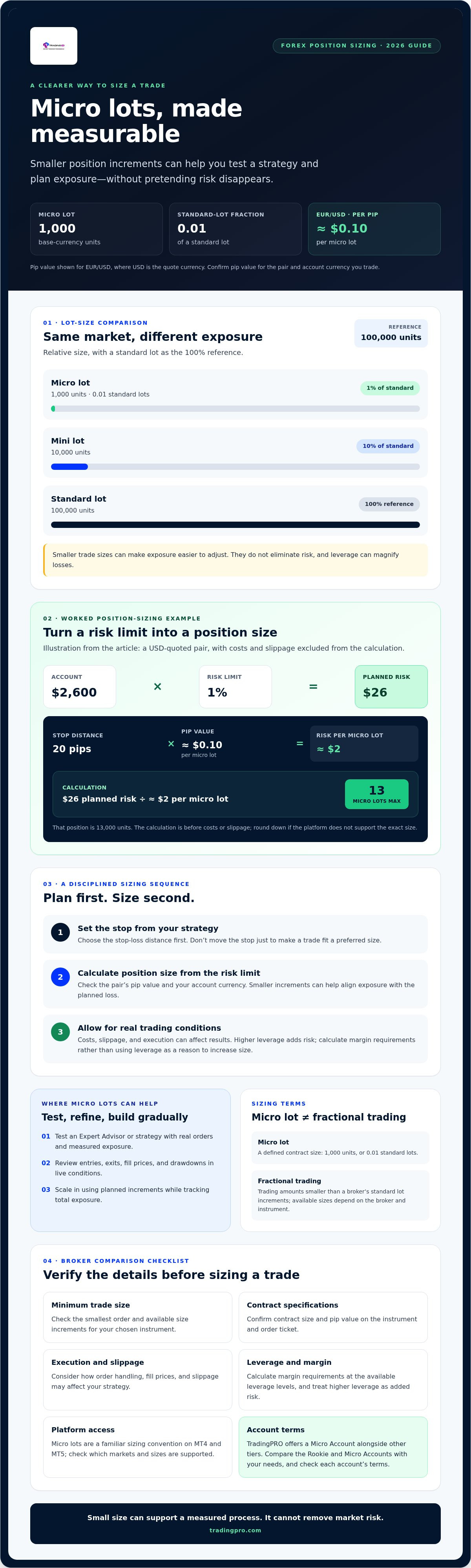
A larger deposit isn’t the only route to more disciplined forex trading. The right micro lot forex broker lets you adjust position size in smaller increments instead of risking too much on a single move. A micro lot represents 1,000 units of the base currency, or 0.01 standard lots. On EUR/USD, a one-pip move is worth approximately $0.10 per micro lot, giving you finer control over exposure.
If you’re worried about losing a large share of your deposit, unsure how lot sizes translate into risk, or facing high entry requirements, you’re not alone. Smaller trade sizes can help you test a strategy in a live market with more measured exposure. They don’t remove risk, and leverage can magnify losses, so a clear plan still matters.
This 2026 guide explains how to calculate micro-lot positions, set risk limits, and compare features when choosing a broker. You’ll also find practical checks for execution, platform access, and leverage. TradingPRO offers a Micro Account alongside its other account tiers. Build your process one measured trade at a time.
Key Takeaways
- Compare micro, mini, and standard lot sizes to understand how position size changes your exposure and margin needs.
- Use micro lots to test Expert Advisors in live conditions and build positions incrementally through scaling in.
- When choosing a micro lot forex broker, check minimum trade sizes, execution conditions, and how slippage may affect your strategy.
- Calculate margin requirements at different leverage levels, and treat higher leverage as added risk, not a reason to increase position size.
- Compare TradingPRO’s Rookie and Micro Accounts with your trading needs, and check each account’s terms before opening a trade.
What is a Micro Lot and Why Does it Matter in 2026?
A micro lot is 0.01 of a standard lot, equal to 1,000 units of the base currency in a currency pair. It’s smaller than a standard 100,000-unit lot, making it easier to manage exposure without committing to a large position. The Bank for International Settlements’ April 2022 survey recorded average daily forex trading volume of $7.5 trillion, a market that individual traders can access through retail foreign exchange trading.
Changing economic conditions can make disciplined position sizing especially important. Micro lots let traders adjust exposure in smaller increments rather than choosing between a position that feels too large and sitting out entirely. They can also make live practice more manageable. Unlike demo trading, a live position involves real financial consequences, so small trade sizes let new traders experience that difference with more controlled exposure. They don’t eliminate risk.
The Mathematics of a Micro Lot
For pairs where USD is the quote currency, such as EUR/USD, one pip on a micro lot is approximately $0.10. On a standard lot, the same pip movement is approximately $10. A 20-pip stop-loss on one micro lot therefore represents about $2 in price movement, before trading costs or slippage. That smaller pip value can help you match position size to a planned loss limit. Set the stop based on your strategy first, then calculate position size. Don’t move the stop simply to make a trade fit.
Micro Lots vs. Fractional Trading
A micro lot is a defined contract size: 1,000 units, or 0.01 standard lots. Fractional trading generally means a broker lets clients trade amounts smaller than its standard lot increments. These terms can sound similar, but the minimum size and available increments depend on the broker and instrument. Check the contract specifications and order ticket before trading. Micro lots are a familiar sizing convention on MT4 and MT5, which can help traders apply consistent position-sizing calculations across supported markets.
Why Granular Sizing Matters
Micro lots give traders more room to test a strategy, refine risk limits, or scale into a position gradually. They can also reduce the emotional jump between a simulated trade and a live one, though real-money decisions may still feel different. If you’re comparing a micro lot forex broker, verify its minimum trade size, contract specifications, and execution conditions for your chosen pair. For foundational concepts, consult the Forex Trading for Beginners Guide before placing live trades.
Strategic Advantages: Why Pros Use Micro Lot Forex Brokers
Micro lots aren’t just for beginners. Experienced traders use smaller increments to validate systems, control exposure, and build positions according to a measured plan. A micro-lot account can serve as a proving ground for an Expert Advisor (EA) or another strategy before you consider increasing trade size. It won’t make a strategy profitable, but it can help reveal how it behaves with real orders and real financial risk.
Live Market Testing and Strategy Validation
A demo account is useful for checking trade logic, but simulated fills may not reproduce live execution, including slippage or delays during fast markets. Test an EA with micro-lot exposure and record its entries, exits, fill prices, and drawdowns. That information gives you a more realistic basis for review without committing to a larger position. Execution speed matters too. See the linked high-speed execution tools for context, and assess how order handling fits your strategy. For broader context on broker responsibilities, see FINRA's Retail Forex Guidelines.
Precision Position Sizing
Start with a fixed risk limit, then calculate position size from your stop-loss distance. For example, on a $2,600 account, a 1% risk limit equals $26. If a USD-quoted pair has a 20-pip stop and each micro lot is approximately $0.10 per pip, each micro lot puts about $2 at risk. Dividing $26 by $2 gives a maximum of 13 micro lots, before costs or slippage. Confirm pip value for the specific pair and account currency, and round down if the platform doesn’t support the exact size.
That granularity matters. A 13-micro-lot position is 13,000 units, while one mini lot is 10,000 units. Micro increments can make it easier to align exposure with your calculated risk instead of settling for a coarser size. Position sizing is a practical way to limit how much a planned market move can cost you.
Scale In and Manage Drawdown
Scaling in means opening a position in planned increments rather than entering the full size at once. A trader might add micro lots only when predefined conditions are met, while tracking total exposure and keeping a stop-loss plan. In volatile periods, smaller units can help control position size, but they can’t prevent losses or guarantee a smaller drawdown. Set a maximum combined risk before adding to a trade, and don’t increase size simply to recover a loss.
TradingPRO’s Micro Account is one option to compare for a measured approach. Before deciding, review TradingPRO account options and check the terms that apply to you.
Micro vs. Mini vs. Standard Lots: A Performance Comparison
Lot size sets the scale of a position, affecting both potential gains and losses. Standard contract sizes are:
- Micro lot: 1,000 units of the base currency
- Mini lot: 10,000 units
- Standard lot: 100,000 units
Each step multiplies exposure by ten. That changes your margin requirement and how much a given market move can affect your account. A smaller lot size can also leave more room before a loss reaches a set amount, provided the stop-loss and risk plan stay consistent.
Margin and Leverage Dynamics
Margin is the funds required to open a leveraged position. As a simplified illustration, assume each lot’s notional exposure is equivalent to $1,000, $10,000, or $100,000 respectively. At 1:30 leverage, approximate margin would be $33, $333, or $3,333. At 1:100, it would be $10, $100, or $1,000. Actual margin depends on the currency pair, its exchange rate, account currency, and the broker’s terms.
Lower margin isn’t lower risk by itself. Leverage can magnify losses, and opening multiple micro positions can create substantial combined exposure. Lot size also doesn’t provide negative balance protection. That depends on the broker’s terms and the rules applying to your account. For related risk context, see this rookie trader guide.
Think of “account breathability” as the spare equity left after a position is opened. Micro lots generally use less margin per position than mini or standard lots, leaving more room for price fluctuations. However, spare equity doesn’t guarantee a trade can recover.
Choosing the Right Fit for Your Capital
Choose lot size from your planned loss per trade and stop distance, not from the maximum size your margin allows. There’s no universal account balance that makes micro, mini, or standard lots appropriate. Start with micro sizing when you need finer control. Consider larger lots only when your tested strategy, risk limits, and available equity support the increase.
TradingPRO offers Rookie, Micro, Pro, and Scalp Accounts, designed for different trader profiles and experience levels. Don’t assume an account tier automatically dictates a particular lot size. Check each account’s current contract specifications, minimum trade size, and margin terms. If you’re comparing account options, review the TradingPRO Rookie Account details alongside the Micro Account. A micro lot forex broker can help you size trades precisely, but your risk plan must lead every order.
How to Choose a Micro Lot Forex Broker for Your Strategy
The right micro lot forex broker should fit your process, not just advertise a low spread. Compare the trade conditions you’ll actually use, then check whether the platform and account options support your risk plan. Use this checklist:
- Confirm minimum size: Check that 0.01 lots is available on the major currency pairs you plan to trade. Review each pair’s contract specifications rather than assuming the minimum is universal.
- Assess execution: Look at how orders are handled, including during volatile periods. Spreads alone won’t tell you whether slippage or execution delays could affect your entries and exits.
- Review funding terms: Read the available deposit and withdrawal methods, processing information, and any applicable terms before funding an account. Check the details rather than assuming the process is frictionless.
- Check social features: If you plan to use Social Trading or Copy Trading, understand how strategies are selected, monitored, and sized for your account.
- Match the account to your needs: Compare each account’s stated features and conditions. TradingPRO’s Rookie Account details are one place to start if you’re considering that option.
Execution Speed and Infrastructure
A low advertised spread isn’t enough. During major news or fast-moving markets, liquidity and execution conditions can change, so check how the broker describes order execution and what its terms say about slippage. Test the platform in conditions relevant to your strategy, and review order records to see how fills compare with your intended prices. If you scalp, assess execution on the specific account you’d use. Don’t assume that a feature or account label guarantees a particular fill quality. A multi-asset setup may matter if your strategy spans markets, so confirm which instruments and platform functions are available to you.
Social Integration and Account Fit
Social and copy trading can help you follow or replicate another trader’s strategy, but copied trades still carry risk. Check whether you can control allocation and position sizing, review the strategy’s history and drawdowns, and monitor exposure across copied trades. Micro-lot increments may help tailor trade size to your balance, but they don’t make a strategy safe or remove the need for independent risk limits. For a clearer distinction between social interaction and automated replication, consult a dedicated comparison of Social Trading and Copy Trading.
TradingPRO offers Social Trading and Copy Trading alongside Rookie and Micro Accounts. Compare the account terms with your intended trading style, then review TradingPRO’s account options before deciding whether they fit your approach.
TradingPRO’s Micro Account and Trading Options
Micro-lot trading connects precise position sizing with tools that can support a structured trading process. TradingPRO offers Rookie, Micro, Pro, and Scalp Accounts, plus Social Trading and Copy Trading. Its account tiers are designed for different trader profiles and styles. Those options can help you compare trading environments, but they don’t remove trading risk or guarantee a particular fill. Check the terms and account specifications that apply to you before placing trades.
The Rookie Account: Compare Your Options
TradingPRO’s Rookie Account is one of its account options for different trader profiles and experience levels. Pair an account’s features with a written plan: set a risk limit, decide where a trade idea is invalidated, and calculate size before entry. The Micro Account is another option to consider when comparing account tiers. Confirm the current minimum trade sizes, instruments, and execution conditions rather than assuming all account tiers share identical terms.
Review the TradingPRO Rookie Account details alongside the Micro Account. Choose based on the conditions you need, not the assumption that a particular account tier automatically means smaller risk.
Scale Carefully with Social and Copy Trading
Copy Trading can replicate another trader’s activity, while micro-lot increments may help you manage the size of your own positions. But copying a strategy doesn’t make it suitable for your balance. Review its drawdowns and trading approach, set an allocation you can afford to risk, and monitor combined exposure. A track record can’t predict future results.
Consider the proposed example of following a $100,000 account with $100. The smaller balance is 0.1% of the larger one, but that ratio doesn’t guarantee every trade can be copied at precisely 0.1% size. Minimum lot sizes, available margin, instrument specifications, and copy settings may affect the result. Check whether trades are rounded, skipped, or adjusted, and understand how losses, open positions, and stop settings are handled. In a multi-asset strategy, assess each instrument’s contract size and risk separately. Don’t assume the same allocation works across markets.
TradingPRO’s Micro Account and Social Trading or Copy Trading options bring account choice and strategy replication into one trading environment. Treat them as tools, not shortcuts: check the settings, define risk limits, and keep control of your decisions. Review the available account terms before you trade.
Take Your Next Step with Precision
Micro lots put control at the center of your trading plan. Choose position size according to your risk limit, test strategies carefully in live conditions, and remember that smaller trades can still lose. The right micro lot forex broker should also fit your execution needs and offer account features that support the way you trade.
TradingPRO offers Rookie, Micro, Pro, and Scalp account tiers, as well as a Social Trading and Copy Trading ecosystem. Compare the account terms and features before you decide, and treat Copy Trading as a tool to assess, not a promise of results.
What is the minimum deposit for a micro lot forex broker?
There’s no universal minimum deposit for a micro lot forex broker. Requirements vary by broker, account type, payment method, and region, and a low minimum doesn’t necessarily provide enough funds to manage risk responsibly. Check the broker’s current account terms and margin requirements before depositing. Choose an amount you can afford to lose, and base your trade size on a defined risk limit rather than the minimum needed to open an account.
Can I use micro lots on MetaTrader 4 and MetaTrader 5?
Yes, MT4 and MT5 can support micro-lot orders when the broker enables that size for the account and instrument. A 0.01-lot order is commonly used to represent a micro lot, but trading conditions can vary by pair and account. Check the platform’s order ticket and the broker’s contract specifications for minimum volume and permitted increments. Don’t assume every instrument has the same minimum.
How much is 1 pip worth in a micro lot?
For currency pairs where USD is the quote currency, one pip on a 0.01-lot micro position is approximately $0.10. For example, a 20-pip price move would represent about $2 in profit or loss before trading costs or slippage. Pip value differs for pairs with other quote currencies and can change with exchange rates. Confirm the value for your pair and account currency before placing a trade.
Are micro lot accounts only for beginners?
No. Experienced traders can use micro lots to test automated strategies in live markets, scale into a position gradually, or fine-tune exposure. Smaller increments are useful whenever a trader wants closer control over position size, not only when learning the basics. They don’t make a strategy profitable or remove market risk. Apply the same entry rules, stop-loss planning, and risk limits you’d use with a larger position.
Does TradingPRO offer micro lot trading on all account types?
TradingPRO offers Rookie, Micro, Pro, and Scalp Accounts, but the available information doesn’t confirm that every account type supports micro-lot trading on every instrument. The Micro Account is one option among its account tiers. Before opening a trade, review the relevant account’s current contract specifications, minimum trade size, and instrument conditions. Don’t assume account tiers have identical features or trading terms.
Is leverage higher on micro lot accounts?
Not necessarily. Leverage is set by the broker’s account conditions, the instrument, and the rules applicable to your location. A micro lot has a smaller notional position than a standard lot, so its margin requirement is generally smaller at the same leverage. That doesn’t mean the account has higher leverage or that risk disappears. Check the leverage and margin terms that apply to your specific account.
How do I calculate my risk when trading 0.01 lots?
Multiply your stop-loss distance in pips by the pip value for your position to estimate price risk, then include any applicable trading costs and possible slippage. For a USD-quoted pair, 0.01 lots is approximately $0.10 per pip, so a 20-pip stop represents about $2 before those additional factors. Compare that estimate with your predetermined risk limit. Pip values can differ on other pairs.
Can I copy professional traders using a micro account?
TradingPRO offers Social Trading and Copy Trading, which allow clients to replicate other traders’ strategies. Whether copied trades can be sized to fit a micro account depends on available copy settings, minimum trade sizes, instrument specifications, and account conditions. Review those details before enabling replication, and assess a strategy’s risks rather than relying on its past performance. Copied trades can lose money, so set limits and monitor your exposure.


