




- Published on: 2026-09-23 12:57:19
Legal Requirements for Signal Providers: 2026 Guide

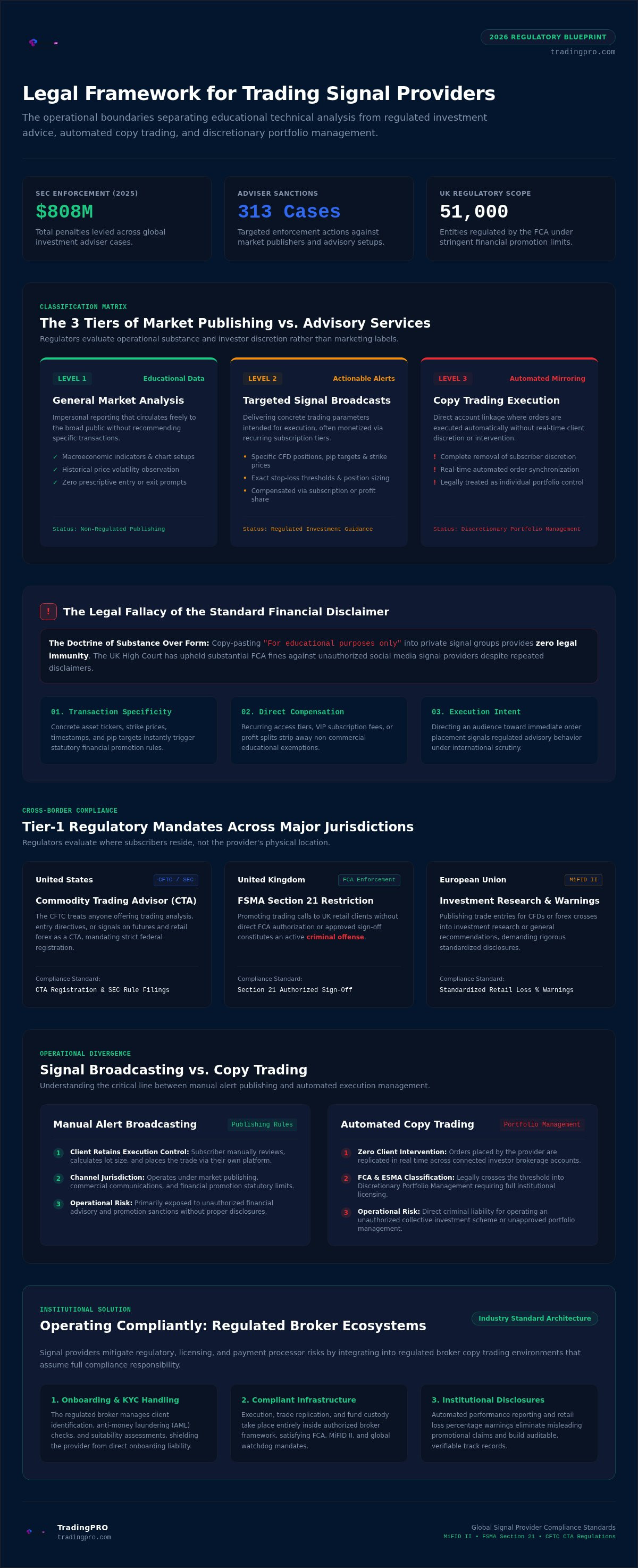
In 2025, the SEC levied $808 million in fines across 313 investment adviser cases, proving that global regulators no longer overlook digital market publishers. If you broadcast setups or distribute trade alerts, mastering the legal requirements for signal providers isn't just best practice. It's the critical barrier between building a high-performance trading brand and facing sudden payment processor shutdowns or severe regulatory penalties.
You're right to question whether selling forex, CFD, or crypto signals pushes you into regulated advisory territory. With the UK's FCA classifying automated trade replication as discretionary portfolio management and authorities worldwide clamping down on finfluencers, separating generic technical market analysis from personal financial advice has never felt more challenging.
You don't need to operate in the dark or halt your momentum. You'll master the precise legal boundaries distinguishing educational data from regulated advice, explore key operational exemptions, and discover how partnering with regulated broker ecosystems protects your enterprise.
Here is your definitive 2026 blueprint to operating cleanly, establishing institutional credibility, and scaling your signal operations across global jurisdictions.
Key Takeaways
- Define the precise operational boundary separating generic technical analysis from personal financial advice to avoid triggering unauthorized advisory licensing.
- Master the core legal requirements for signal providers across tier-1 jurisdictions to safeguard your commercial setup against enforcement actions.
- Discover why automated trade replication crosses legally into discretionary portfolio management, whereas manual alert channels operate under distinct publishing rules.
- Streamline your operations by partnering with regulated broker social trading ecosystems that handle investor onboarding and compliant execution infrastructure.
- Deploy institutional-grade performance disclosure standards and risk protocols to eliminate misleading claims and build verifiable market credibility.
What Classifies a Trading Signal Provider Under Global Financial Law?
Global securities and derivatives watchdogs evaluate signal providers based on practical market impact, not marketing rhetoric. Under modern financial regulations, a trading signal provider is any individual or entity that issues actionable trade parameters; including entry rates, stop-loss limits, and profit targets; designed for execution across financial markets. Regulators assess these transmissions through one central question: does this service offer factual market observation, or does it constitute an individualized call to action?
The distinction rests on the boundary between impersonal reporting and targeted persuasion. Factual market analysis presents macroeconomic indicators, chart formations, and historical price volatility without prescriptive instructions. Recommending a specific CFD position, contract size, and exact order timing changes the dynamic entirely. If you charge recurring subscription tiers, access fees, or profit splits, regulatory bodies view you as a compensated investment advisor. You are no longer treated as a neutral publisher. Understanding these foundational legal requirements for signal providers protects your enterprise from crippling unauthorized advisory sanctions.
General Information vs. Regulated Investment Advice
Impersonal market analysis circulates freely to the public, offering macro views without encouraging specific transactions. The moment your alerts dictate exact entries, risk thresholds, or position sizes, watchdogs view the service as actionable investment guidance. In complex trading structures such as copy trading setups, automated mirroring strips away client discretion entirely, crossing directly into regulated portfolio management.
The Legal Fallacy of the Standard Financial Disclaimer
Copy-pasting "for educational purposes only" into your private channel provides zero legal protection. Global enforcement agencies apply the doctrine of substance over form. If your daily workflow delivers real-time signals, precise pip targets, and direct execution calls, courts reject boilerplate waivers. The UK High Court proved this precedent by upholding substantial FCA fines against unauthorized social media signal operations despite widespread disclaimers. Fulfilling the legal requirements for signal providers demands structural operational compliance, not cosmetic text.
- Transaction Specificity: Concrete asset tickers, strike prices, and timestamps trigger financial promotion rules.
- Direct Compensation: Paid subscriptions and performance fees strip away non-commercial educational exemptions.
- Execution Intent: Funneling audiences toward immediate order execution signals regulated advisory behavior.
Major Regulatory Frameworks Governing Trading Signals in 2026
Operating a global signal channel means confronting fragmented international mandates. Regulators evaluate where your subscribers reside, not where you sit behind your terminal. If you distribute alerts across borders, your commercial model must align with tier-1 compliance expectations. Mastering the legal requirements for signal providers across major jurisdictions prevents sudden legal notices and frozen bank accounts.
European Union and UK Standards: MiFID II and the FCA
Under MiFID II, publishing trade entries for CFDs or forex crosses into investment research or general recommendations, demanding rigorous disclosure. In the UK, the Financial Conduct Authority (which regulates roughly 51,000 businesses) enforces strict financial promotion limits under Section 21 of FSMA. Promoting trading calls to UK retail clients without direct FCA authorization or approved sign-off constitutes a criminal offense. Both regions mandate standardized risk warnings showing retail loss percentages on all promotional materials.
United States: CFTC Regulations and CTA Registration
Operating in the US derivatives space demands extreme caution. The Commodity Futures Trading Commission treats anyone offering trading analysis or calls on futures and retail forex as a Commodity Trading Advisor (CTA). Check the official Commodity Trading Advisor (CTA) Regulations to verify registration rules through the National Futures Association (NFA). While impersonal publishing exemptions exist for non-customized newsletters, CFTC Rule 4.41 requires explicit disclosures whenever presenting hypothetical track records.
South Africa and Regional Hubs: FSCA and Offshore Regimes
The South African Financial Sector Conduct Authority regulates market advice under the FAIS Act. Strategy providers recommending foreign exchange derivatives directly to local retail traders must hold Category I or II Financial Services Provider licensing. Emerging market regulators frequently view cross-border alerts as unauthorized solicitation. Working through multi-regulated broker hubs; such as entities licensed under South Africa's Trading Pro (PTY) LTD or Mauritius via Trading Pro Ltd; gives strategy publishers a compliant footing. To protect your commercial operations, register an institutional account within a legitimate regulatory infrastructure.
- United Kingdom: Strict FCA Section 21 financial promotion vetting; unapproved distribution triggers criminal liability.
- European Union: MiFID II and DORA operational compliance; mandatory standardized risk disclosures.
- United States: CFTC/NFA registration mandatory unless qualifying for impersonal publisher exemptions under Rule 4.41.
- South Africa: FSCA oversight requires Category I/II authorization for targeted forex intermediary services.
Navigating every cross-border threshold independently drains time and capital. Securing a compliant structure early ensures your trading brand scales without regulatory friction.
Signal Broadcasting vs. Copy Trading: The Critical Legal Divergence
Execution architecture defines your compliance classification. Many traders assume sending a signal alert and mirroring an order into an investor's account carry identical regulatory oversight. They do not. The transition from human evaluation to automated algorithmic execution transforms your legal exposure entirely. Understanding this dividing line forms one of the most vital legal requirements for signal providers aiming to scale an international service without crossing into unauthorized portfolio management.
Our comprehensive breakdown on social trading vs copy trading highlights these architectural differences. The core difference centers on user intervention. When an alert sits on a screen awaiting manual entry, the subscriber retains ultimate investment discretion. When software executes that trade directly through an API, the law views the strategy publisher as the discretionary asset manager.
Manual Signal Channels: Information Dissemination Protocols
Distributing manual trade ideas through private messaging apps keeps you largely in the realm of information publishing. Because the end subscriber independently reviews the chart, sets lot sizing, and clicks execute, you avoid handling client funds or exercising trade authority. Charging periodic subscription fees for research access remains legally defensible, provided your alerts avoid personalized account management and include transparent risk disclosures.
Automated Account Mirroring: Discretionary Asset Management Risks
Connecting your terminal directly to subscriber accounts via API keys or master copier software strips away client discretion. Watchdogs like ESMA and the FCA classify automated copy trading directly as portfolio management. When sudden volatility causes execution lag, severe slippage, or account liquidation, unvetted operators face personal civil liability. Rulemaking efforts like CFTC Regulation Automated Trading demonstrate how watchdogs target automated execution systems that lack algorithmic risk safeguards.
- Discretionary Threshold: Zero-click trade execution legally converts strategy distribution into regulated investment management.
- Latency Liabilities: Master-account slippage and broker execution gaps create actionable investor dispute risks during rapid market swings.
- Regulatory Mandate: Operating unhosted copier networks demands full asset management licensing unless hosted inside an authorized broker structure.
Building your own mirror-trading infrastructure exposes you to severe regulatory enforcement. Partnering with established brokerage copy trading ecosystems delivers institutional execution while eliminating the compliance burden of independent portfolio management licensing.
Essential Compliance Checklist: Operating a Legal Signal Service
Professionalizing your strategy distribution demands concrete operational guardrails. Vague promises and unregulated chat channels invite immediate regulatory scrutiny. To satisfy the core legal requirements for signal providers, you must implement institutional protocols across every subscriber touchpoint. This five-step roadmap shields your operations, protects your commercial revenue, and establishes unquestioned credibility in the market.
- Publish Standardized Risk Waivers: Mandate explicit client acknowledgments detailing leverage hazards and capital risk before unlocking alert access.
- Deploy Immutable Track Records: Connect your master account to verified, public auditing platforms to eliminate accusations of altered execution records.
- Secure Subscriber Terms of Service: Require legal click-wrap contracts confirming that signals represent generalized technical commentary rather than individualized advisory calls.
- Establish AML and KYC Onboarding: Partner with regulated processors to screen customer identities and combat fraudulent capital flows.
- Maintain Auditable Communication Trails: Archive every timestamped market alert, stop adjustment, and educational commentary in an unalterable database.
Performance Disclosures and Marketing Rules
Aggressive marketing claims attract instant enforcement action. Never use deceptive terminology like "guaranteed pips," "zero-risk strategies," or fabricated win rates. Every promotional asset must display prominent disclosures stating that historical performance offers no guarantee of future returns. Integrate read-only third-party audit links to demonstrate verifiable trading execution across market cycles.
Subscriber Agreements and Risk Management Safeguards
Your subscriber agreement is your primary legal defense. Define the instructional scope of your channel clearly. Mandate affirmative customer checkouts where users actively confirm they understand leveraged CFD and forex risks. Establish a formal dispute resolution procedure to handle drawdown complaints swiftly, preventing customer grievances from escalating into formal regulatory investigations.
Eliminate compliance overhead entirely by integrating your trading strategy into an institutional execution platform. Create an account today to operate within a regulated brokerage infrastructure designed for sustainable growth.
Aligning with transparent reporting practices transforms your alert channel into a respected market powerhouse. Elite strategy providers embrace these legal requirements for signal providers as powerful operational moats, filtering out low-tier competitors while securing loyal capital.
Operating Legitimately: Leveraging Regulated Broker Copy Trading Ecosystems
Strategy creators don't need to shoulder the immense legal fees and administrative weight of independent asset management licensing. Forward-thinking traders bypass standalone regulatory hurdles by deploying their strategies within an established multi-asset broker infrastructure. This operational structure directly satisfies the most demanding legal requirements for signal providers. The regulated broker acts as the institutional backbone, assuming direct legal responsibility for client onboarding, trade execution, and regulatory compliance.
Operating inside an authorized framework shifts your legal status from an exposed, unlicensed advisor to a strategy creator operating inside a compliant trade-mirroring platform. The broker manages client custody, risk segregation, and trade reconciliation, freeing you to focus entirely on trading performance.
The Broker Ecosystem Advantage for Strategy Providers
Broadcasting through an authorized broker's Social Trading / Copy Trading infrastructure instantly removes discretionary portfolio management liabilities. The broker handles know-your-customer verification, anti-money laundering screening, and suitability profiling before any client mirrors your positions. Strategy providers can monetize their trading edge compliantly through established initiatives like the TradingPRO Partners program, creating scalable revenue without unhosted legal risks.
Selecting High-Performance Infrastructure for Signal Delivery
Technical execution safeguards your operational credibility just as much as legal contracts. A winning trade on your terminal means nothing if severe slippage wipes out connected client balances. Millisecond execution speed and raw market spreads ensure that automated portfolio mirroring replicates your exact entry and exit prices across all follower accounts.
Growing strategy providers can scale across flexible infrastructure, testing setups on a Rookie Account before running aggressive, high-frequency algorithms through an institutional-grade Scalp Account. Deploy sophisticated market telemetry and advanced analytics using the TradingPRO Trade Hub to maintain peak strategy efficiency. Aligning with an authorized broker ensures your operations meet strict legal requirements for signal providers while delivering the institutional execution your followers demand.
- Custodial Protection: Followers retain direct control of their funds, eliminating your liability for third-party capital management.
- Execution Precision: Low-latency servers prevent damaging slippage, preserving signal integrity across high-volatility sessions.
- Regulatory Shield: Broker-managed client onboarding fulfills international compliance demands automatically.
Future-Proof Your Trading Strategy in 2026
Mastering the legal requirements for signal providers transforms compliance from a burdensome barrier into an elite operational moat. The regulatory standard is absolute. While manual technical commentary falls under publishing rules, automated account replication requires authorized oversight. Trying to operate an independent, unhosted mirror network invites regulatory penalties and freezes commercial growth.
Partnering with an authorized multi-asset broker gives your enterprise an immediate legal shield. You leverage regulated brokerage operations ensuring robust client fund protection, alongside comprehensive multi-asset account tiers tailored for emerging and pro traders. Crucially, you access institutional infrastructure engineered for precision trade replication, safeguarding follower equity without the crushing expense of standalone licensing.
You don't need to navigate cross-border uncertainty on your own. Take control of your commercial destiny and distribute your market edge with unquestioned authority. Launch your strategy on TradingPRO Social Trading and scale your operations with total institutional confidence.
Frequently Asked Questions
Do I need a financial license to run a paid trading signal channel on Telegram?
It depends on whether your messages provide general market commentary or specific, actionable execution orders for compensation. If you charge paid subscriptions and provide exact entry points, stop-losses, and position timing, regulators often classify you as an investment advisor. Operating purely as an impersonal publisher requires keeping technical research generalized and open to public subscriber discretion. Meeting the legal requirements for signal providers hinges on strictly avoiding tailored personal portfolio guidance.
Can I legally sell forex signals if I include a standard risk disclaimer?
No, standard legal disclaimers cannot override commercial reality. Global watchdogs enforce the principle of substance over form. If your group functions as an active advisory channel directing trades for paying members, inserting a boilerplate "educational purposes only" statement will not protect you in court. Regulators assess the actual nature of your alerts, historical marketing claims, and subscriber interactions rather than relying on decorative waiver text.
What is the legal difference between sharing a signal and automated copy trading?
The fundamental difference lies in execution control and client discretion. Manual signals allow followers to independently evaluate setups, manage risk sizing, and execute orders manually on their own terms. Automated copy trading removes human intervention entirely via software or APIs, executing trades directly in investor accounts. Regulators treat zero-click trade mirroring as discretionary asset management, which triggers mandatory portfolio management authorization across major financial jurisdictions.
How do regulators like the FCA and ESMA view trading signal subscriptions?
Regulators view paid signal subscriptions as commercial investment services rather than neutral publishing. The FCA treats direct trade alerts as financial promotions, requiring strict authorization under Section 21 of FSMA. ESMA subjects paid strategy channels to MiFID II standards, scrutinizing product governance, target market suitability, and mandatory retail loss risk warnings. Commercializing alerts without compliance oversight immediately invites regulatory inquiries and potential enforcement action.
What legal penalties do unauthorized signal providers face for non-compliance?
Unlicensed operators face severe civil, financial, and criminal consequences. Enforcement agencies issue substantial fines, freeze domestic and offshore bank accounts, and compel payment processors to terminate merchant services. In high-profile jurisdictions like the UK and US, providing unauthorized investment advice or deceptive performance claims can trigger criminal indictments, permanent trading bans, and mandatory restitution orders to reimburse subscriber losses.
Can I legally provide signals through a regulated broker social trading platform without a personal license?
Yes, partnering with an authorized broker's Social Trading / Copy Trading platform offers a fully legitimate path. The regulated broker; such as TradingPRO, operating under South African and Mauritian regulatory frameworks; assumes legal responsibility for client custody, regulatory reporting, and trade execution. Strategy providers simply broadcast their trades across specialized tiers like Rookie or Scalp accounts while remaining compliant with global legal requirements for signal providers.
Are performance fees legal for signal providers who do not hold fund management licenses?
Directly collecting performance fees from private subscribers outside a regulated framework is illegal in most tier-1 jurisdictions. Charging a percentage of client profits legally classifies your operation as discretionary fund management. To receive compliant performance-based compensation without an independent fund manager license, strategy creators must operate inside an authorized broker copy trading ecosystem where the broker formally calculates, deducts, and distributes fee allocations under regulatory supervision.


