




- Published on: 2026-10-01 10:08:32
How to Trade GBP/JPY: A Practical Guide for 2026

GBP/JPY doesn’t reward a rushed entry. Its sharp swings can quickly turn a promising setup against you, especially when UK or Japanese economic news shifts expectations. If you’re learning how to trade GBP/JPY, the goal isn’t to predict every move. It’s to understand what may drive the pair and decide how much risk to take before entering.
Entry and exit decisions can feel difficult when the pair is moving quickly. Add pip values, spreads, leverage, and position sizing, and it’s easy to take on more risk than intended. A clear process helps: assess the market, identify a setup, calculate your exposure, and define when your trade idea is no longer valid.
This guide covers the main forces that influence GBP/JPY, including central bank policy, economic releases, and broader risk sentiment. You’ll also learn to build a repeatable trade plan and account for costs and downside risk before placing an order. The pair can move fast, so have your plan ready first.
Key Takeaways
- Learn how to trade GBP/JPY by combining a clear market view with a defined setup and risk plan.
- Track UK and Japanese data and central bank decisions to understand potential shifts in currency demand.
- Use technical analysis, fundamental context, and price action together, while recognizing the limits of each.
- Set your trade’s invalidation point and calculate exposure before choosing a position size.
- Practise your process consistently and keep a journal to review catalysts, outcomes, and lessons.
What Is GBP/JPY, and What Makes This Forex Pair Move?
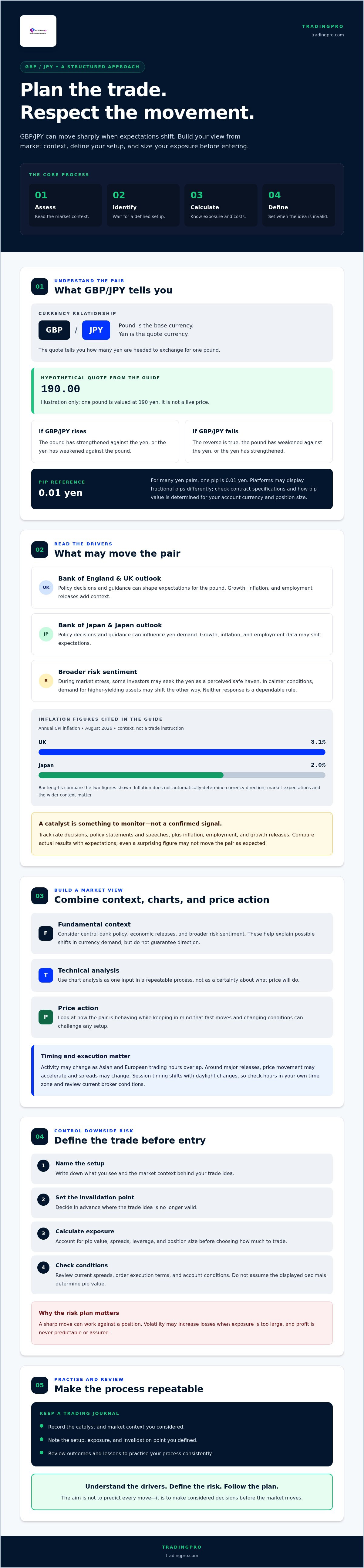
GBP/JPY is the exchange rate between the British pound and the Japanese yen. It tells you how many yen are needed to exchange for one pound. GBP is the base currency and JPY is the quote currency, so the pound comes first and the yen second.
For example, a hypothetical GBP/JPY quote of 190.00 means one pound is valued at 190 yen. This is an illustration, not a live price. Like other currency pairs in the foreign exchange market, GBP/JPY shows one currency’s value against another. The quote changes as buyers and sellers respond to new information.
How to Read a GBP/JPY Quote and Measure a Pip
Read the quote as yen per pound. If it rises, the pound has strengthened against the yen, or the yen has weakened against the pound. If it falls, the reverse is true.
A pip is a standard unit for measuring a currency pair’s price movement. For many yen pairs, one pip is 0.01 yen, though platforms may display fractional pips and decimal places differently. Before calculating a trade, check your broker’s contract specifications and confirm how pip value is determined for your account currency and position size. Don’t assume the displayed decimals tell you how much a pip is worth.
Why GBP/JPY Can Be a Fast-Moving Currency Pair
GBP/JPY can react to changing expectations for both the UK and Japanese economies. Traders may reassess the pound or yen when new information changes the outlook for growth, inflation, employment, or interest rates. A shift in expectations about either central bank’s policy, for example, may alter demand for its currency and move the pair.
Price activity can also vary across market sessions as participation and liquidity change. Active periods may bring more movement, while thinner conditions can affect how smoothly orders are filled. Economic announcements and unexpected headlines can accelerate price changes in either direction.
That movement may create trading opportunities, but profit is never predictable or assured. A sharp move can work against a position, and volatility may increase losses if your exposure is too large. Understanding the pair is only the first step in learning how to trade GBP/JPY. Build your analysis around a clear plan and decide how much risk you’re prepared to take before entering.
How UK and Japanese Market Drivers Shape GBP/JPY
GBP/JPY reflects shifting expectations for two economies, not just movement on a chart. The Bank of England sets UK monetary policy, while the Bank of Japan shapes policy in Japan. Their decisions and guidance can influence expected interest-rate differences, which may affect demand for the pound and yen. The Bank of Japan outlines its goals and approach in its guide to Bank of Japan's monetary policy.
Economic releases add context. Stronger-than-expected growth or employment data may support a currency if traders think it strengthens the outlook or changes the likely path of interest rates. Inflation can influence expectations for central bank action, but the relationship isn’t automatic. High inflation, for example, could support a currency if it prompts expectations of tighter policy, or weigh on it if markets focus on economic strain.
Risk sentiment matters too. During periods of market stress, some investors may seek the yen as a perceived safe-haven currency, potentially adding pressure to GBP/JPY. In calmer conditions, demand for higher-yielding assets may shift the other way. Treat this as a possible influence, not a dependable rule: the response depends on the wider market context.
Which UK and Japan Economic Releases Should Traders Track?
Watch inflation, employment, and growth releases, along with central bank rate decisions, policy statements, and speeches. The latest figures cited here show UK annual CPI inflation at 3.1% in August 2026, while Japan’s was 2.0%. These figures are context, not a trade instruction. Check an up-to-date economic calendar before planning around an announcement, and compare actual results with market expectations. Positioning and prior expectations can shape the reaction, so even a surprising figure may not move the pair as expected.
A scheduled catalyst is an event to monitor, not a confirmed trading signal. Use it to prepare scenarios, not to assume direction.
How Trading Sessions and News Events Affect Trade Timing
Market activity may change as Asian and European trading hours overlap, bringing participants from both regions into the market. Session timing shifts with daylight changes, so check the hours in your own time zone rather than relying on a fixed schedule.
Around major releases, price movement can accelerate and spreads may change. Check your broker’s current trading conditions, including spreads and order execution terms, before planning an entry. This is a practical part of learning how to trade GBP/JPY with more structure. If you’re comparing account options, review the registration details and confirm instrument availability and account conditions before deciding.
How to Analyse GBP/JPY Before Choosing a Trade Direction
Build your view from several inputs, not one signal. Technical analysis helps map chart structure, fundamental context frames what may influence the pound and yen, and price action shows how buyers and sellers are responding now. Together, these tools can help you form a scenario. None can tell you with certainty where GBP/JPY will go next.
| Input | What it can show | Limitation |
|---|---|---|
| Technical analysis | Trends, potential support or resistance, and areas to watch for a setup. | Patterns can fail, especially when new information shifts market conditions. |
| Fundamental context | Economic or policy factors that may influence demand for GBP or JPY. | Markets can price in expectations before a release, and reactions may differ from the headline. |
| Price action | How price behaves around a level, such as pausing, rejecting it, or moving through it. | A short-term move can be noisy and doesn’t confirm what will happen next. |
Use Chart Structure Without Treating Indicators as Predictions
Choose your chart timeframe first, then mark potential decision areas that make sense on that view. On a hypothetical chart, a series of higher swing highs and higher swing lows may suggest an uptrend. A price area where the market has repeatedly stalled could be marked as potential resistance. These are illustrative observations, not guarantees that price will behave the same way again.
Indicators can help organize information, but they summarize past or current data. A moving average may describe recent trend direction, for instance, while an oscillator may show momentum. Neither reliably predicts the next move on its own. Treat indicators as supporting context, then check whether price action and your broader analysis align.
Combine the Chart with a GBP/JPY Economic Calendar
Before assessing a chart setup, check an up-to-date calendar for scheduled UK and Japanese releases. A setup that looks clear technically may be disrupted by a central bank announcement or important economic data. Decide in advance how you’ll respond: wait until the event passes, reduce exposure if that fits your plan, or skip the trade if the uncertainty exceeds your risk limits.
This is a practical foundation for how to trade GBP/JPY: build a case, look for conflicting evidence, and stay selective. Use charting tools to support your analysis, but check their current features before relying on any specific capability. A tool can support your process; it can’t replace a reasoned decision.
How to Build a GBP/JPY Trade Plan and Control Risk
A trade plan turns analysis into decisions you can make before price starts moving. Use this sequence to define the idea, limit potential loss, and know when to stand aside:
- Identify the context. Note the chart structure, relevant UK or Japanese events, and why a setup may form. State what would support your trade idea.
- Define invalidation. Decide what price behaviour would show that your reasoning is no longer valid. Place a stop-loss in line with that point and your plan, not at an arbitrary pip distance.
- Calculate exposure. Set your maximum acceptable loss first. Use the stop distance and broker-confirmed pip value to work out a position size that fits that limit.
- Review before entry. Check upcoming news, spread and execution conditions, and whether the trade still meets your rules. If it doesn’t, skip it.
Set Entry, Exit, and Invalidation Conditions Before Trading
Write down why you’d enter, what would invalidate the idea, and how you intend to exit if the trade moves as planned. That planned exit is different from reacting emotionally to every short-term fluctuation. A stop-loss can help manage risk, but it may not execute at the requested price during volatile conditions, so the final loss can differ from the amount you planned.
Choose Position Size and Decide When to Skip a Setup
Position size depends on both the loss you’re willing to accept and the distance from entry to stop. In a hypothetical example, suppose a trader sets a maximum loss of $25 and the stop is 50 pips away. The position must be sized so each pip is worth no more than $0.50 in the account currency, before allowing for costs or slippage. That’s a risk calculation, not a recommended risk level. Check your broker’s contract specifications and pip-value calculation before converting it into units or lots.
Leverage magnifies both gains and losses. A position that’s too large can accelerate account drawdown, so don’t use available leverage as a target for position size. When learning how to trade GBP/JPY, discipline also means passing on a setup when:
- Important event risk is unclear or outside your plan.
- Trading conditions, such as spreads or execution, don’t suit the setup.
- Your entry confirmation is missing, or the invalidation point can’t be defined.
Build your plan before you act. If you’d like to explore TradingPRO, review the registration options and confirm current instrument availability and account conditions before deciding.
How to Practise GBP/JPY Trading and Choose Your Next Step
Build consistency before considering live exposure. Practise the same written process each time: assess the market context, record the setup, define invalidation, calculate planned risk, and decide whether to enter or stand aside. Repeating those steps helps reveal whether you’re following a method or making decisions on impulse.
A practice trade isn’t proof that a strategy will work in live conditions. Use it to test whether your decisions follow your rules and identify where your process needs attention. Keep the method consistent enough to review fairly, including the same entry criteria and risk limits.
Review a GBP/JPY Practice Journal for Repeatable Decisions
For each trade, record the setup, the catalyst you were watching, planned risk, outcome, and one lesson. Then note whether you followed your planned entry, invalidation point, and risk limit. Review a meaningful sample of decisions rather than drawing conclusions from one winning or losing trade. Look for process errors, such as entering without confirmation or changing a stop out of fear. A journal can improve awareness, but it can’t promise future performance.
Explore an Account Only After Checking Its Trading Conditions
Choosing an account is separate from deciding whether a GBP/JPY setup is suitable. TradingPRO’s Rookie Account is its primary account offering, but GBP/JPY availability and account specifications should be confirmed directly with the broker. Before choosing an account, verify the pair’s availability, trading costs, account terms, and applicable regional entity.
Keep risk at the centre of the decision. Live trading involves the possibility of loss, and practising doesn’t remove that risk. Stand aside if the setup, conditions, or potential downside don’t fit your plan. That distinction is central to learning how to trade GBP/JPY with discipline: choose the trade on its merits, and choose an account only after checking its terms.
If you’ve reviewed the conditions and want to explore TradingPRO further, visit the registration page. Registration isn’t a signal to trade; assess suitability and risk before placing any order.
Take Your GBP/JPY Plan One Step Further
Learning how to trade GBP/JPY starts with understanding what can move the pair, then putting your analysis into a repeatable process. Check economic catalysts alongside chart structure, define what would invalidate your trade idea, and calculate your exposure before entering. Practise the same rules consistently and use a journal to review your decisions, not just the outcome of one trade.
Keep account selection separate from trade selection. TradingPRO offers Rookie, Micro, Pro, and Scalp account tiers, as well as social and copy trading. Before choosing an account or considering a live trade, verify current terms for your region, associated costs, and whether GBP/JPY is available. These checks matter, and no account or tool can remove trading risk or guarantee results.
Ready to explore TradingPRO’s account options? Visit the registration page and review the details carefully before making a decision.
Frequently Asked Questions
Is GBP/JPY suitable for beginner traders?
GBP/JPY can be challenging for beginners because its price may move sharply, especially around economic news. You can study it in practice, but learn how quotes, pips, position size, and stop orders work before considering live exposure. Start with a written plan and practise following it consistently. If you can’t define your potential loss or explain why a setup fits your rules, stand aside.
What is the best time to trade GBP/JPY?
There’s no single best time for every trader or setup. Activity may change during Asian and European market hours, including when those sessions overlap, but conditions vary. Check an economic calendar for relevant UK and Japanese announcements, then confirm session times in your own time zone. Daylight changes can affect those times. Compare activity and trading conditions with your own plan instead of assuming a particular session guarantees better opportunities.
How many pips does GBP/JPY move in a day?
GBP/JPY doesn’t have a fixed daily pip range. Its movement changes with market conditions, session activity, economic releases, and unexpected news. Check a chart or reliable market-data source for the period you’re analysing, and make sure you understand whether the measurement uses highs and lows or another method. Don’t treat a historical average as a promise of future movement or a substitute for setting risk.
How do I calculate position size when trading GBP/JPY?
Start with the maximum amount you’re prepared to lose, then measure the distance between your planned entry and stop-loss. Divide the acceptable loss by the loss per unit at that stop distance to estimate position size. Confirm the pair’s pip value, contract size, account currency conversion, and costs with your broker. The calculation is only an estimate, since execution can differ from the requested price, particularly in volatile conditions.
Does GBP/JPY react to Bank of England and Bank of Japan decisions?
Yes. Bank of England and Bank of Japan decisions can influence expectations for interest rates and the economic outlook, which may affect demand for the pound or yen. The market response isn’t always straightforward: traders may have anticipated a decision or may focus on policymakers’ guidance rather than the headline rate. Check what markets expected before the announcement and treat the reaction as uncertain, not as a guaranteed directional signal.
Can I trade GBP/JPY during economic news releases?
Trading during a release is possible if your broker permits it, but fast price changes can increase execution risk. Spreads may widen, orders may fill at a different price than requested, and a stop-loss may not limit a loss to its planned amount. Check the release calendar and your broker’s conditions first. If event risk exceeds your plan, waiting or skipping the trade is a disciplined choice.
What should I check before placing a GBP/JPY trade?
Before placing a trade, check the setup, relevant UK and Japanese events, entry conditions, invalidation point, stop-loss, and maximum acceptable loss. Calculate position size using broker-confirmed pip value and review spreads, contract specifications, and order terms. This is the core of how to trade GBP/JPY with a structured process. Also confirm the pair is available through your chosen broker and that its current terms apply to your region.


