




- Published on: 2026-09-22 09:30:55
How to Survive a Market Crash: The Complete Trader Survival Guide (2026)

Passive endurance during a market collapse isn't discipline; it's account suicide. When volatility spikes and liquidity evaporates, the paralyzing fear of a blown balance can freeze even disciplined traders in place. You watch green P&L turn violently red, agonizing over whether to hold through the drawdown or cut positions instantly. Knowing how to survive a market crash isn't about blind optimism or hoping for a quick rebound. It demands immediate, systematic execution before automated intraday margin liquidations take control of your capital.
We know how disorienting rapid market liquidations feel when execution speed is everything. True portfolio preservation requires institutional-grade precision rather than emotional guesswork. In this complete guide, you'll master actionable risk protocols, defensive position sizing, and capital defense mechanics to protect your trading portfolio during severe market shocks. We will walk through rapid emergency triage steps, dynamic margin defense, and the exact technical signals required to re-enter markets safely without catching falling knives.
Key Takeaways
- Master the mechanics of systemic liquidity depletion and learn how to survive a market crash by replacing panic with an institutional-grade emergency protocol.
- Enforce strict defensive position sizing and micro-lot precision to protect equity before automated intraday margin liquidations take effect.
- Deploy tactical multi-asset hedging strategies to neutralize net market exposure instead of passively holding through catastrophic drawdowns.
- Execute a disciplined five-step triage sequence to audit margin health, secure defensive cash buffers, and halt uncontrolled account bleed during peak volatility.
- Identify high-probability technical confirmation signals to redeploy capital confidently at liquidity bottoms without catching falling knives.
Understanding Market Crashes: Anatomy, Velocity, and Psychological Pitfalls
A true market crash isn't a slow, orderly downward drift. It is an abrupt, systemic liquidity shock where order book depth vanishes in seconds. Market makers instantly pull quotes, widening bid-ask spreads exponentially across multi-asset derivatives and spot markets. Passive investment theories urge participants to simply wait out the storm, but that logic fails when leverage is involved. Forced liquidations trigger cascading automated sell orders, obliterating accounts before retail traders can react. Knowing how to survive a market crash starts with understanding the mechanical violence of liquidity depletion.
Market Correction vs. Crash: Identifying Structural Breakdown
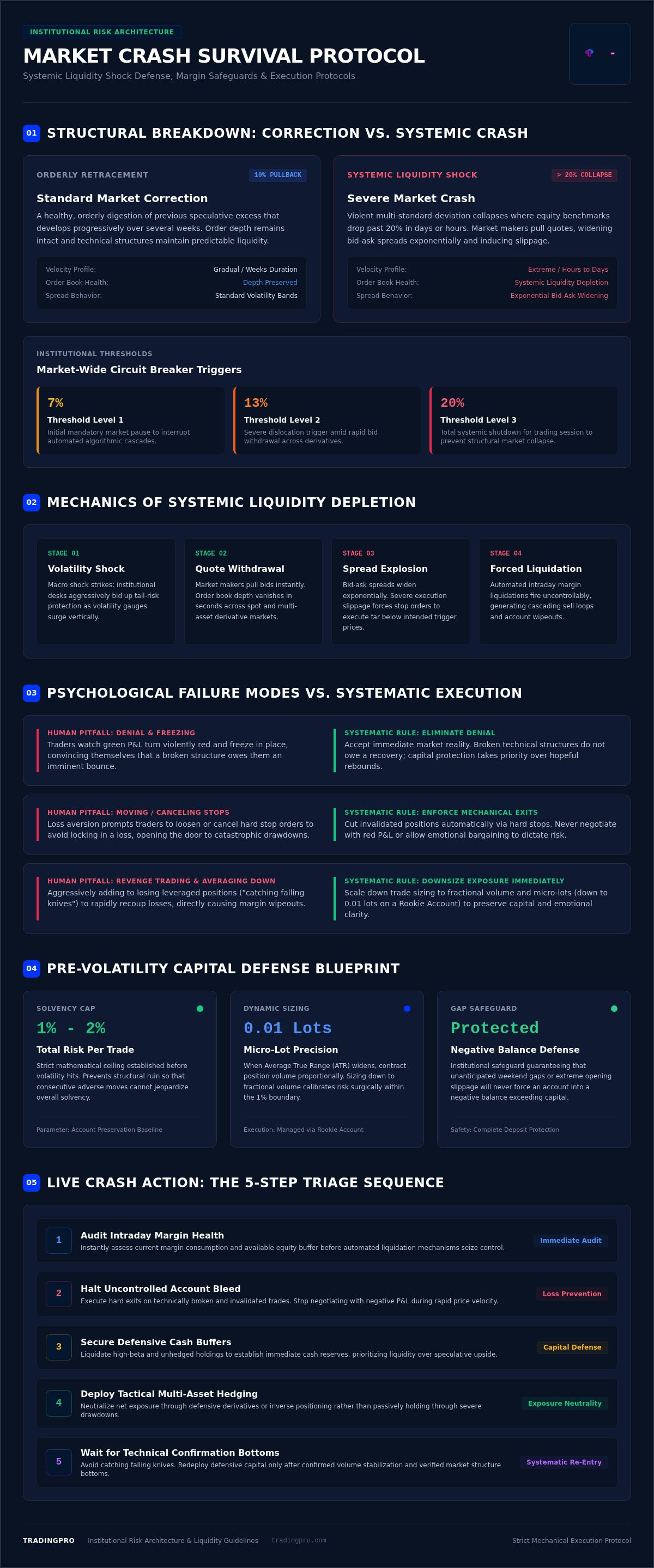
Standard corrections represent healthy 10% pullbacks that digest previous speculative excess over several weeks. Crashes, by contrast, are violent, multi-standard-deviation collapses. Equity benchmarks plunge past 20% within days or hours, frequently tripping Market-Wide Circuit Breakers at the 7%, 13%, and 20% thresholds. To track benchmark ETF performance and visual market movements during steep drawdowns, click here. Volatility gauges surge vertically as institutional desks aggressively bid up tail-risk protection. In these high-velocity drops, standard liquidity evaporates, causing severe execution slippage and rapid bid withdrawal across the entire financial ecosystem.
The Psychology of Panic: Why Traders Blow Up Accounts
Price velocity damages portfolios, but human psychology finishes the job. When a flash crash strikes, cognitive bias and acute loss aversion take over. Traders freeze. They watch capital evaporate, move or cancel protective stop-losses, and convince themselves that a sharp bounce is imminent. When prices drop further, panic turns into toxic revenge trading and reckless position averaging.
Survival requires systematic discipline that overrides emotional hesitation:
- Eliminate denial: Accept that broken market structures do not owe you an immediate recovery.
- Enforce mechanical exits: Cut invalidated positions automatically instead of negotiating with red P&L.
- Downsize exposure immediately: Scaling down to fractional volume, such as micro-lot sizing on a Rookie Account, preserves capital and emotional clarity when spreads widen.
Mastering how to survive a market crash means recognizing that account defense is your primary objective. When institutional panic strikes, automated discipline is the only thing standing between strategic survival and catastrophic liquidation.
Capital Defense: Core Risk Protocols to Implement Before Volatility Hits
Institutional risk architecture places capital defense ahead of profit generation. When market dislocation strikes, passive buy-and-hold advice leaves active portfolios completely vulnerable. Surviving an aggressive drawdown requires strict mathematical parameters established long before volatility hits the tape. Capping your total account risk per trade to 1% or 2% prevents structural ruin, ensuring consecutive adverse moves never threaten your overall solvency. Understanding how to survive a market crash begins with turning dynamic risk control into an uncompromised daily routine.
External volatility also brings overnight gap risks that standard stop orders cannot always contain. In fast-moving environments, choose broker infrastructure equipped with negative balance protection. This institutional-grade safeguard guarantees that unanticipated weekend gaps or extreme opening slippage will never force your account into a negative balance exceeding your deposited capital. Explore our forex trading for beginners guide to master technical entry and defense fundamentals across varied market conditions.
Dynamic Position Sizing and Fractional Lot Management
Never base your position size on gut feel or arbitrary cash allocations. Calculate trade volume strictly from the distance between your planned entry and technical invalidation level. When the Average True Range (ATR) widens, contract your position size proportionally. Implementing micro-lot precision down to 0.01 lots allows you to calibrate trade exposure with surgical accuracy, keeping total risk safely within your 1% threshold.
Managing execution through a dedicated Rookie Account provides the ideal framework to trade micro lots, helping you maintain defensive discipline while volatility surges across multi-asset markets.
Automated Stop-Loss Orders and Guaranteed Execution
Hard stop-loss orders eliminate hesitation when liquidity dries up mid-session. However, ordinary market stops can experience severe slippage during sharp circuit-breaker trading halts or liquidity air pockets. Protecting your balance requires advanced order awareness:
- Avoid predictable liquidity pools: Never plant your stops right at clean psychological numbers or obvious swing points where institutional hunting algorithms look for liquidity.
- Utilize dynamic trailing stops: Lock in unrealized gains systematically as rapid downward legs progress.
- Monitor intraday margin deficits: Keep maintenance margin buffers wide to prevent automated liquidation engines from flattening your trades prematurely.
Defensive execution requires reliable infrastructure. If you are ready to implement disciplined risk controls on high-speed execution tiers, open a live trading account to execute with precision in any market condition.
Active Defense vs. Passive Holding: Evaluating Modern Hedging Strategies
Wall Street wealth managers love telling clients to "stay the course" through severe drawdowns. For an unleveraged multi-decade fund, that philosophy might function. For active traders using leverage, that mindset leads directly to catastrophic wipeouts. When a market unravels, a 20% drop isn't an uncomfortable paper dip; it's an account-killing margin event. Discovering how to survive a market crash requires active defense rather than blind hope. Tactical multi-asset hedging neutralizes net market exposure, insulating your balance while undisciplined participants absorb systemic liquidation.
Hedging with Multi-Asset Instruments and Safe Havens
Institutional capital rotates rapidly during structural breakdowns. Shifting tactical focus toward safe havens like the US Dollar or Gold helps offset adverse equity swings. Simultaneously, opening short index contracts directly counterbalances paper losses on core holdings without requiring you to dump long-term assets at fire-sale bids. Watch correlation matrices carefully. In high-stress panics, historical correlations decouple as leveraged institutions sell whatever is liquid to satisfy cash demands.
The Reality of Leverage: Margin Calls and Forced Liquidation
Excessive leverage turns standard volatility into an existential threat. In volatile conditions, thin order books accelerate price slippage, draining usable margin at breakneck speed. Modern regulatory standards enforce real-time intraday margin deficit tracking. When equity breaches maintenance levels, broker liquidation engines step in instantly, dumping positions into weak market bids at the worst possible prices.
Neutralize balance-sheet risk using structured defense mechanisms:
- De-leverage aggressively early: Trim position sizing before projected volatility spikes drain your required maintenance margin.
- Distinguish direct shorting from synthetic hedges: Naked shorting introduces severe squeeze exposure, whereas structured hedges establish net-neutral stability.
- Treat liquidity as a tactical weapon: Unencumbered cash provides the operational freedom needed to hedge efficiently without triggering forced broker liquidations.
Executing an active defense keeps your capital intact while unhedged traders wash out. True survival requires treating your portfolio as a dynamic balance sheet that adapts instantly to market velocity.
The 5-Step Emergency Protocol: How to Navigate a Live Market Crash
Mainstream financial media often tells retail investors to look away and stop checking their screens when markets plunge. That head-in-the-sand tactic guarantees catastrophic liquidation for an active trader. Real portfolio survival requires an unemotional, repeatable action plan executed the moment liquidity snaps. Knowing how to survive a market crash demands operational triage, not passive avoidance. Monitor centralized market analytics using Trade Hub to track shifting volatility benchmarks and execute this five-step defense protocol immediately.
Steps 1 & 2: Audit Total Portfolio Exposure and Cut Toxic Leverage
First, calculate your aggregate margin utilization instantly across every open ticket. If your account margin usage exceeds 40% during a structural crash, you face severe risk of an automated stop-out. Second, eliminate toxic leverage without hesitation. Close unhedged high-beta trades and speculative positions immediately to reclaim equity. Tighten remaining stop levels to protect against overnight session gap-downs, accepting minor losses before they snowball into structural ruin.
Steps 3 & 4: Rotate to Defensive Cash and Establish Volatility Bands
Third, convert open equity directly into cash margin. Cash provides the ultimate operational freedom, creating an unshakeable cushion against widening spreads. Fourth, plot current Average True Range (ATR) metrics and dynamic volatility bands before clicking another order button. Liquidity air pockets generate violent, false counter-trend wicks. Never attempt to catch falling knives during peak unconfirmed liquidation sweeps.
Step 5: Define Rule-Based Structural Re-entry Triggers
Re-entry requires technical confirmation, not speculative hope. Step five enforces patience until the structural liquidation exhausts itself completely:
- Wait for multi-timeframe alignment: Require higher-timeframe market structure shifts before allocating fresh capital to long setups.
- Confirm institutional accumulation: Look for pronounced absorption volume signatures on daily candles, signaling smart money bid defense.
- Scale via micro-lot allocation: Rebuild exposure gradually using fractional lots rather than entering full-sized swing positions on the initial bounce.
Surviving systemic liquidation requires execution speed and institutional infrastructure. To deploy this disciplined protocol with multi-asset agility, register your live trading account and take control of your capital defense today.
Rebuilding and Capitalizing: Turning Market Downturns into Systematic Opportunity
Surviving a violent market shock does far more than safeguard your capital; it positions you to seize generational multi-asset rebound trends. While undisciplined participants absorb crushing losses and freeze, institutional desks view systemic liquidity resets as premier wealth-building windows. Learning how to survive a market crash is only the initial phase. Once selling climax exhaustion prints on the tape, executing a systematic rebuilding strategy transforms preserved capital into high-velocity growth.
Systematic Re-entry: Scaling In with Micro Lots
Never deploy recovery capital in an impulsive lump-sum entry. Professional traders divide speculative capital into staggered tranches, waiting for clear structural invalidation levels before committing funds. Deploying micro lots down to 0.01 size allows you to test emerging price structure with surgical precision, keeping risk exposure fractional while markets establish a reliable base.
Scale into high-conviction reversals only after confirming bullish divergence or aggressive absorption volume. Consult our comprehensive best broker for rookie traders guide to discover trading infrastructure engineered for fine-tuned micro-lot risk control and razor-thin execution latency.
Copy Trading: Replicating Resilient Strategies Through Drawdowns
Rebuilding your portfolio equity after a severe shock doesn't mean you have to navigate post-crash volatility alone. Modern multi-asset platforms provide seamless access to Social Trading and Copy Trading ecosystems, letting you mirror vetted strategy managers who demonstrated audited capital defense throughout the downturn.
Replicating battle-tested strategies provides immediate operational advantages:
- Eliminate emotional second-guessing: Automated execution follows predefined risk parameters without fear or hesitation.
- Analyze crisis performance: Filter strategy managers by drawdown resilience and real-time risk-adjusted returns rather than pure raw profit.
- Diversify tactical exposure: Allocate capital across multiple uncorrelated trading styles, from conservative multi-asset hedging to agile scalping.
Review our social trading vs copy trading breakdown to choose the optimal mirror execution setup for your trading objectives. When you know how to survive a market crash and execute a methodical comeback plan, market liquidations stop being threats and start becoming your greatest competitive edge.
Master the Liquidity Shock: Execute Capital Defense with Precision
Market crashes aren't anomalies to fear; they're structural resets that test the integrity of your risk framework. True longevity in active trading doesn't come from wishing away volatility. Knowing how to survive a market crash boils down to absolute execution discipline: neutralizing toxic leverage, establishing strict fractional stops, and scaling into confirmed reversals with patience.
Equip your trading arsenal with institutional architecture built for severe turbulence. TradingPRO backs your strategy with robust negative balance protection, ensuring rapid gaps never exceed your deposited capital. Deploy micro-lot trading starting at 0.01 lots for surgical risk control, or access an integrated Copy Trading ecosystem showcasing audited trader track records to mirror proven risk managers during high-stress cycles.
Take command of your capital before the next liquidity shock hits the tape. Trade with institutional discipline on TradingPRO and turn market volatility into your ultimate edge.
Frequently Asked Questions
How much cash margin should I hold during periods of extreme market volatility?
Maintain an unencumbered free margin buffer of at least 60% to 70% of your total account equity. High cash allocations absorb sudden spread widening and unexpected volatility spikes without threatening your maintenance thresholds. Keeping substantial cash reserves ensures you avoid forced broker liquidations while preserving buying power to deploy once conditions stabilize.
Is it better to hedge an existing trade or close the position completely during a crash?
Closing the position entirely is generally superior for retail traders unless you operate a pre-tested, market-neutral hedging model. Hedging requires managing two opposing positions simultaneously, which doubles transaction costs and increases margin consumption as bid-ask spreads widen. Mastering how to survive a market crash means eliminating unhedged risk immediately rather than complicating underwater trades with synthetic overlays.
What is the difference between a margin call and a stop-out during rapid liquidations?
A margin call serves as a formal broker warning that your account equity has dropped below the maintenance requirement, signaling you to deposit funds or cut exposure. A stop-out occurs when equity breaches the broker's minimum threshold, triggering an automated engine that forcibly liquidates open positions at prevailing market bids to protect the brokerage from systemic deficits.
How does negative balance protection safeguard my trading account when markets gap down?
Negative balance protection acts as an automated risk cap, ensuring your account losses never exceed your deposited capital. If an extreme market dislocation causes an asset to gap over your stop-loss level, your balance might drop below zero. Your broker's risk architecture absorbs the negative differential and resets your balance to zero, preventing outstanding legal liabilities.
Can retail traders profit from market crashes without physical share ownership?
Yes, retail traders can actively speculate on declining asset prices using derivative contracts rather than physical share ownership. By opening short positions on index contracts, commodities, or currencies, you speculate purely on downward price movement. Knowing how to survive a market crash involves recognizing that falling asset prices offer symmetric profit opportunities when managed with disciplined lot sizing.
How do I know when a market crash has officially formed a confirmed bottom?
A confirmed market bottom forms when higher-timeframe charts print clear structural shifts, characterized by higher lows and successful breaks of market structure. Look for a dramatic contraction in the Average True Range alongside heavy institutional absorption volume on daily candles. Waiting for these exhaustion patterns eliminates premature entries and prevents you from catching falling knives.


