



- Published on: 2026-09-27 06:24:05
How to Start Forex Trading in 2026: A Beginner’s Step-by-Step Guide

Your first forex trade shouldn’t be your first real test of risk. If you’re learning how to start forex trading, focus first on understanding how trades work, setting clear limits, and knowing what you’re agreeing to before putting real money at risk.
Currency pairs, spreads, margin, and leverage can feel like a lot at first. A step-by-step approach makes it easier to see how they affect a trade’s size and cost. This guide explains the essential terms, shows how to practise before trading live, and outlines a routine for managing risk. You’ll also find practical criteria for comparing accounts, including costs, leverage, terms, and suitability for your needs. Use the checklist to prepare, not as a promise of quick returns.
Key Takeaways
- Learn how to start forex trading by understanding currency pairs and how exchange rate changes affect a position.
- Build skills in stages: learn key terms, observe a pair, plan a hypothetical trade, and review the outcome.
- Compare account terms, costs, instruments, and platform access instead of relying on an account label alone.
- Prepare a trade plan with an entry condition, an invalidation point, an exit plan, and a defined maximum acceptable loss.
- Review your readiness and current account terms before considering TradingPRO’s Rookie Account.
How to Start Forex Trading: Understand the Market Before You Begin
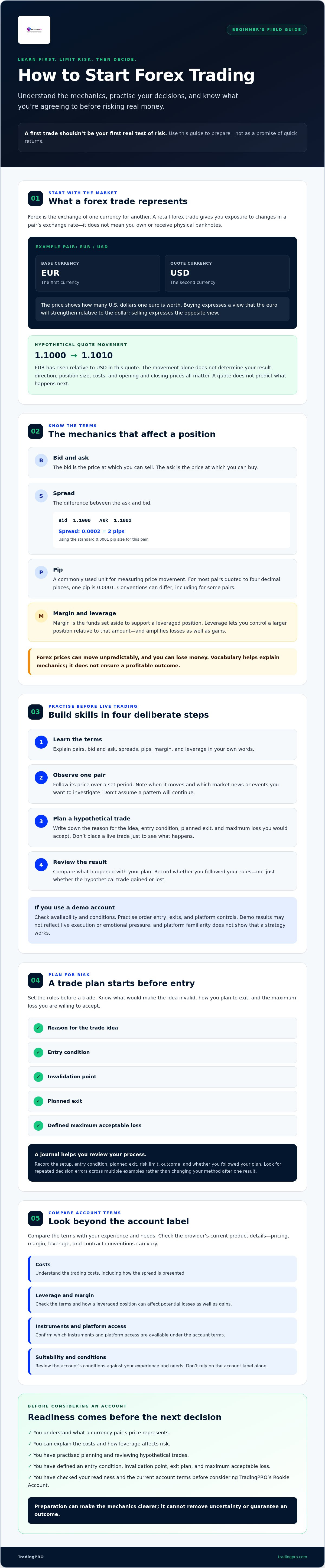
Forex is the exchange of one currency for another. A retail forex trade gives you exposure to changes in a currency pair’s exchange rate. It doesn’t mean you own or receive physical banknotes. The Foreign exchange market overview explains the market’s participants and history. As a beginner, start by understanding what a pair’s price represents and how trading costs and leverage affect a position.
What happens when you trade a currency pair?
A currency pair compares two currencies. The first is the base currency; the second is the quote currency. In EUR/USD, EUR is the base and USD is the quote, so the price shows how many U.S. dollars one euro is worth. Buying the pair expresses a view that the euro will strengthen relative to the dollar. Selling expresses the opposite view.
For example, if a hypothetical EUR/USD quote moves from 1.1000 to 1.1010, the euro has risen in value relative to the dollar in that quote. The movement alone doesn’t determine your result. Trade direction, position size, costs, and the prices at which you open and close the position all matter. A quote does not predict what happens next.
Which forex terms should beginners learn first?
Learn these terms before placing an order. Quoting conventions and contract details can vary by provider, so check the product terms.
- Bid and ask: The bid is the price at which you can sell; the ask is the price at which you can buy.
- Spread: The difference between the ask and bid. If EUR/USD shows a bid of 1.1000 and an ask of 1.1002, the spread is 0.0002, or 2 pips using the standard 0.0001 pip size for this pair.
- Pip: A commonly used unit for measuring price movement. For most pairs quoted to four decimal places, one pip is 0.0001. Conventions can differ, including for some pairs.
- Margin and leverage: Margin is the funds set aside to support a leveraged position. Leverage lets you control a larger position relative to that amount, amplifying losses as well as gains.
Forex prices can move unpredictably, and you can lose money. Knowing the vocabulary helps you understand the mechanics, but it doesn’t ensure a profitable outcome. As you learn how to start forex trading, focus on how a position behaves, what it costs, and how much you could lose. Check the provider’s current terms rather than assuming how its pricing, margin, or leverage works.
Build Forex Skills Before Trading: Practice, Observe, and Record
Learning the terms is only the beginning. Build a routine that lets you test your decisions without treating a short run of results as proof that a strategy works. For a broader introduction, read this forex trading for beginners guide, then apply what you learn step by step.
How can a beginner practise forex trading?
Use this sequence to turn learning into deliberate practice:
- Learn the terms. Make sure you can explain pairs, bid and ask prices, spreads, pips, margin, and leverage in your own words. Forbes offers an overview of how currency trades work.
- Observe one pair. Follow its price over a set period. Note when it moves and which market news or events you want to investigate. Don’t assume a price pattern will continue.
- Plan a hypothetical trade. Write down the reason for the idea, the condition for entry, the planned exit, and the maximum loss you would accept. Don’t place a live trade just to see what happens.
- Review the result. Compare what happened with your plan. Record whether you followed your rules, not just whether the hypothetical trade gained or lost.
If a provider offers a demo account, check whether it’s available to you and review its conditions before using it to practise. Use it to learn order entry, exits, and platform controls. Familiarity with a platform doesn’t show that a strategy works. Demo results may not reflect live trading conditions, including execution and emotional pressure.
What belongs in a simple trading journal?
Keep a record for every practice trade. Before entry, note the setup, why it interests you, the entry condition, planned exit, and risk limit. Afterward, record the outcome and whether you followed your plan.
Review your journal regularly for repeated decision errors, such as entering without a clear condition or moving an exit without a reason. Look for patterns across multiple examples instead of changing your method after one result. A journal won’t remove uncertainty, but it can help you make your process more consistent as you learn how to start forex trading.
When you’re ready to explore an account, you can review TradingPRO’s registration process. Check the current terms and your suitability before taking any further step.
Choose a Forex Account by Comparing Terms, Risk, and Your Experience
An account name may sound informative, but it doesn’t tell you what trading will involve. If you’re learning how to start forex trading, compare the current terms that affect access, costs, and risk. Check the provider’s information for your jurisdiction before deciding, as availability and conditions can differ by region.
What should beginners check before opening a forex account?
Use this framework to guide your research. Verify each detail in the provider’s current account information and legal disclosures rather than assuming it applies everywhere.
Account minimums: The required starting amount affects access and how much capital you commit. Ask: What minimum applies to this account in my region?
Spreads and commissions: These can affect the cost of opening and closing trades. Ask: How are costs charged, and where are they disclosed?
Instruments: Available markets may vary by account and jurisdiction. Ask: Which currency pairs and other instruments can I access?
Platform access: Tools and functions can differ between providers or account types. Ask: Which platform and order functions are included, and can I use them where I live?
Legal and risk terms: The contracting legal entity, client eligibility, execution terms, and risk disclosures matter. Ask: Which entity would serve me, and what protections and risks do its disclosures describe?
Don’t assume a minimum deposit, leverage level, or protection based on a general description. Verify the details in current disclosures for the specific account and your location.
Is a Rookie Account the right starting point?
TradingPRO offers a Rookie Account alongside Micro, Pro, and Scalp accounts. The Rookie Account is an option to investigate, not a universal recommendation. Review its details and verify eligibility, minimum deposit, instruments, fees, leverage, platform access, and regional availability before deciding. Don’t infer features from the account name.
Compare the verified terms with your experience, objectives, and ability to absorb losses. If you can’t explain a fee or risk condition, pause and get clarity before proceeding. For foundational learning before comparing accounts, revisit a forex trading for beginners guide and use it to identify any concepts you still need to understand.
Plan Your First Forex Trade with a Risk-First Checklist
A trade plan turns an idea into a set of decisions you can review. Write it before entering, while you’re calm. If you can’t explain why you’re considering the trade or what would make you exit, pause. It’s better to skip a trade than to enter with unclear risk.
How do you create a basic forex trade plan?
Use this checklist before placing an order:
- Thesis: Why are you considering this pair and direction? State the idea plainly without treating it as a prediction.
- Entry condition: What needs to happen before you enter? Define a condition instead of chasing a sudden price move.
- Invalidation point: What price movement or change in your reasoning would show that the idea is no longer valid?
- Exit plan: Decide in advance how you’ll close the trade, whether or not the original idea still holds. Don’t improvise solely in response to market pressure.
- Maximum acceptable loss: Set the most you’re prepared to lose on the position, then check that the position size fits your limit.
A risk limit is a boundary for how much you’re willing to risk on a trade, not a guarantee of the exact loss you’ll incur. Fast price movements, gaps, execution conditions, and other factors can affect the final result.
Position size should reflect both your planned risk and the distance between entry and the point where your trade idea is invalidated. A wider stop distance generally means a smaller position is needed to keep planned risk within the same boundary. Confirm the instrument’s pip value and contract details before calculating size. Spreads add to trading costs, volatility can move prices quickly, and leverage can magnify gains and losses. Verify how these mechanics apply to the specific account and instrument.
How can beginners avoid common first-trade mistakes?
Keep your process steady. Don’t increase exposure to recover a loss, and don’t copy another trader’s position without understanding its risks, sizing, and exit decisions. Avoid trading money needed for essential expenses or relying on borrowed funds. If a potential loss would affect your financial security, step back.
Judge your decisions across a series of trades, not by one winning or losing outcome. Review whether you followed the plan, whether the risk was clear, and what you’d repeat or change next time. If the plan or risk still feels uncertain, skip the trade.
When you’re ready to review your next steps, explore TradingPRO registration and check the current account terms before proceeding.
Take the Next Step: Review TradingPRO’s Rookie Account and Terms
Before moving from practice to a live account, pause for a readiness check. You should be able to explain the core forex terms, have practised hypothetical trades, written down your risk rules, and reviewed the account terms that apply where you live. If any step is incomplete, keep learning before committing funds. A careful process is a stronger starting point than rushed registration.
What to verify before registering with a broker
TradingPRO offers a Rookie Account as one option to investigate. Its name alone doesn’t establish whether it suits your experience or objectives. Read the current account terms and disclosures for the specific TradingPRO legal entity that would serve you, then confirm the details directly before registering.
- Jurisdiction and eligibility: Check whether the account is available to you and what conditions apply.
- Costs and account conditions: Confirm applicable spreads, commissions, minimums, and other charges in the current disclosures.
- Instruments and platform: Verify which instruments and platform functions you can access in your region.
- Risk disclosures and protections: Read the relevant warnings and terms. Don’t assume features or protections are identical across regions or account types.
If a term is unclear, resolve it before proceeding. Revisit the foundational forex concepts and strengthen any gaps before making an account decision. Learning how to start forex trading means checking the details, not relying on an account label or brief description.
How to keep learning after choosing an account
Choosing an account doesn’t replace preparation. Continue practising and journaling, and review your decisions before increasing trading activity. Track whether you followed your plan, how costs and price movements affected the trade, and whether the risk stayed within your written limits. A series of thoughtful reviews can reveal more than a single outcome.
Registration is an administrative step, not evidence that you’re ready to trade or a guarantee of trading success. If you’ve completed the checks and want to review the next step, review the registration options. Confirm the current terms and your suitability before proceeding.
Move Forward with a Clear Forex Trading Plan
Knowing how to start forex trading means more than learning currency pair terms. Build skills through structured practice, compare current account terms for your region, and write down your trade idea, exit plan, and acceptable risk before considering an order. If a cost, feature, or risk condition is unclear, pause and verify it.
TradingPRO offers Rookie, Micro, Pro, and Scalp account tiers. Its Rookie Account may be one option to research, but check eligibility, costs, instruments, leverage, and applicable disclosures before deciding. TradingPRO also offers Social Trading and Copy Trading. Verify current features and regional availability, and assess the risks rather than treating copying as a shortcut to results.
If you’ve completed your checks and want to explore the next step, review the registration options. Registration can’t guarantee trading success, and it doesn’t replace continued practice and careful risk management. Build your knowledge one considered decision at a time, and move forward only when the plan makes sense to you.
Frequently Asked Questions
Is forex trading suitable for complete beginners?
Beginners can learn how forex works, but trading involves meaningful risk and isn’t suitable for everyone. Start by learning key terms, practising without live trades where a suitable demo account is available, and reading account conditions before considering real-money trading. Preparation can help you make informed decisions, but it can’t guarantee a profit. Only consider risking money you can afford to lose, and pause if potential losses could affect essential needs.
How much money do I need to start forex trading?
There’s no universal starting amount. Requirements depend on the broker, account type, your region, and the applicable terms. Check the current account minimum and all relevant fees directly with the provider before deciding. A stated minimum is an access requirement, not a recommended amount or proof that the account suits your circumstances. Don’t trade with money needed for essentials, and consider whether you could absorb a loss without financial hardship.
Can I learn forex trading without risking real money?
Yes. Educational materials and a demo account, if a provider currently offers one, can help you learn platform basics and practise a trading process without placing a live trade. Use practice to rehearse entries, exits, and journaling. Simulated conditions may differ from live markets, so demo performance can’t prove future results. Check whether demo access is available to you and review its conditions. Keep a journal of practice decisions and outcomes.
What should I learn before placing my first forex trade?
Learn how currency pairs, bid and ask prices, spreads, pips, margin, and leverage work, and understand that a trade can lose money. Practise how to place and close an order, then write a plan that states your reason for trading, exit decisions, and risk boundary before entry. Verify the specific instrument and account terms with the provider. Trading mechanics can vary, so don’t assume every broker handles them identically.
How do beginners manage risk in forex trading?
Before entry, write down your trade rationale, the point that invalidates it, your exit plan, and the maximum loss you’re prepared to accept. Set position size according to planned risk and stop distance, and verify instrument-specific calculations and conditions. Stop orders and other risk controls can help structure a plan, but they don’t eliminate every risk or guarantee a particular execution price. If you can’t define the risk clearly, skip the trade.
Can I copy another trader instead of learning forex myself?
Social Trading or Copy Trading may let users follow or replicate other participants where those features are available, but they don’t remove market risk or guarantee results. TradingPRO offers Social Trading and Copy Trading. Check current features and regional availability before relying on them. Review a strategy’s history, drawdowns, costs, and settings, and understand how copied trades could affect your account. Keep learning and assess each decision rather than treating copying as a substitute for understanding risk.
How do I choose a forex broker as a beginner?
Choosing a broker is a key step in how to start forex trading. Compare the applicable legal entity, client eligibility, fees, available instruments, platform access, risk disclosures, and support. Confirm the current terms for your jurisdiction, and assess the information in official disclosures instead of relying on marketing claims alone. Account names don’t prove suitability. Compare verified features with your objectives, experience, and capacity to absorb losses before deciding.


