




- Published on: 2026-09-24 10:05:31
Hedging Strategies for Trading Portfolios: 2026 Guide

Hedging is not passive wealth insurance; it is active tactical risk engineering. Liquidating your highest-conviction positions every time macro volatility hits isn't risk management; it is a surrender of your edge. Deploying calculated hedging strategies for a trading portfolio empowers you to neutralize downside shocks while keeping your capital positioned for growth. You already know the sting of watching unrealized profits vanish during flash crashes, especially when holding conflicting positions that bleed balance through excessive carry fees and mismatched correlations.
You don't have to retreat to cash to protect your gains. In this guide, you will master institutional-grade tactical instruments across currencies, indices, and commodities to neutralize downside risk and trade volatility with total precision. We will dissect quantitative position-sizing frameworks, map precise cross-asset correlation models, and show you how elite traders maintain aggressive market exposure while keeping capital fully shielded.
Key Takeaways
- Explore institutional-grade hedging strategies for a trading portfolio to neutralize unexpected drawdowns without closing long-term core holdings.
- Deploy tactical shorting and cross-currency correlation models to build immediate, targeted risk shields across multi-asset markets.
- Calculate financing trade-offs, overnight swap rates, and spread impacts accurately to keep carrying costs from eroding your defensive gains.
- Implement a structured five-step execution blueprint to audit net market vulnerability and size your hedge ratios with quantitative precision.
- Leverage dynamic execution infrastructure and flexible account tiers to maintain optimal margin efficiency during periods of peak volatility.
What Is Portfolio Hedging and How Does It Protect Capital?
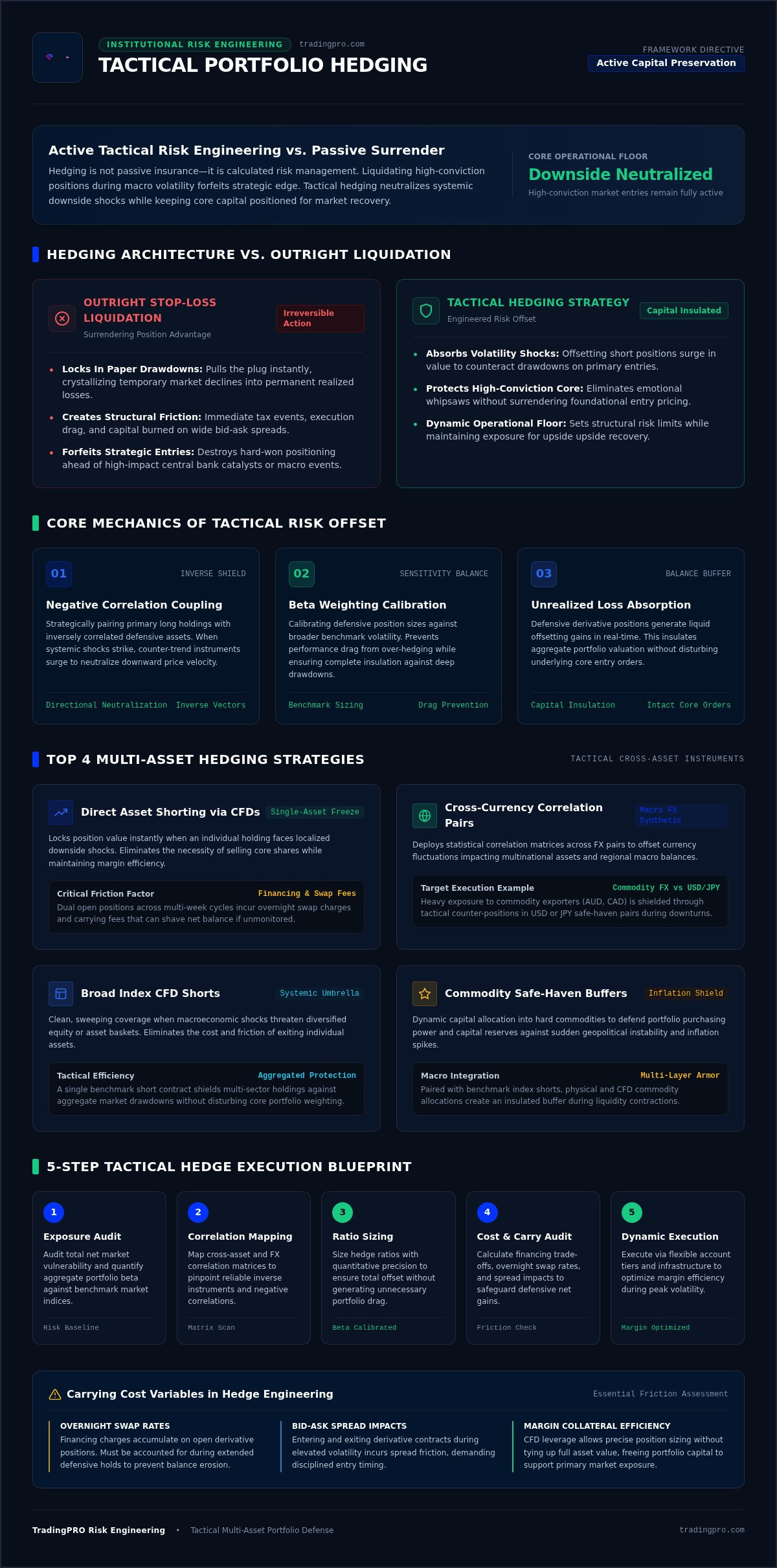
Mainstream finance often compares portfolio defense to buying homeowner's insurance. That passive analogy falls flat for dynamic traders. In high-velocity markets, institutional hedging functions as active risk engineering. You open strategically correlated, offsetting positions designed to neutralize adverse price action across your balance sheet. The goal isn't driving speculative home runs; it's absolute capital preservation. Executing systematic hedging strategies for a trading portfolio allows you to lock in an operational floor, dampening the fallout when macro volatility and geopolitical shocks shake global liquidity.
Stop-loss orders merely pull the plug. They trigger irreversible liquidation, turning temporary paper drawdowns into realized losses. Hedging operates differently: it insulates your risk profile while leaving your high-conviction positions active in the market.
The Core Mechanics of Risk Offset
- Negative Correlation Coupling: Pairing long positions with inverse instruments to neutralize abrupt downward price velocity.
- Beta Weighting: Calibrating position sizes relative to market sensitivity to prevent under-hedging or excessive drag.
- Unrealized Loss Absorption: Generating offsetting gains in derivative trades while keeping primary entries undisturbed.
Hedging vs. Outright Liquidation
Dumping positions ahead of key central bank meetings or high-impact reports introduces severe structural frictions. Liquidating creates instant tax burdens, burns capital on wide bid-ask spreads, and destroys hard-won entry points. Hedging sidesteps these penalties entirely. Maintaining strategic positions while deploying flexible hedging strategies for a trading portfolio lets you sidestep emotional whipsaws, insulate capital against flash crashes, and navigate macro volatility with surgical precision.
The Top 4 Hedging Strategies for Active Multi-Asset Portfolios
Traditional guides push passive index options, but active desks demand responsive instruments. Applying flexible hedging strategies for a trading portfolio across CFDs, foreign exchange, and physical commodities gives you precise, tactical control over downside exposure. By managing positions across these asset classes, you can neutralize specific risks without sacrificing overall market velocity.
- Direct CFD Shorting: Freezing drawdowns instantly on specific vulnerable holdings.
- Cross-Currency Hedging: Exploiting macroeconomic foreign exchange correlations.
- Broad Index CFD Shorts: Shielding diversified baskets against systemic sell-offs.
- Commodity Safe-Haven Allocations: Defending capital against sudden inflation spikes.
Direct Asset Shorting via CFDs
Direct shorting through Contracts for Difference (CFDs) locks your position value on command. If an individual asset faces localized downside, opening an equivalent short CFD position neutralizes price movement instantly. Margin efficiency lets you hedge without tying up excessive collateral. Keep a strict eye on overnight financing fees and swap charges, as carrying dual positions across multi-week cycles can gradually shave off capital.
Cross-Market and Currency Pair Hedging
Currency fluctuations directly impact international portfolio valuations. By analyzing statistical correlation matrices across major and minor currency pairs, you can build synthetic hedges that neutralize regional macroeconomic shifts. If you hold heavy exposure to commodity exporters like Australia or Canada, tactical counter-positions in USD or JPY pairs help insulate your capital against sudden commodity downturns. If you want to dive deeper into the mechanics of currency correlations, review our forex trading for beginners guide to build your baseline knowledge.
Index and Safe-Haven Commodity Buffers
Broad index CFDs offer clean, sweeping coverage when broad systemic shocks threaten multi-asset holdings. Rather than exiting individual positions across different sectors, executing a short position on a benchmark index CFD insulates your aggregate exposure. Pairing this with safe-haven commodities adds an extra layer of defense. Allocating dynamic capital to gold or crude oil counterbalances acute inflationary pressures and geopolitical panic.
Precision execution makes all the difference when market gaps threaten open trades. To protect your margin and streamline execution across diverse instruments, open a live trading account to deploy high-speed hedging strategies for a trading portfolio in real time.
Evaluating the True Cost and Trade-Offs of Hedging
Protection comes with friction. Hedging is never free; it trades away upside explosive potential to establish guaranteed downside containment. When implementing hedging strategies for a trading portfolio, amateur traders often make the fatal mistake of ignoring the carrying expenses. Over-hedging paralyzes performance, leaving you caught in self-canceling positions that generate negative yield while bleeding equity through account charges.
Every defensive maneuver carries quantifiable trade-offs. You must weigh these operational costs against the capital preserved:
- Opportunity Cost: Capping potential upside while the hedge remains active.
- Financing Frictions: Daily overnight swap debits slowly eroding defensive gains.
- Margin Consumption: Locking up available capital that could back other high-conviction trades.
Financing Frictions and Spread Drag
Carrying opposite positions across daily roll-overs triggers ongoing financing charges. When central bank interest rate differentials widen, holding leveraged counter-trades overnight can rapidly drain your account through swap fees. Enter a position during high-impact news releases, and bid-ask spreads expand aggressively, multiplying your entry friction. Tight operational execution protects your balance sheet from these hidden leaks. To see how low-latency platforms minimize transaction friction during rapid volatility, explore the mechanics outlined in our best trading infrastructure for scalping.
Margin Constraints and Capital Efficiency
Opening defensive positions locks up crucial free margin. If your account does not offer margin netting, holding simultaneous long and short exposure effectively doubles your required collateral. When sudden market spikes hit both legs of a cross-market trade, inadequate margin buffers can trigger immediate margin calls, closing positions prematurely before your defense can take effect.
Active risk management requires matching your strategy with an account structure engineered for institutional efficiency. Selecting tiers with dynamic leverage, such as the Pro Account or Scalp Account, gives you the breathing room needed to absorb intra-day volatility without threatening total balance integrity. Mastering efficient hedging strategies for a trading portfolio means balancing defensive coverage against financing overhead, keeping your active capital lean, shielded, and fully liquid.
How to Build and Execute a Tactical Portfolio Hedge: A 5-Step Process
Executing institutional-grade protection demands a repeatable mathematical framework. Leaving risk controls to intuition invites disaster during volatile liquidity events. Follow this structured five-step workflow to implement calculated hedging strategies for a trading portfolio with absolute precision:
- Audit Exposure: Aggregate total open holdings to isolate your net directional vulnerability.
- Select the Instrument: Choose an inverse asset with proven liquidity and tight spreads.
- Calculate Hedge Ratio: Derive the exact contract size required to match your baseline exposure.
- Define Exit Triggers: Establish technical indicators and volatility milestones for unwinding.
- Execute Swiftly: Route counter-orders through high-speed infrastructure to freeze balance drawdowns.
Quantifying Portfolio Exposure and Correlation
Start by calculating the net beta of your combined positions relative to the broader market. A diversified basket of long trades often shares hidden systemic vulnerabilities. Run a cross-asset correlation check to verify that your selected defensive instrument demonstrates a strong inverse relationship (ideally approaching -0.80 to -1.0) under elevated volatility conditions. Isolating your most exposed clusters ensures you hedge targeted risks without over-committing margin capital.
Calculating Hedge Ratios and Lot Sizing
Imprecise sizing destroys balance integrity. Sizing a hedge requires matching the nominal value and tick sensitivity of your core holding against the counter-instrument. Use this standard formula:
Hedge Ratio (HR) = (Portfolio Value * Beta) / Notional Value of Hedging Instrument
Adjust your lot allocation directly based on contract tick value differences to prevent accidental over-exposure. You can model these parameters and test lot adjustments using the analytics in the TradingPRO Trade Hub before deploying capital in fast-moving market environments.
Executing and Unwinding the Hedge
A hedge is a temporary shield, not a permanent anchor. Define clear technical levels to take profits on your counter-positions as macro shocks subside. When the primary trend resumes, scale out of your hedge incrementally rather than liquidating it all at once. Decisive execution prevents profit givebacks and protects your core entries.
Ready to deploy dynamic risk engineering? Take complete control of your capital by choosing to register an active account today and execute high-speed hedging strategies for a trading portfolio across global markets.
Optimizing Your Risk Infrastructure with TradingPRO
Execution speed separates successful portfolio defense from costly slippage. When market shocks trigger high volatility, delays of just a few seconds can distort your hedge ratios and compromise your balance. TradingPRO provides an institutional-grade, multi-asset trading environment engineered to execute rapid risk-containment strategies effortlessly. Paired with negative balance protection, this technical architecture ensures you maintain total control over your downside risk without unexpected slippage surprises.
Executing responsive hedging strategies for a trading portfolio requires infrastructure built for speed. TradingPRO empowers your tactical defensive maneuvers through focused engineering:
- Ultra-Fast Order Routing: Fills counter-positions immediately to freeze market drawdowns.
- Dynamic Margin Management: Preserves free margin across long and short positions.
- Negative Balance Protection: Safeguards trading capital against extreme market gap risk.
- Multi-Asset Coverage: Connects CFDs, currencies, and physical commodities under a unified architecture.
Selecting the Right Account Tier for Hedging
Every trading style demands a targeted operational setup. Novice traders can deploy micro-lot sizing to protect smaller balances using the Rookie Account. To understand foundational account sizing and leverage mechanics, review our guide to the best broker for rookie traders. For high-volume traders requiring maximum execution efficiency, Pro and Scalp accounts deliver ultra-tight spreads and flexible leverage. These institutional tiers eliminate unnecessary spread friction, allowing you to establish and unwind tactical hedges with complete cost control.
Automating Risk Through Social and Copy Trading
Active risk mitigation does not require sitting in front of screens all day. The TradingPRO Social Trading and Copy Trading ecosystem lets you benchmark and mirror the real-time execution models of veteran risk managers. Instead of manually auditing complex cross-asset correlations, you can automatically align your capital with proven strategies that actively neutralize downside exposure. Discover how these approaches compare by exploring our analysis of social trading vs copy trading.
Whether you choose to automate position shielding through Copy Trading or take direct manual control via high-performance account tiers, deploying advanced hedging strategies for a trading portfolio protects your hard-earned balance. Align your execution with TradingPRO infrastructure to neutralize downside volatility with total confidence.
Master Your Risk and Dominate Market Volatility
Tactical risk engineering transforms how you navigate turbulent markets. By quantifying portfolio beta, managing financing trade-offs, and executing precision offsets across multi-asset instruments, you protect your bottom line without liquidating your best ideas. Deploying calculated hedging strategies for a trading portfolio keeps you firmly in command when unexpected macro volatility shakes unprepared traders.
TradingPRO provides the high-performance infrastructure engineered for rapid risk containment. Take advantage of ultra-fast order routing designed to minimize slippage during volatile price shocks. Tailor your operational leverage across our dedicated Rookie, Micro, Pro, and Scalp account tiers, or replicate the protective playbooks of veteran managers directly through our integrated Social Trading network. Stop reacting to market drawdowns after the damage is done. Shield your capital with institutional-grade execution on TradingPRO today and execute every defense with absolute conviction.
Frequently Asked Questions
What is the primary difference between a stop-loss and a hedge?
A stop-loss order closes your trade completely, converting an unrealized paper loss into a permanent realized exit. A hedge keeps your core position active while opening a counter-position to absorb incoming downside. This structure allows you to protect capital during transient volatility without sacrificing strategic entry pricing or generating immediate tax and re-entry costs.
Can hedging completely eliminate trading losses in a portfolio?
No strategy eliminates all risk, but hedging neutralizes adverse price moves within specific parameters. Imperfect correlations, sudden basis shifts, and execution slippage can leave small residual exposures. Implementing structured hedging strategies for a trading portfolio aims to establish a defined downside floor, preventing catastrophic drawdowns while keeping balance fluctuations within strictly manageable boundaries.
How do correlation coefficients affect currency portfolio hedging?
Correlation coefficients measure how reliably two currency pairs move together on a scale from -1.0 to +1.0. A coefficient near -1.0 indicates a reliable inverse relationship, making it an ideal counter-weight for hedging open currency risk. Coefficients shift over time, so you must monitor rolling metrics to prevent your defensive pairs from suddenly decoupling during major central bank policy shifts.
Is direct hedging allowed on all retail trading platforms?
Direct hedging rules vary significantly depending on regulatory frameworks and platform architectures. Certain regional jurisdictions enforce strict First-In, First-Out (FIFO) rules that automatically prevent opening simultaneous opposite positions in the same instrument. Advanced multi-asset brokers bypass these friction points by providing account structures engineered to allow simultaneous long and short positions across diverse asset classes.
What are the primary costs associated with holding long-term hedges?
Financing rates represent the single largest expense of maintaining open defensive positions over extended horizons. Overnight swap fees debit your balance continuously, especially when holding positions across high interest-rate differentials. Secondary frictions include initial bid-ask spread charges on the defensive leg and additional margin allocation, which locks up deployable capital that could back other setups.
What is a hedge ratio and how do I calculate it accurately?
A hedge ratio determines the exact sizing needed to offset price movements in your primary holdings. You calculate it by multiplying your core portfolio value by its beta relative to the hedging instrument, then dividing that total by the hedging asset's notional contract size. Accurate ratios prevent under-hedging or excessive risk exposure across conflicting trades.
Can I use copy trading strategies as a portfolio hedge?
Yes, you can allocate capital to copy trading strategies specifically designed to run counter to your primary market bias. Allocating a portion of your funds to seasoned traders who specialize in short-bias setups or safe-haven commodities adds automated defensive diversification. This approach lets you balance your overall risk profile without manually managing additional counter-trend positions around the clock.


