




- Published on: 2026-09-29 01:34:06
Forex Trading with Small Capital: A Practical 2026 Guide

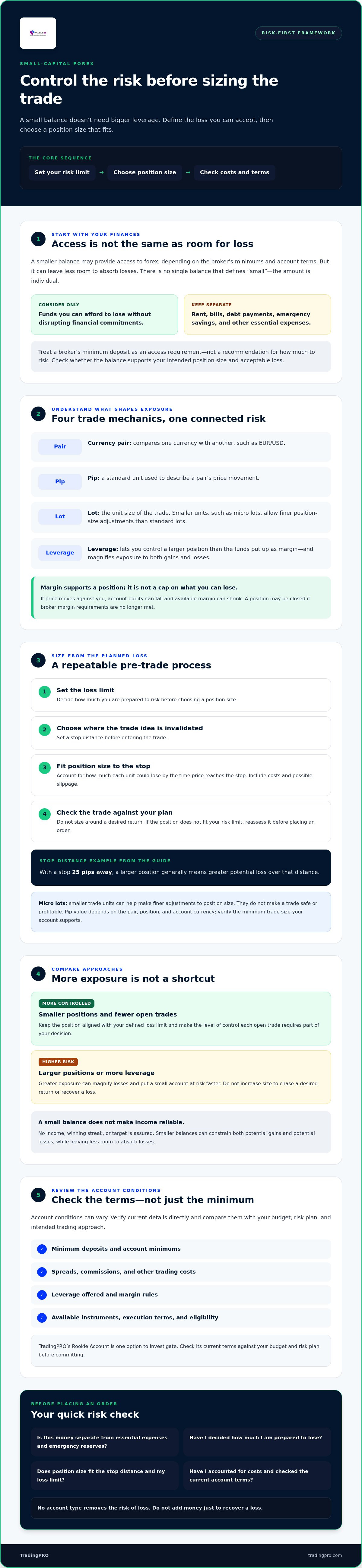
A small forex balance doesn’t need bigger leverage. It needs tighter control. Forex trading with small capital is easier to approach deliberately when each position is sized to a defined risk limit, rather than the maximum position a broker allows.
It’s reasonable to wonder whether your starting balance is enough. Lot sizes, margin, leverage, and trading costs can quickly feel confusing, and a small account leaves less room for mistakes. No account type can remove the risk of loss. Plan each trade before placing it: decide how much you’re prepared to risk, choose a position size that fits, and account for costs.
This 2026 guide provides a repeatable framework for assessing trades, explains how balance and leverage affect position sizing, and shows what to compare when reviewing account options. Check minimum deposits, spreads, commissions, margin rules, and available instruments rather than assuming they’re the same across accounts. TradingPRO’s Rookie Account is one option to investigate. Check its current terms against your budget and risk plan before committing.
Key Takeaways
- Forex trading with small capital is more manageable when you define your acceptable loss before choosing a position size.
- Understand how lot size, leverage, margin, and stop distance combine to shape a trade’s potential exposure.
- Compare smaller positions and fewer open trades with higher-risk approaches, including the level of control each requires.
- Use a pre-trade checklist to assess your budget, planned loss, and position size before placing an order.
- Review account minimums, trading costs, execution terms, and eligibility, then compare those conditions with your needs.
Can You Trade Forex with Small Capital? Set Realistic Expectations First
Yes, a smaller balance may provide access to forex trading, depending on the broker’s minimums and account terms. But access isn’t the same as having enough room to absorb losses. The foreign exchange market is where currencies are traded, and trading through a broker carries risk regardless of account size.
Forex trading with small capital means trading with an amount that limits your position size and capacity for loss relative to your personal finances and the broker’s terms. There’s no single balance that defines “small.” The right amount is individual and should never come from money needed for rent, bills, debt payments, emergency savings, or other essential expenses. Only consider funds you can afford to lose without disrupting your financial commitments.
What counts as small capital for forex trading?
Start with your own budget, not a headline deposit figure. A broker’s minimum deposit tells you only what may be required to open or fund an account. It doesn’t tell you whether the balance supports the position sizes your strategy requires or lets you keep potential losses within a personally acceptable limit.
Check both sides before deciding: what you can set aside without affecting essential expenses, and what the account’s trading conditions allow. Minimums and terms can vary by account and jurisdiction, so verify the current details directly. Treat the minimum as an access requirement, not a recommendation for how much to risk.
Can a small balance produce reliable income?
No income is assured. Currency prices can move against a position, and a small balance generally means less room to take losses and continue trading. It can also constrain position size, limiting potential gains as well as potential losses. Neither a winning streak nor an income target is guaranteed.
The pressure to grow a small balance quickly can tempt traders to use larger positions or more leverage than their plan supports. That can magnify losses and put the account at risk faster. Don’t size a trade around a desired return. First decide how much you’re willing to lose, then assess whether the position fits that limit.
Set a firm boundary before you begin: keep trading funds separate from emergency reserves and essential spending, and don’t add money just to recover a loss. A smaller account can be a setting for learning disciplined decision-making, but it isn’t a shortcut to dependable income. Judge a trade by its planned risk, not by the result you hope it will deliver.
How Lot Size, Leverage, and Margin Shape Small-Capital Forex Trades
Before sizing a trade, understand what the platform is measuring. A currency pair compares one currency with another, such as EUR/USD. A pip is a standard unit used to describe a pair’s price movement. A lot is the trade’s unit size, while leverage lets you control a larger position than the funds you put up as margin.
These mechanics connect directly to potential loss. First, decide where your trade idea is invalidated and set a stop distance. Then choose a position size so movement from entry to stop keeps the planned loss within your limit, allowing for costs and possible slippage. In practical terms, position size depends on the amount you’re willing to lose and how much each unit of the trade could lose by the time price reaches the stop. For example, if your chosen stop is 25 pips away, a larger position generally means a greater potential loss over that distance. Don’t choose size based on the profit you hope to make.
How do micro lots affect position sizing?
Micro lots represent smaller trade units than standard lots, so they can give you finer adjustments when calculating a position that fits your risk limit. They don’t make a trade safe or profitable: the market can still move against you, and pip value depends on the pair, position, and account currency. Review the micro-lot forex broker guide for more detail, then verify the minimum trade size your account supports.
Why leverage and margin need careful limits
Leverage magnifies market exposure, so it can accelerate losses as well as gains. Margin is the collateral required to maintain an open position; it isn’t a cap on what you can lose. In short, margin is the amount set aside to support a position, while risk is the potential loss if the market moves against it.
If price moves adversely, account equity can fall and available margin can shrink. Depending on the broker’s rules, a position may be closed when margin requirements are no longer met. Before trading, verify the leverage offered, how margin is calculated, and the broker’s margin-call and liquidation rules. The CFTC’s Forex Fraud Advisory also outlines risks to consider when evaluating forex offers.
For forex trading with small capital, prioritize a position size that fits your planned loss, not the maximum exposure your leverage permits. Once you understand the mechanics, you can review TradingPRO account options and check their current terms against your sizing needs before committing funds.
Compare Small-Capital Forex Approaches Without Chasing Bigger Returns
With limited funds, the trade-off isn’t simply “safe” versus “risky.” Smaller positions can reduce the amount exposed per trade, while fewer open positions can make total exposure easier to track. Increasing position size or relying heavily on leverage can raise potential gains, but it also magnifies the impact of adverse moves. Leverage doesn’t create the financial capacity to absorb losses.
Compare downside exposure before comparing potential returns. Use this framework to assess how each approach may affect your capital and the attention your risk plan requires:
| Approach | Capital exposure | Complexity | Risk-control demands |
|---|---|---|---|
| Smaller position sizes | Lower exposure per trade | Usually simpler to track | Still requires a defined exit and loss limit |
| Fewer simultaneous trades | Can limit combined exposure | Fewer positions to monitor | Check whether positions share similar market risks |
| Larger sizes or aggressive leverage | Higher exposure and potentially faster losses | May be harder to manage as positions move | Requires strict limits and close attention to margin |
Smaller positions versus aggressive leverage
In forex trading with small capital, reducing position size can make it easier to keep a trade’s possible loss within a planned limit. The trade-off is that cautious sizing may also mean slower account growth, with no guarantee of gains. Larger positions may pursue faster returns, but losses can build just as quickly. Neither approach fits every trader. Choose only after assessing your finances, experience, and tolerance for loss.
Manual trading versus copying another trader
Manual trading puts trade selection and timing in your hands, along with responsibility for managing each position. Copy trading can mirror another trader’s decisions, but it doesn’t transfer responsibility for losses or ensure their approach matches your goals. Before copying, examine historical drawdown, consistency across different market conditions, and how clearly the strategy is explained. Past results can’t guarantee future outcomes. For a deeper comparison, read this social trading and copy trading guide.
Keep the decision grounded: compare each approach by its possible downside, the exposure it creates, and whether you can follow its risk controls consistently. A higher leverage limit or copied strategy shouldn’t replace a position-size plan that fits your circumstances.
Build a Small-Capital Forex Plan with Clear Risk Rules
A repeatable process keeps decisions anchored to your limits, not the pressure of a fast-moving market. For forex trading with small capital, set your maximum acceptable loss before considering the return you hope to make. If the position size needed for a trade would exceed that limit, reduce the size or pass.
A pre-trade checklist for limited capital
Run through these checks before placing an order:
- Review your trading budget. Confirm the funds are separate from essential expenses and emergency savings. Decide what loss you can accept without adding money or changing your financial plans.
- Check the trade against your written plan. Record why you’re considering it, where the idea is invalidated, and the stop distance. If there’s no defined exit or loss limit, don’t proceed.
- Calculate position size. Use your maximum acceptable loss and stop distance to work out a suitable size. If the account currency differs from the pair’s quote currency, account for the relevant conversion. Recheck the calculation using the broker’s contract and pip-value details.
- Review trading costs and order conditions. Check the spread, any commission, possible swap charges, and how the order type and stop may be handled. Costs and execution conditions can affect the final result.
- Confirm the combined exposure. Consider other open positions and available margin. A trade that fits on its own may push total exposure beyond your plan when combined with existing positions.
How to review progress without chasing losses
Keep a trade journal. For each position, note the rationale, planned risk, size, entry and exit, costs, result, and whether you followed your rules. Review process separately from outcome: a losing trade can still follow a sound plan, while a profitable trade can still involve avoidable risk.
Practice can help you learn order entry and test whether you can follow a routine, but demo results don’t predict live performance. Live conditions, costs, and decision-making can differ. Treat practice as preparation, not proof that a strategy will work with real funds.
Set a pause rule in advance. After an emotional decision or repeated breaks from your plan, stop trading and review what happened before considering another position. Don’t increase size to recover losses. If your checklist and risk limits are clear, you can create a TradingPRO account and review the current account terms before deciding whether they fit your approach.
Choose a Forex Account for Small Capital by Checking the Terms
The account label alone won’t tell you whether its conditions suit your budget or trading plan. For forex trading with small capital, compare the account’s costs and trading rules with the position sizes you intend to use. Confirm details directly before depositing, since terms can vary by account and jurisdiction.
What should beginners verify before opening an account?
Use this checklist to assess whether the account fits your needs:
- Deposits and withdrawals: Check the current minimum deposit, withdrawal methods, processing conditions, and any applicable charges.
- Trading costs: Review spreads, commissions, and overnight swap charges. Consider how these costs could affect the strategy and position sizes you plan to use.
- Execution and orders: Understand how orders are handled, including relevant execution conditions, stop-order rules, and margin or liquidation procedures.
- Instruments and restrictions: Confirm which currency pairs are available and whether account features or trading restrictions match your intended approach.
- Jurisdiction and protections: Identify the legal entity that would hold your account, check its applicable regulator using official sources, and verify what protections apply where you live.
- Position sizing: Check minimum trade sizes and other account conditions against your planned stop distances and risk limits. A low deposit threshold doesn’t guarantee that suitable trade sizes are available.
Don’t treat a broker’s minimum deposit as a recommendation. It’s an account condition, not a measure of how much risk you can afford to take. Decide only after confirming the terms fit your personal requirements.
Is TradingPRO’s Rookie Account worth considering?
TradingPRO offers a Rookie Account, alongside Micro, Pro, and Scalp account tiers. The account name alone doesn’t establish its minimum deposit, costs, leverage, trading conditions, or suitability for a particular balance. Review the current Rookie Account terms and compare them with your budget, intended position sizes, and risk rules.
Keep learning before committing funds. A beginner’s forex guide can help you build familiarity with market concepts, but education doesn’t remove trading risk or replace checking account conditions. Read the current terms carefully, confirm that the account is available to you, and decide whether it meets your needs before registering.
Take Your Next Step with a Clear Risk Plan
Forex trading with small capital starts with realistic expectations, not a target for fast returns. Decide what you can afford to risk, size each position around its stop distance, and remember that leverage increases exposure rather than your capacity to absorb losses.
Before choosing an account, compare its minimums, trading costs, execution conditions, margin rules, and eligibility with your plan. TradingPRO offers Rookie, Micro, Pro, and Scalp account tiers, as well as social trading and copy trading. Review the current terms carefully; an account name alone can’t confirm which option fits your budget or approach.
Review your options and register with TradingPRO only after confirming the account conditions match your requirements. Build your process one decision at a time, protect your limits, and keep learning as you go.
Frequently Asked Questions
Can you start forex trading with a small amount of money?
Yes, you may be able to start with a small balance if a broker’s account minimum and trading conditions allow it. But access doesn’t mean the amount is appropriate for your finances or trading plan. Keep trading funds separate from essential expenses and emergency savings. Before depositing, check whether the account supports position sizes that let you set a loss limit you can accept.
How much money do you need to trade forex?
There’s no universal amount. The minimum depends on the broker, account type, and your jurisdiction, while a sensible personal trading budget depends on your finances and risk tolerance. A broker’s deposit minimum indicates only what may be required to fund an account. It doesn’t show whether you can manage costs, choose suitable position sizes, or absorb potential losses. Verify current account terms before deciding.
Can you make money trading forex with small capital?
It’s possible to make gains, but losses are also possible, and no result or regular income is assured. A small balance may limit both position size and the amount of loss it can withstand. Trying to force larger returns by increasing trade size or leverage can magnify losses. Set risk limits before entering trades, and don’t treat forex trading with small capital as a dependable income source.
What is the safest way to trade forex with a small account?
No approach removes forex risk. Focus instead on controlling exposure: use a written plan, define your maximum acceptable loss before entering, and calculate position size from that limit and the stop distance. Consider trading fewer positions so combined exposure is easier to monitor. Check costs and margin conditions, and avoid risking money needed for bills or emergency savings. If a trade exceeds your limit, skip it.
Are micro lots suitable for small-capital forex trading?
Micro lots may help you adjust position size in smaller increments than standard lots, which can be useful when matching a trade to a risk limit. They don’t make a position safe or profitable. Potential loss still depends on the pair, trade size, price movement, costs, and stop execution. Check the broker’s minimum trade size and pip-value details, then make sure the resulting position fits your plan.
Does higher leverage make small-capital forex trading easier?
Higher leverage can let you control a larger market position with less margin, but that doesn’t increase your ability to absorb losses. A larger position can magnify adverse price movements and reduce available margin faster. Choose trade size based on your planned loss, not the maximum leverage offered. Before opening an account, verify the applicable leverage, margin calculations, and rules for closing positions.
Can copy trading help someone with a small forex account?
Copy trading can let you mirror another trader’s decisions, but it doesn’t remove your responsibility for the outcome or guarantee that the strategy fits your balance. Review drawdowns, consistency, and how transparently the approach is explained. Check whether copied position sizes and potential losses suit your own risk limits. TradingPRO offers social trading and copy trading, but verify the current features and terms before deciding whether to use them.


