




- Published on: 2026-09-26 01:24:37
Building a Non-Correlated Trading Portfolio: A Practical Guide

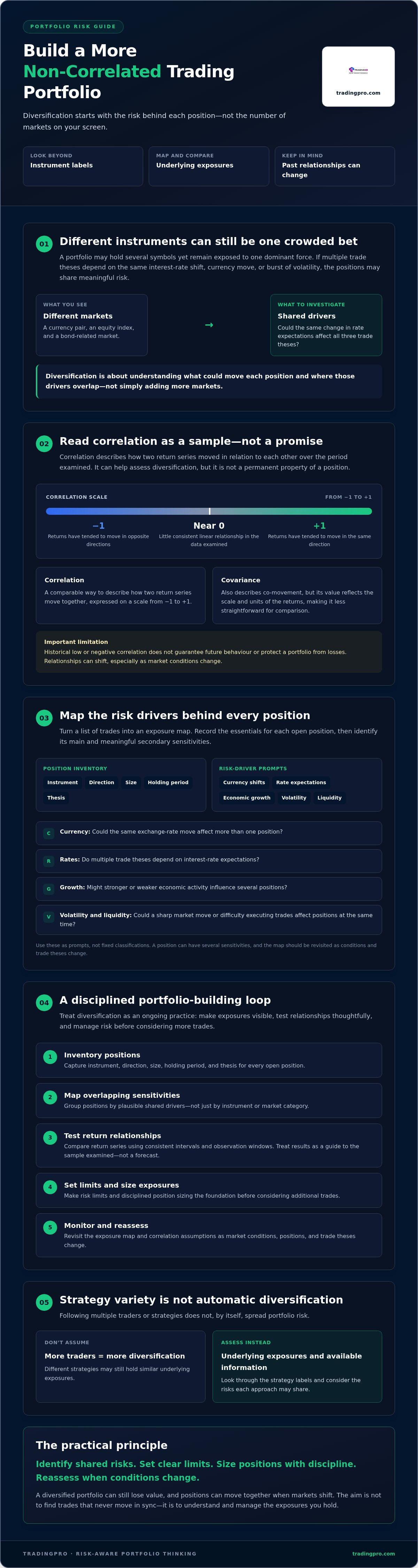
Five positions across five markets can still add up to one crowded bet. If they react to the same interest-rate shift, currency move, or burst of volatility, the labels don’t make them diversified. Building a non-correlated trading portfolio starts with a sharper question: what underlying risk is driving each position?
It’s easy to see a mix of instruments and assume your exposure is spread out. But correlations can change, and positions that moved independently in the past may respond together when market conditions shift. The goal isn’t to find a perfect set of trades that never move in sync. It’s to identify shared risks, set clear limits, and avoid treating historical patterns as promises.
This guide offers a practical process for mapping risk drivers, testing correlations across relevant time periods, and sizing exposures with discipline. You’ll also learn what to monitor and when to reassess your portfolio, so diversification stays an active practice rather than a one-time calculation.
Key Takeaways
- Different instruments can still share the same underlying risk. Look beyond market labels to identify what may drive each position.
- Build a position inventory that captures direction, size, holding period, and thesis, then scan for overlapping sensitivities.
- Compare return series using consistent intervals and observation windows, while treating historical correlation as a guide, not a guarantee.
- Make risk limits and position sizing the foundation of building a non-correlated trading portfolio before considering additional trades.
- Assess copied strategies by their underlying exposures and available information. Following multiple traders doesn’t automatically diversify your portfolio.
What Does a Non-Correlated Trading Portfolio Actually Mean?
Holding different instruments isn’t the same as holding different risks. A portfolio can contain several symbols yet remain exposed to one dominant force, such as interest-rate expectations or economic growth. Building a non-correlated trading portfolio is therefore not just about adding markets. It’s about understanding what could move each position and how those drivers may overlap.
A non-correlated trading portfolio is a group of positions whose returns have shown limited or different relationships over a chosen period, while still carrying market risk. Correlation measures how two return series move in relation to each other. It can help assess diversification, but a historically low or negative correlation doesn’t promise future behaviour or protect a portfolio from losses.
Correlation, covariance, and diversification in plain English
Correlation is commonly expressed on a scale from -1 to +1. A positive reading indicates returns have tended to move in the same direction; a negative reading indicates they have tended to move in opposite directions. A reading near zero suggests little consistent linear relationship in the data examined. These readings describe a particular sample, not permanent properties of the positions.
Covariance also describes how returns move together, but its value reflects the scale and units of those returns. This makes covariance useful in calculations, yet less straightforward than correlation for comparing relationships across positions. Modern Portfolio Theory uses relationships between assets as part of portfolio construction, but diversification aims to spread exposure, not erase risk. Each position can still lose value, and several can fall together when conditions change.
Why a longer instrument list can still hide concentrated risk
Consider a hypothetical trader with positions in a currency pair, an equity index, and a bond-related market, where those instruments are available through the trader’s broker and account. The positions look distinct. But if each trade thesis depends on interest rates moving in the same direction, a change in rate expectations could affect all three. The portfolio may contain more instruments without having meaningfully different risk drivers.
Different symbols or market categories don’t prove independent behaviour. Before counting a position as a diversifier, ask what conditions could move it, what could invalidate its thesis, and whether those same conditions could also affect existing trades. Instrument examples depend on the markets available through a broker and account. Check those details before applying an example to your own portfolio.
Map the Risk Drivers Behind Every Trading Position
Before adding a trade, make its role and risk visible. Create a position inventory that records the instrument, direction, size, holding period, and thesis for each open position. Then note the conditions that could move it, including currency shifts, interest-rate expectations, economic growth, and volatility. A single trade can carry several of these sensitivities, so record the main drivers and any meaningful secondary ones.
Portfolio diversification depends on shared risk drivers, not the number of instruments you hold. This principle turns a list of positions into an exposure map. NYU Stern’s Correlation analysis resource explains why relationships between assets matter and why they may shift, particularly under market stress.
Build an exposure map before adding another trade
Group positions by plausible common drivers, not just by market label. For example, if two trades could both gain or lose value when one currency strengthens, flag them as potentially sharing currency exposure. That doesn’t mean they’ll always move together. It tells you what to examine and monitor.
- Currency: Could the same exchange-rate move affect more than one position?
- Rates: Do multiple trade theses depend on interest-rate expectations?
- Growth: Might stronger or weaker economic activity influence several positions?
- Volatility and liquidity: Could a sharp market move or difficulty executing trades affect them at the same time?
Use these as prompts, not fixed classifications. Revisit the map as market conditions and trade theses change. Any instrument or asset-class examples are illustrative; check which markets are available through your broker and account before applying them.
Separate strategy diversification from market diversification
Different instruments can still respond to the same driver. Different strategies can also share risk. One might follow a breakout while another trades a pullback, yet both could depend on liquid conditions and be vulnerable to a sudden volatility spike. Compare entry and exit logic, typical holding periods, and the market conditions each strategy needs. Strategy variety is worth assessing, but it doesn’t establish independent exposure on its own.
Replicating several traders may add strategy exposure without adding distinct risk drivers. Check their approaches and underlying positions rather than assuming multiple profiles mean diversification. TradingPRO offers Social Trading and Copy Trading functionality. Its blog can be a starting point for exploring the distinction between those approaches. Once you’ve set your criteria, you can review TradingPRO account options and verify the instruments, conditions, and tools available to you.
How to Test Correlation Without Mistaking It for a Guarantee
A correlation reading is a snapshot of how returns moved together in the data you selected. It describes observed co-movement, not what caused it or what will happen next. When building a non-correlated trading portfolio, use the measure to ask better questions, not to certify that two positions will remain independent.
| Measure | What it reveals | Limitation | Sensible use |
|---|---|---|---|
| Single-window correlation | How two return series moved together over one chosen period. | A different period may produce a different reading. | Use as an initial comparison, with the dates clearly recorded. |
| Rolling correlation | How the relationship shifts across successive windows. | Short windows can be noisy; longer ones may hide recent changes. | Check whether the relationship appears stable or varies over time. |
| Scenario analysis | How positions might respond to a specified market shock. | A scenario is a thought experiment, not a forecast. | Test whether a shared risk could affect multiple positions at once. |
Choose data and time windows that fit the trading horizon
Match return intervals to the way you hold trades. Comparing daily returns for a short-term strategy with monthly returns for a longer-term position can blur the relationship you’re trying to assess. Use consistent intervals and aligned dates so each observation covers the same period. A short sample may be dominated by a handful of unusual moves, producing an unstable reading.
Make the test repeatable. Record the data source, instruments, return frequency, observation dates, and any assumptions, such as how missing observations were handled. Revisit the calculation as new data arrives. A single historical window provides context, while rolling windows can reveal whether the relationship has changed. Neither method turns past results into a promise.
Use stress scenarios to question historical relationships
Go beyond the correlation figure. Ask how each position might react if interest-rate expectations shift, liquidity thins, or volatility spikes. Could a common shock challenge several trade theses at once? Consider the direction and possible scale of the effect, but don’t treat the exercise as a prediction of the next market move. It’s a way to examine assumptions and prepare your review process.
For foundational context on currency-market risks and terminology, consult a beginner forex guide before assessing forex-related positions. Check how the guide defines its examples, and remember that available instruments depend on your broker and account.
Build and Rebalance a Non-Correlated Trading Portfolio Step by Step
Building a non-correlated trading portfolio takes more than finding positions with different historical patterns. Set risk boundaries first, then decide whether a new trade adds a distinct exposure without pushing total portfolio risk beyond your limits.
- Define limits. Decide what exposure you’re willing to carry, what loss limit requires action, and which changes should trigger a review. Set these rules before entering trades, not in response to a sudden market move.
- Map current positions. Record each trade’s direction, size, holding period, thesis, and potential shared drivers. Note where several positions depend on similar conditions.
- Test relationships. Compare returns using consistent intervals and time windows. Check more than one historical window, and treat the results as evidence to examine, not a guarantee.
- Size positions and assess total risk. Consider each trade’s potential loss alongside the combined exposure of all open positions. Several positions with low historical correlation can still create excessive combined risk if they’re each sized too aggressively or share a risk driver the data doesn’t capture.
- Review and adjust. Add a position only after checking its effect on exposure and total risk. Document why you entered, changed, or closed it.
Set risk limits before seeking more diversification
There’s no universal percentage or position size that suits every trader. Define limits in terms you can apply consistently, and make sure you understand how a planned loss on one trade could combine with losses elsewhere. Diversification doesn’t replace risk controls. It helps you see how exposure is distributed.
Use a simple worksheet to make the decision concrete. For example, for a hypothetical trade, write: “What is the thesis? Which existing positions share its drivers? What is the planned size and loss limit? What would make me reassess?” This is a planning tool, not a return forecast or an instruction to buy a particular instrument.
Review concentration and rebalance with a clear rule
Choose a review schedule that fits your strategy and holding period. Reassess sooner if a position grows materially, its thesis changes, or market conditions alter its likely exposure. Don’t rebalance just because one correlation reading moves. Identify the reason, check the broader risk picture, and record the rationale for every adjustment. That record helps distinguish disciplined changes from reactive overtrading.
If you’re comparing account setups after defining your criteria, you can review the Rookie Account as one option and verify its current terms and available instruments. You can also review TradingPRO account options before deciding whether a setup fits your plan.
Use Trading Tools and Copy Trading Without Assuming Diversification
Tools can make trading easier to organize, but they don’t determine whether your exposures are independent. Manual analysis gives you direct control over trade selection and sizing, with more responsibility for research and monitoring. Copy trading can reduce some hands-on decision-making, but it still requires oversight and a clear understanding of the strategies you’re following. Neither approach guarantees diversification.
| Approach | Control | Monitoring effort | Transparency to assess |
|---|---|---|---|
| Manual analysis | You choose and manage each position. | You track your own trades and exposures. | Review your thesis, entry and exit rules, and position risk. |
| Copy trading | Trade decisions are replicated from another trader or strategy. | You still need to check performance and overlapping exposure. | Review the strategy information and risk details available to you. |
Evaluate copied strategies by behaviour and exposure
Before following a strategy, examine its available history, drawdowns, typical holding periods, and risk information. Then compare its positions and likely market drivers with your own portfolio. Copying several traders may simply repeat the same currency, rate, growth, or volatility exposure under different profiles. More strategies don’t automatically mean more diversification.
Social trading and copy trading can involve different levels of interaction and trade replication. For a fuller format comparison, read the social-versus-copy trading guide on the TradingPRO blog. Use the comparison to clarify how each approach works, then check what information is actually available before relying on it.
Choose trading infrastructure around your process
Set your strategy, experience level, and requirements before comparing accounts. TradingPRO offers Rookie, Micro, Pro, and Scalp account tiers, as well as Social Trading and Copy Trading functionality. These are options to evaluate, not solutions to shared exposure. Check current account terms, eligible instruments, and available reporting or risk tools directly, since those details can vary by account.
Building a non-correlated trading portfolio still depends on your own risk rules. Platform tools may support your review, but they don’t replace independent analysis, position limits, or ongoing monitoring. Confirm that an account setup fits your needs before proceeding, then create a TradingPRO account.
Make Your Portfolio Process Clear and Repeatable
Strong diversification starts with a disciplined process, not a longer list of positions. As you continue building a non-correlated trading portfolio, focus on the risks behind each trade, set position and portfolio limits before adding exposure, and review whether your original assumptions still hold.
Use correlation as one input, not a promise of how positions will behave next. A clear inventory and consistent review routine can help you spot concentration and make adjustments for a defined reason rather than reacting to every market move.
TradingPRO offers Rookie, Micro, Pro, and Scalp account tiers, along with Social Trading and Copy Trading functionality. Consider these options only after defining your approach, and verify current account terms and eligible instruments before choosing. Copying strategies doesn’t guarantee diversification or performance.
When you’re ready to explore your setup, create a TradingPRO account after reviewing suitability and account terms. Keep your risk rules at the centre of every decision, and build your process one considered step at a time.
Frequently Asked Questions
What is a non-correlated trading portfolio?
A non-correlated trading portfolio holds positions whose returns have shown limited or differing relationships over a selected period. The aim is to spread exposure across distinct risk drivers, rather than simply collect different market symbols. The phrase doesn’t mean positions are guaranteed to move independently. When building a non-correlated trading portfolio, treat correlation as historical evidence to consider alongside each trade’s thesis, size, and potential loss.
Can a trading portfolio be completely non-correlated?
No portfolio can be assumed to stay completely non-correlated across every market condition. Relationships depend on the data period and can change as economic conditions, volatility, or liquidity shifts. Even positions with little observed relationship may be affected by an unexpected shared shock. Use diversification to understand and distribute exposure, not as a promise that trades will offset one another or prevent losses.
How do I measure correlation between trading positions?
Compare the returns of two positions over matching intervals and dates, then calculate their correlation using a spreadsheet or another suitable analysis tool. The coefficient ranges from -1 to +1: positive values indicate returns tended to move together, negative values indicate they tended to move in opposite directions, and values near zero show little consistent linear relationship in that sample. Compare more than one window and record your data choices.
Does trading different markets automatically diversify a portfolio?
No. Different markets can respond to the same underlying factor, while positions in one market may have distinct strategies or holding periods. Look beyond the instrument label: identify the economic conditions that support each trade and what could challenge its thesis. Also check how position sizes combine. A varied market list may still conceal concentrated exposure if several trades depend on similar conditions.
How often should I rebalance a trading portfolio?
Set a review schedule that matches your strategy and holding period, rather than reacting to every market move. Review earlier if a position changes materially in size, its original thesis no longer holds, or market conditions alter its risk. Before adjusting, write down the reason and check the effect on total exposure. This creates a consistent decision trail and helps distinguish planned rebalancing from impulsive trading.
Can copy trading help build a non-correlated portfolio?
Copy trading can add strategy exposure, but copying several traders doesn’t automatically create diversification. Their approaches may hold similar positions, respond to the same market drivers, or share risks tied to timing and liquidity. Review the strategy information available to you, including history, drawdowns, holding periods, and risk details, then compare those exposures with your own. TradingPRO provides Social Trading and Copy Trading functionality, but neither guarantees portfolio diversification or performance.
What should beginners check before building a trading portfolio?
Before opening positions, understand the instruments available to you, how each trade could lose value, and what account conditions apply. Set your risk limits and review rules before choosing additional exposure. Check whether positions may share drivers, and decide how you’ll monitor them. TradingPRO offers Rookie, Micro, Pro, and Scalp account tiers. Verify current terms and eligible instruments to see whether an option fits your requirements.


