




- Published on: 2026-09-29 10:13:26
Best Forex Pairs for Beginners: Choosing Your Markets

EUR/USD may look like the obvious first choice, but popularity alone doesn’t make a currency pair easy to study. If unfamiliar symbols, fast price moves, and major news releases make the market feel crowded, the best forex pairs for beginners are the ones you can observe and compare methodically, not pairs that promise easy profits.
Start with a short list of major pairs and assess what distinguishes each one. Liquidity, typical volatility, the currencies involved, and scheduled economic news can all shape how a pair behaves. EUR/USD, USD/JPY, and GBP/USD are widely followed, while EUR/GBP and USD/CHF may also be worth comparing. None is risk-free, and conditions can change.
This guide explains what these pairs have in common, where their differences matter, and how to choose one or two markets to study first. You’ll also find a cautious routine for tracking price action, checking the economic calendar, and practising before considering live trades. Build familiarity one pair at a time, and let your observations guide your next step.
Key Takeaways
- The best forex pairs for beginners are those you can research consistently, not pairs that promise easy or predictable results.
- Compare major pairs by the currencies involved, their economic drivers, active sessions, and the news that can move prices.
- Consider liquidity and volatility separately. Larger price moves can increase both opportunity and risk.
- Build a steady research routine: focus on one pair, observe its behaviour, record what you notice, and review your findings.
- Practise in a simulated environment before considering live trades. Treat your first pair choice as a learning decision, not a forecast of returns.
What makes the best forex pairs for beginners easier to study?
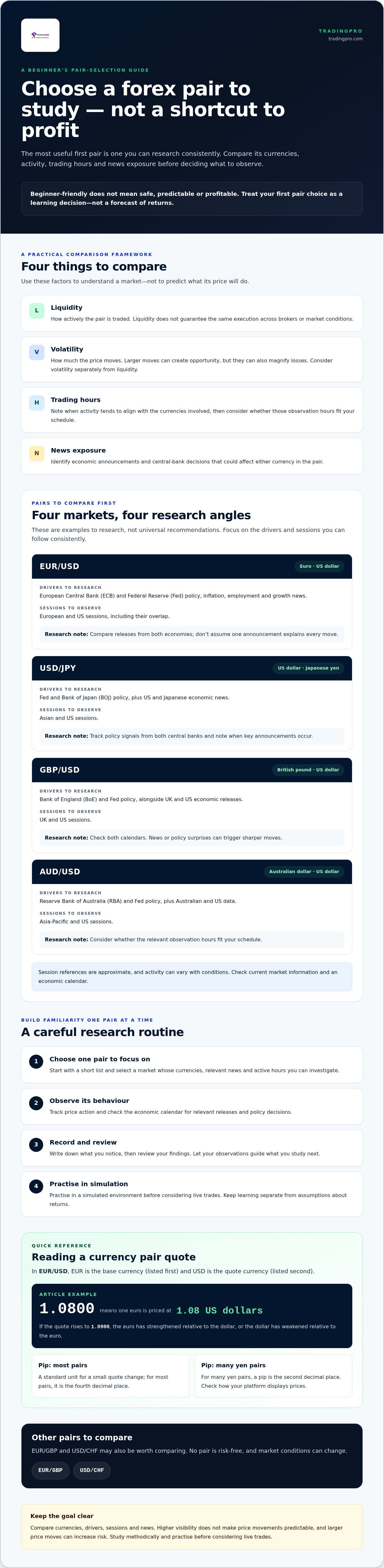
A forex pair shows the value of one currency relative to another. But “beginner-friendly” doesn’t mean safe, predictable, or profitable. It means a pair may be easier to research and follow because you can find information about its currencies, market activity, trading hours, and relevant news. Use these factors to compare markets, not to predict what prices will do.
A major pair is a widely followed currency combination, commonly one that includes the US dollar. The label describes the pair, not whether it suits a particular trader. Definitions can vary. The Currency pair overview explains the standard categories, including majors, minors, and exotics.
How to read currency pair quotes
In EUR/USD, EUR is the base currency, listed first, and USD is the quote currency, listed second. A quote of 1.0800 means one euro is priced at 1.08 US dollars. If the quote rises to 1.0900, the euro has strengthened relative to the dollar, or the dollar has weakened relative to the euro.
A pip is a standard unit for describing a small change in a pair’s quote. For most pairs, it’s the fourth decimal place; for many yen pairs, it’s the second. Check how your platform displays prices so you can read changes consistently.
Why major pairs often make a practical starting point
Major pairs involve currencies that attract substantial market attention, giving learners a broad range of news and analysis to explore. That visibility can make it easier to investigate possible influences, such as economic releases or central bank decisions. However, the information can be complex, and greater coverage doesn’t make price movements easier to predict.
Compare each candidate using four practical criteria:
- Liquidity: How actively the pair is traded. This doesn’t guarantee the same execution across brokers or market conditions.
- Volatility: How much the price moves. Larger moves can create opportunity, but they can also magnify losses.
- Trading hours: Note when activity tends to align with the currencies involved, then consider whether those hours fit your schedule.
- News exposure: Identify the economic announcements and policy decisions that could affect either currency.
These criteria can help you narrow down the best forex pairs for beginners to study, but they won’t identify a risk-free choice. High visibility doesn’t remove volatility or the possibility of loss. Learn a pair’s drivers and practise observing it before considering live trades.
Which major forex pairs should beginners compare first?
Start by comparing EUR/USD, USD/JPY, GBP/USD, and AUD/USD. These are examples to research, not universal recommendations. Each connects different economies, policy decisions, and market hours. The useful question isn’t which pair is “best” in general, but which one you can follow and understand consistently.
No currency pair is consistently easiest for every beginner. The right pair to study depends on how clearly you can research its drivers and follow its active hours. Use the table as a starting framework, then check an economic calendar and current market information. Session references are approximate, and activity can vary with conditions.
| Pair and currencies | Drivers to research | Sessions to observe | Research consideration |
|---|---|---|---|
| EUR/USD, euro and US dollar | European Central Bank (ECB) and Federal Reserve (Fed) policy, inflation, employment, and growth news | European and US sessions, including their overlap | Compare releases from both economies; don’t assume one announcement explains every move. |
| USD/JPY, US dollar and Japanese yen | Fed and Bank of Japan (BOJ) policy, plus US and Japanese economic news | Asian and US sessions | Track policy signals from both central banks and note when key announcements occur. |
| GBP/USD, British pound and US dollar | Bank of England (BoE) and Fed policy, alongside UK and US economic releases | UK and US sessions | Check both calendars. News or policy surprises can trigger sharper moves. |
| AUD/USD, Australian dollar and US dollar | Reserve Bank of Australia (RBA) and Fed policy, plus Australian and US data | Asia-Pacific and US sessions | Consider whether the relevant observation hours fit your schedule. |
Turn pair names into a research plan
For EUR/USD, compare European and US releases rather than following only one side. The ECB and Fed publish policy information, while inflation, employment, and growth data can shape expectations. Exchange rates also relate to broader changes in purchasing power; the IMF explains this distinction in its overview of real exchange rates.
For USD/JPY, follow policy news from both the US and Japan. For GBP/USD and AUD/USD, add the BoE or RBA and their respective national data to your calendar. These pairs may react sharply to important news, but don’t assume any one pair has a fixed volatility ranking. Liquidity and price behaviour can vary with market conditions and broker, so compare what you observe rather than relying on a permanent label.
The best forex pairs for beginners are candidates for careful study, not shortcuts to a result. Pick one, note its drivers and active hours, then practise observing its reactions before considering live trades. When you’re ready to learn about account options, you can review TradingPRO’s Rookie Account and explore the registration option.
How do volatility, liquidity, and trading sessions change pair selection?
A pair’s name tells you which currencies you’re comparing, but not whether it’s practical for you to study. Look at how actively it trades, how sharply its price moves, and whether you can follow it during relevant market hours. These conditions change. Don’t treat a familiar pair as automatically calm or assume it will behave the same way across brokers and market situations.
Liquidity describes how readily a currency pair can be traded without a large price impact. It doesn’t guarantee identical spreads, execution, or order outcomes across providers or conditions. Volatility describes the scale or speed of price changes. A bigger move may create more opportunity, but it can also increase losses. Volatility and risk are related, but they aren’t interchangeable: risk also depends on decisions such as position size and how much loss you can tolerate.
How trading sessions affect the pairs you follow
Currency activity can shift as regional markets open and close. A pair may attract more attention when markets connected to its currencies are active, and the overlap between the London and New York sessions is generally a highly liquid period. That’s useful context, not a signal. It doesn’t promise better trades or lower risk, and activity can change with news and market conditions.
Convert session references to your local time, accounting for seasonal clock changes where relevant. Then consider whether you can observe the pair during those hours. A market you can monitor consistently may be more useful for learning than one whose busiest periods don’t fit your schedule.
How economic news can move major currency pairs
Central bank decisions and economic releases can shift expectations about a currency, sometimes prompting quick price changes. For pairs involving the US dollar, follow Federal Reserve announcements and US data. For EUR/USD, track the European Central Bank as well; for USD/JPY, include the Bank of Japan. Inflation, employment, and growth releases may also matter, depending on the currencies in your pair.
Use an economic calendar to see what’s scheduled, and verify dates and times before planning your observations. An announcement is a potential catalyst, not a reliable forecast of direction. Price reactions can differ from expectations, so don’t treat a scheduled event as a trade instruction.
Apply a consistent checklist rather than ranking pairs based on unverified spread or movement claims:
- Can you find and understand the main economic drivers for both currencies?
- Do the pair’s active periods fit the hours you can study?
- Have you observed how the price behaves during ordinary conditions and around news?
- Can you account for changing volatility and broker-specific trading conditions?
This framework helps you narrow down the best forex pairs for beginners based on research fit, not promises. Record your observations over time, and keep practising before considering live trades.
How can a beginner build a careful forex pair research routine?
Keep the process simple and repeatable. Choose one pair, learn what may influence both currencies, observe it during relevant sessions, record what happens, and review your notes. Studying one market at a time makes it easier to identify what you understand and where uncertainty remains. A forex trading for beginners guide can provide broader context as you build your research process.
A simple observation plan for one currency pair
Use a journal to separate what you expected from what you observed. Before each review, note the pair, date, session, and any scheduled news you’re watching. Write down a simple hypothesis, such as whether a particular release could affect one currency, without treating it as a prediction.
Afterward, record the price behaviour and whether it matched your expectation. Include uncertainty and alternative explanations. Review your entries regularly to identify questions worth investigating, rather than only examples that seem to confirm your first idea.
- Select one pair: Keep your focus narrow while learning about its currencies and economic drivers.
- Observe its sessions: Note the time and market conditions, including whether relevant news is scheduled.
- Record and review: Compare your initial reasoning with later observations, without assuming you could have known the outcome in advance.
Practise before moving beyond learning
Demo or other simulated practice can help you learn platform processes and test how you record decisions without putting trading funds at risk. Check whether the platform you’re considering offers a suitable simulated environment. Practice has limits: it can’t reproduce every feature of live conditions or remove the possibility of loss if you later trade with real money.
Learn the basics of risk controls before considering a live trade. Position sizing means deciding how much exposure a trade creates; a stop-loss order is intended to close a position at a specified level if price moves against it. Neither guarantees a particular outcome, and availability or operation can vary. Understand the account terms, costs, and risks that apply to you, and avoid risking money you can’t afford to lose. This is general education, not individual financial advice.
Once you’ve built a research routine and explored practice options, you can review the Rookie Account as a possible next step. Check current terms and availability before deciding. The best forex pairs for beginners are the ones you can study with care, not a shortcut to returns.
What should you do after choosing a forex pair to study?
Choosing a pair is a learning decision, not a prediction of returns. Use what you’ve observed to decide whether you can keep researching it, rather than assuming you know its next move. The best forex pairs for beginners are those whose currencies, news drivers, active periods, and price behaviour you can examine carefully and consistently.
A final checklist before following a pair
Before settling on a pair for continued study, work through this checklist. Be specific. Knowing which currencies are in a pair is a start; identifying relevant economic sources and market hours gives you a clearer research plan.
- Currency knowledge: Can you explain which currencies the pair contains and identify relevant central banks or economic news sources?
- News awareness: Do you know where to check for scheduled releases and policy announcements that could affect either currency?
- Session fit: Have you checked when the pair tends to be active in your local time, and can you give those periods your attention?
- Price behaviour: Have you observed how its volatility changes, including around important news, without assuming past moves will repeat?
- Learning gaps: Have you reviewed your practice notes and listed what you still need to understand?
If you can’t answer these questions yet, keep studying. Change your focus only when your notes give you a clear reason, not because a pair had an unusually large move.
When a brokerage account becomes relevant
Learning about currency pairs and choosing a broker or account are separate decisions. First build your understanding through research and simulated practice. If you later consider trading with real money, review the account’s current terms, confirm regional availability, and make sure you understand the risks. Account tiers don’t guarantee better results or remove market risk.
TradingPRO offers a Rookie Account, but its suitability depends on your needs and the current account terms. Don’t treat opening an account as a signal to trade; take time to assess whether you’re ready and what you can afford to risk. You can review the account registration option and check the details before proceeding.
Build your market knowledge one pair at a time
The best forex pairs for beginners aren’t guaranteed winners. They’re pairs you can research methodically. Compare what drives each currency, check relevant news and active sessions, and consider whether the pair’s volatility and timing fit your learning routine.
Then focus on one market. Use simulated practice and a journal to record what you observe, test your assumptions, and identify what you still need to learn. Choosing a pair is a step toward better-informed study, not a forecast of returns or a reason to rush into live trading.
TradingPRO offers a Rookie Account and brokerage services, including social and copy trading. Before registering, review current account terms, regional availability, and the risks involved. If you’re ready to explore the Rookie Account, review the registration option.
Stay curious, keep your process measured, and let consistent research guide your next step.
Frequently Asked Questions
What is the easiest forex pair for beginners?
There isn’t one forex pair that’s easiest for everyone. The best forex pairs for beginners are those a learner can research and follow consistently, rather than pairs assumed to be safe or predictable. Consider how much information is available about each currency, what news may affect it, when the pair is active, and whether those hours fit your schedule. Start with one pair and use practice observations to assess whether it suits your learning routine.
Is EUR/USD a good forex pair for beginners?
EUR/USD can be a practical pair to study because it’s widely followed, with substantial market attention and analysis to explore. Research both currencies: watch European Central Bank and Federal Reserve communications, as well as relevant economic releases from the euro area and United States. Still, popularity doesn’t make EUR/USD risk-free or easy to predict. Price behaviour, trading conditions, and volatility can change, so learn its drivers and practise observing it before considering live trading.
Which forex pairs are best for beginners to learn?
EUR/USD, USD/JPY, GBP/USD, and AUD/USD are useful major-pair examples to compare, not universal recommendations. Each combines different economies and central bank policies, so the news and active hours to study differ. For example, research the Federal Reserve for the US dollar, the European Central Bank for the euro, and the Bank of Japan for the yen. Choose a pair whose drivers you can explain and whose activity you can follow consistently.
Are major forex pairs less risky than minor pairs?
Not necessarily. Major pairs are widely followed and may have higher liquidity, but that doesn’t remove market risk or guarantee consistent execution. Minor pairs can behave differently, and conditions vary by pair, broker, and time. Risk also depends on price movement, position size, leverage, and your decisions. Compare the currencies, news drivers, volatility, and trading conditions rather than assuming a pair’s category tells you how safe it is.
Can beginners trade more than one forex pair?
They can, but following several pairs at once may make it harder to track each currency’s news, market hours, and price behaviour. Begin by observing one pair and keeping clear notes. Once you can explain its main drivers and review your decisions consistently, consider comparing another pair in a simulated environment. Adding markets isn’t automatically an improvement. Make sure you understand how each pair may respond to news before increasing your focus.
What is the best time to trade forex pairs as a beginner?
There’s no single best time for every beginner. Currency activity can vary across regional market sessions, and a pair may attract more attention when markets connected to its currencies are open. The overlap between the London and New York sessions is generally a highly liquid period, but it doesn’t guarantee better trades or lower risk. Check session times in your local time zone, account for clock changes, and choose observation hours that fit your schedule.
Should beginners practise forex pairs before trading with real money?
Yes. Demo or other simulated practice can help you learn platform processes, observe price changes, and keep a record of your decisions without risking trading funds. Check whether the platform you’re considering offers a suitable simulated environment. Practice can’t reproduce every aspect of live trading or eliminate its risks. Before considering real-money trades, review the account terms and risks, and make sure you understand that losses are possible.


